
How do scientists know whether a peptide is the claimed molecule?
Identity testing asks whether the sample is consistent with a defined chemical structure. It is different from purity testing, which asks about the composition of the sample under a particular measurement. Scientists often combine methods because each provides different information.
A label or appearance cannot establish identity. Neither can an isolated number without a method and a clearly defined expected substance. Exact sequence, terminal groups, modifications and stereochemistry can all matter.
What is molecular weight?
The phrase is commonly used for relative molecular mass, a dimensionless comparison with the atomic mass constant. Molecular mass is often expressed in daltons, while molar mass is expressed in grams per mole. Reports should make clear which quantity and form they mean. A peptide free base, a salt and a hydrated material may not have the same reported formula or mass basis. IUPAC: Relative molecular mass.
Mass calculations are useful checks, but many different structures can share the same mass. An expected mass is therefore important evidence, not a complete description of molecular structure.
What is mass spectrometry?
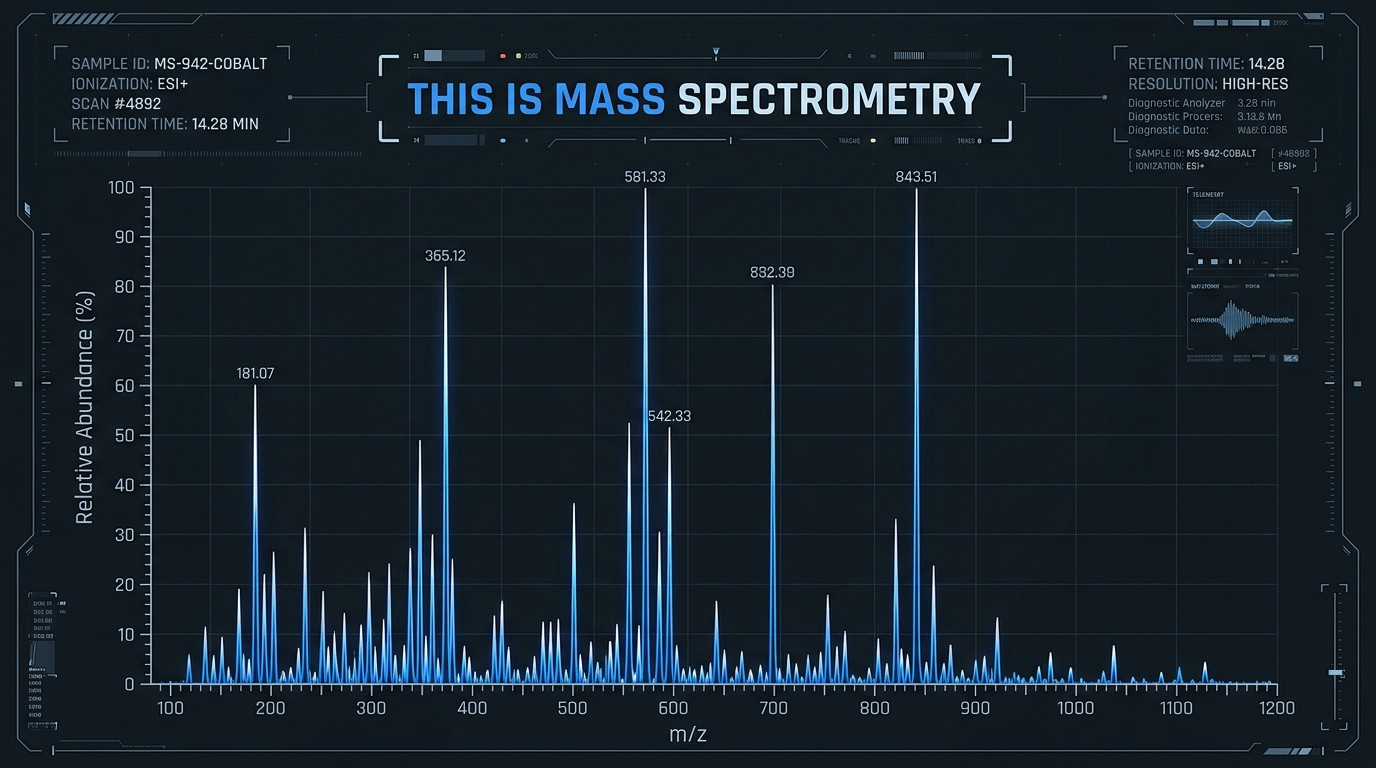
Mass spectrometry measures ions according to their mass-to-charge ratio, written m/z. A molecule may carry more than one charge, so an observed m/z peak should not automatically be read as the neutral molecular mass. Analysts interpret charge states, isotope patterns, calibration and other information to draw conclusions. NIST: Mass Spectrometry Instrument Lab.
Tandem mass spectrometry, often written MS/MS, can fragment selected ions. The resulting fragments can provide additional structural or sequence evidence. The strength of identification depends on the method and data quality; it is not guaranteed by the presence of the letters “MS” on a certificate. Scripps Research: Mass spectrometry principles.
What is LC-MS, and how does it differ from HPLC?
LC-MS combines liquid-chromatographic separation with mass-spectrometric detection. The liquid chromatography helps separate components; the mass spectrometer contributes information about their ions. HPLC describes a separation approach and can use different detectors, including UV or mass spectrometry. Therefore, “HPLC versus LC-MS” is not a simple contest between unrelated tests. NCI: Liquid chromatography–mass spectrometry.
An HPLC-UV chromatogram can be useful for a defined impurity measurement. LC-MS can help investigate what a peak may contain. Their strengths depend on the sample, separation and analytical question. Some questions require additional tools or reference materials.
Can a sample be pure but incorrectly identified?
Yes. A sample could consist mostly of one substance while that substance is not the intended molecule. Purity alone does not tell us what the dominant component is. Conversely, detecting the expected peptide does not establish that it is the only component or that the amount is correct.
Even a mass match can leave ambiguity between certain isomers or sequence arrangements. A robust identity strategy may use complementary evidence, such as retention behavior against an appropriate reference, fragmentation data or other structural methods. NIST provides peptide mass-spectral reference data to support identification work; spectral comparisons are useful only when they are appropriate to the specific method and question. NIST peptide spectral libraries.
A practical interpretation rule
Separate four conclusions: the expected molecule was detected; identity was adequately established; relevant impurities were characterized; and content was measured. A laboratory report should not collapse all four into the word “verified.”
Takeaway: Identity and purity are complementary. LC-MS can strengthen the evidence, but every method has limits, and a single matching mass does not automatically establish every structural feature.
Review flag: Analytical scientist review required.
You might be wondering
Where this question leads.
Original related-reading note
Related articles: A01, A03.
Follow the source material.
Links are preserved from the supplied draft manuscripts. Linked sources may change. Regulatory wording needs a fresh specialist check before public launch.
