
Synthetic peptides are assembled through controlled chemical processes. The goal is to produce a specified amino-acid sequence with the intended chemical structure. Making a chain is only part of the job: the resulting material must also be separated, characterized, and assessed for relevant impurities.
What is solid-phase peptide synthesis?
In solid-phase peptide synthesis, or SPPS, the growing chain is temporarily attached to a solid support. Chemists add building blocks in a planned sequence while the chain remains attached. This arrangement allows soluble materials to be removed between stages without isolating the growing peptide in the same way after every reaction. Bruce Merrifield's work established the principle and transformed peptide synthesis. Merrifield: Nobel Lecture on Solid-Phase Synthesis
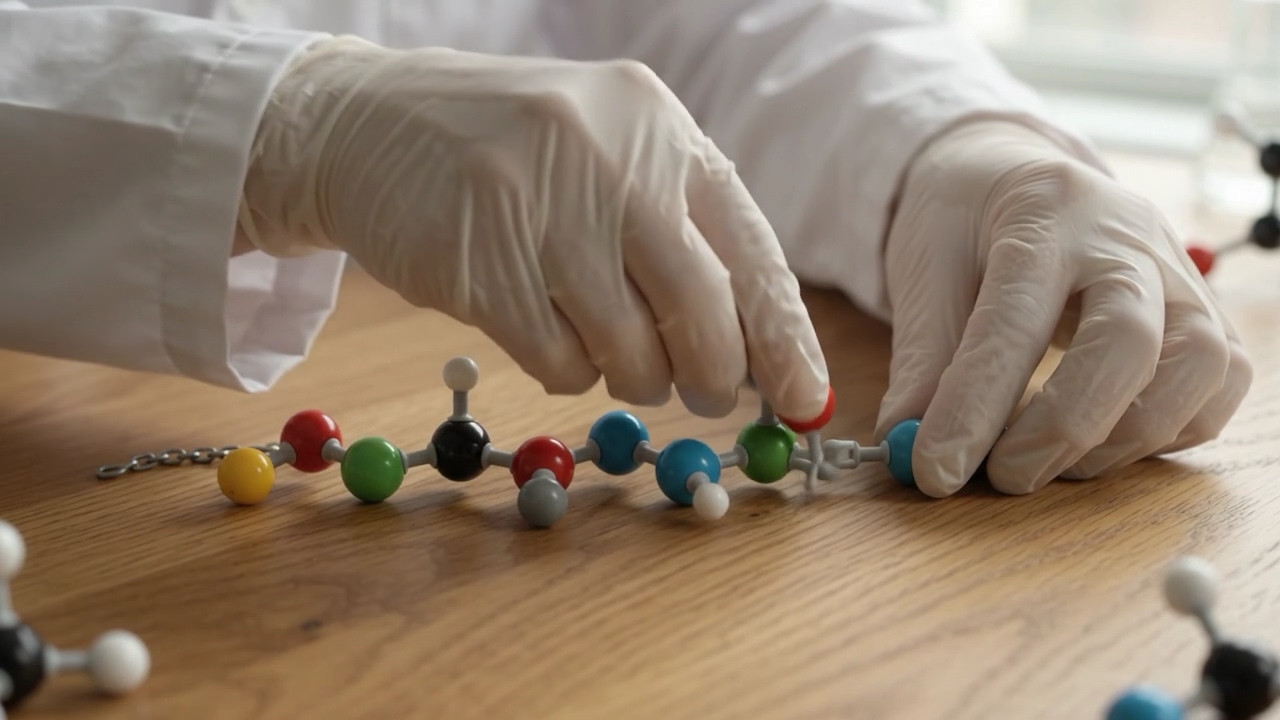
An analogy is assembling a necklace while one end is secured to a workbench. The support helps organize the work, but it does not guarantee that every bead is correct or that every connection succeeds. The chemistry still requires control.
What is Fmoc chemistry?
Fmoc is the abbreviation for a temporary amino-protecting group. Protecting groups prevent selected reactive sites from participating until the appropriate stage. Fmoc-based strategies use its removable protection as part of a planned sequence of chain-extension steps. The original report by Carpino and Han introduced this base-sensitive protecting-group concept. Carpino and Han, 1970
“Fmoc-made” is not a quality grade. It identifies a chemistry strategy, not proof of purity, correct stereochemistry, sequence, or manufacturing compliance.
Is every peptide made this way?
No. Manufacturing routes can include solution-phase chemistry, combinations of chemical approaches, or biological production methods, depending on the molecule. A route is selected for the product's structure and development needs rather than because one method is universally superior. The EMA's synthetic-peptide guideline treats manufacturing and characterization as connected, product-specific activities. EMA: Development and Manufacture of Synthetic Peptides
What comes after the chain is assembled?
The material must be recovered and characterized. Some related substances may be nearly identical to the target, so success cannot be judged from the existence of a powder or a single large chromatographic peak. The manufacturing process, impurity assessment, and analytical methods work together.
For readers evaluating a claim, “chemically synthesized” answers how the material originated. It does not establish that the lot is authentic, suitable for human use, or equivalent to an approved medicine. Those are separate questions requiring separate evidence.
You might be wondering
Where this question leads.
Original related-reading note
Related reading: Peptide bonds and protecting groups; Purification; Sequence verification.
Follow the source material.
Links are preserved from the supplied draft manuscripts. Linked sources may change. Regulatory wording needs a fresh specialist check before public launch.
