
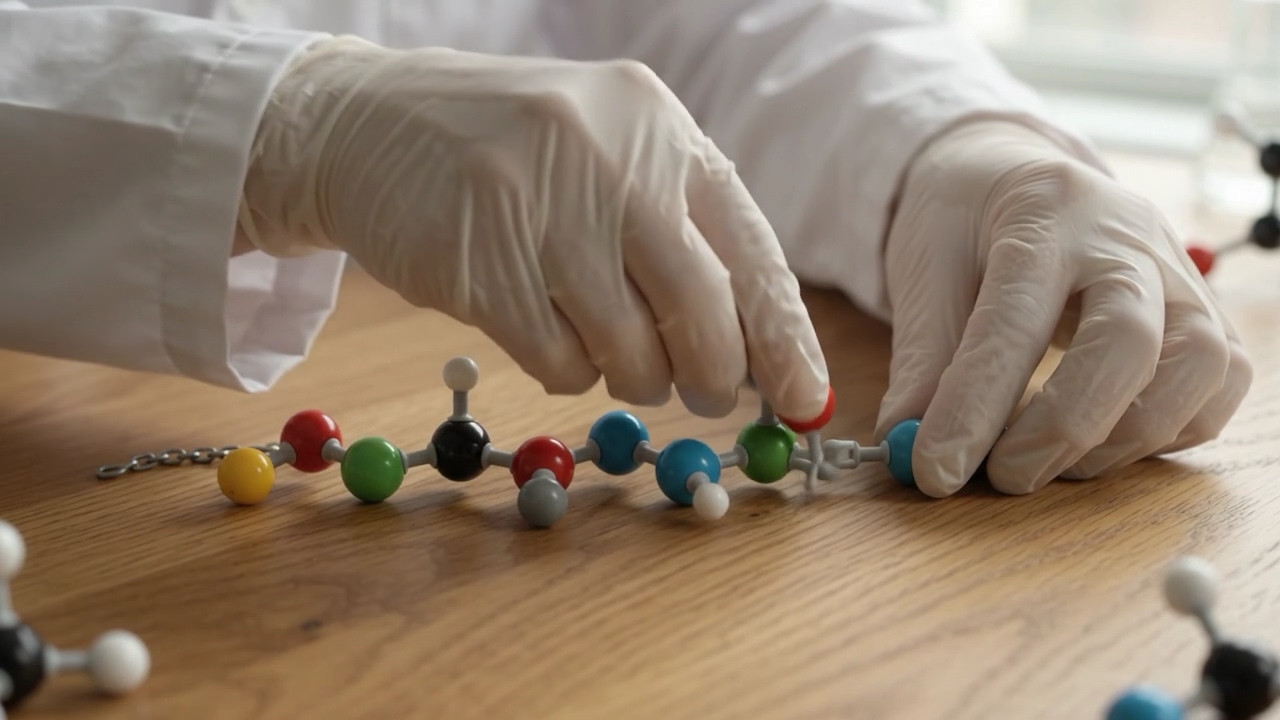
Peptide purification is the process of separating the desired material from other components of a mixture. Those other components may include closely related sequences, reaction by-products, or substances introduced during processing. Purification improves a material's composition; it does not automatically prove that the desired molecule was correctly identified.
How does chromatography work?
Chromatography separates components according to how they interact with two phases: one that stays in place and one that moves. Different components may travel through the system differently, allowing them to be separated. This is the core principle in IUPAC's definition. IUPAC: Chromatography
Imagine travelers moving through a series of rooms. Some spend longer in each room, while others continue quickly. They may enter together and emerge at different times. The analogy explains separation, but real chromatographic behavior depends on the molecules and the method, not a universal speed assigned to each compound.
Analytical and preparative work are different
An analytical run is designed to measure or characterize a sample. A preparative separation is designed to recover material. Both can use chromatographic principles, but their goals differ. A collected fraction still needs testing; its position in a separation is not an identity certificate.
Similarly, a clean-looking chromatogram is limited by the method. Two components can overlap, and a detector may not respond equally to every substance. The EMA's synthetic-peptide guidance specifically recognizes the challenge of closely related and co-eluting impurities and the possible need for complementary methods. EMA: Synthetic Peptide Guideline
Why “purified” is not a complete specification
A useful statement identifies what was measured and how. “Purified by chromatography” describes a process. “Chromatographic area purity” describes a particular result. Neither phrase alone establishes the amount of peptide present, its full structure, or the absence of every possible contaminant.
Method development therefore starts with the measurement purpose and relevant risks. ICH Q14 frames analytical procedures as tools that must remain suitable for their intended quality assessment. FDA/ICH Q14: Analytical Procedure Development
The reader's checkpoint
When a product or study mentions purification, ask whether the statement describes a manufacturing step or a measured outcome. Then ask whether identity and other important attributes were assessed independently. The strongest explanation makes those distinctions explicit instead of using one impressive percentage to answer every question.
You might be wondering
Where this question leads.
Original related-reading note
Related reading: Peptide impurities; Sequence verification; Reference standards and validation.
Follow the source material.
Links are preserved from the supplied draft manuscripts. Linked sources may change. Regulatory wording needs a fresh specialist check before public launch.
