
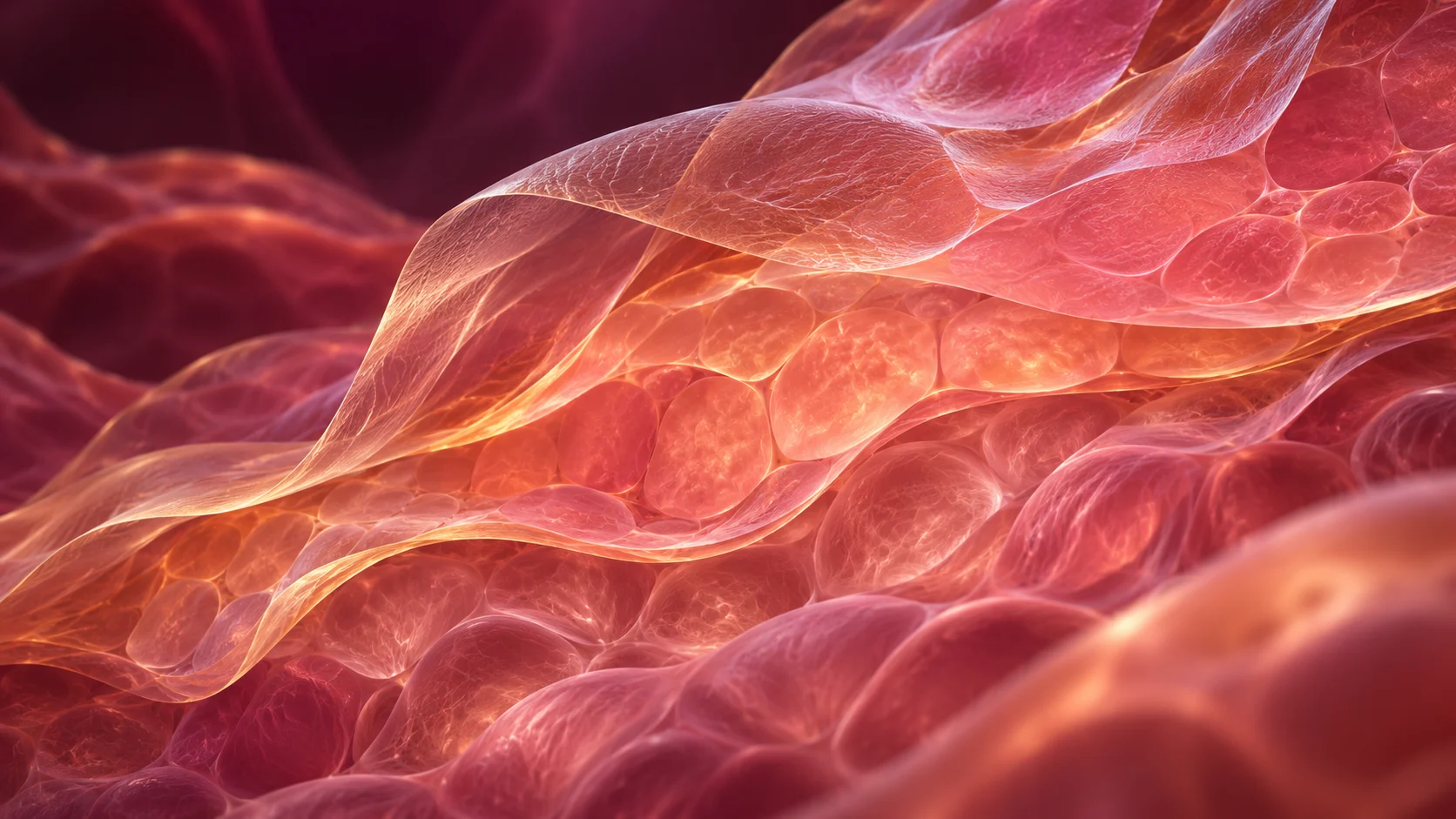
Short answer: Fibroblasts help produce and organize the extracellular matrix, including collagen. Growth factors influence cell behavior, while remodeling continually changes the matrix. Effective repair depends on coordination, not simply making more collagen.
The matrix is an active environment
The extracellular matrix is the material surrounding cells. It provides structural support and helps shape how cells behave. Collagen is an important component, but the matrix also contains other proteins and molecules. Its organization, mechanical properties and turnover matter alongside its quantity.
Collagen production begins with cells making precursor protein chains, assembling and processing them, and secreting material that becomes organized outside the cells. Tissue strength depends on that organization and subsequent maturation, not merely the amount produced. Fibroblasts respond to chemical and physical cues. During repair, some acquire a contractile myofibroblast state. In a three-dimensional laboratory wound model, researchers examined how fibroblasts and endothelial cells interacted as a matrix-filled wound closed. This type of model can reveal coordination that a single-cell assay would miss. Three-dimensional wound model
What growth factors do
Growth factors are signaling molecules that influence processes such as cell proliferation, migration and differentiation. Their effects depend on which receptors are present, the tissue state and other signals. The word “growth” does not mean that a factor will produce healthy tissue under every condition.
An original study of diabetic wound models showed that altered Notch signaling in fibroblasts changed repair-related behavior and angiogenic interactions. It is an example of how the same cell type can function differently in a diseased environment. Fibroblast signaling study
Why remodeling matters
Remodeling includes producing, breaking down and reorganizing matrix. Enzymes such as matrix metalloproteinases participate in that turnover. Too little breakdown can contribute to excessive scarring; disordered breakdown can undermine tissue structure. Neither “more collagen” nor “less collagen breakdown” is a complete goal on its own.
Experiments using human skin maintained outside the body in organ culture, alongside three-dimensional fibroblast cultures, found that collagen fragmentation can alter fibroblast shape and signaling. These were laboratory experiments, not a treatment trial in living patients. They illustrate a feedback relationship: cells change the matrix, and the changed matrix affects the cells. Collagen-fragmentation experiment
When an article or advertisement cites collagen synthesis, ask what was actually measured. Gene expression, newly produced protein, tissue architecture and clinical function are different outcomes. A culture-dish result is useful mechanistic evidence, but it cannot by itself demonstrate stronger tendons, scar reversal or younger-looking skin in people.
You might be wondering
Where this question leads.
Follow the source material.
Links are preserved from the supplied draft manuscripts. Linked sources may change. Regulatory wording needs a fresh specialist check before public launch.
