Visual summary only. The research findings, limitations and references accompany the card on this page.
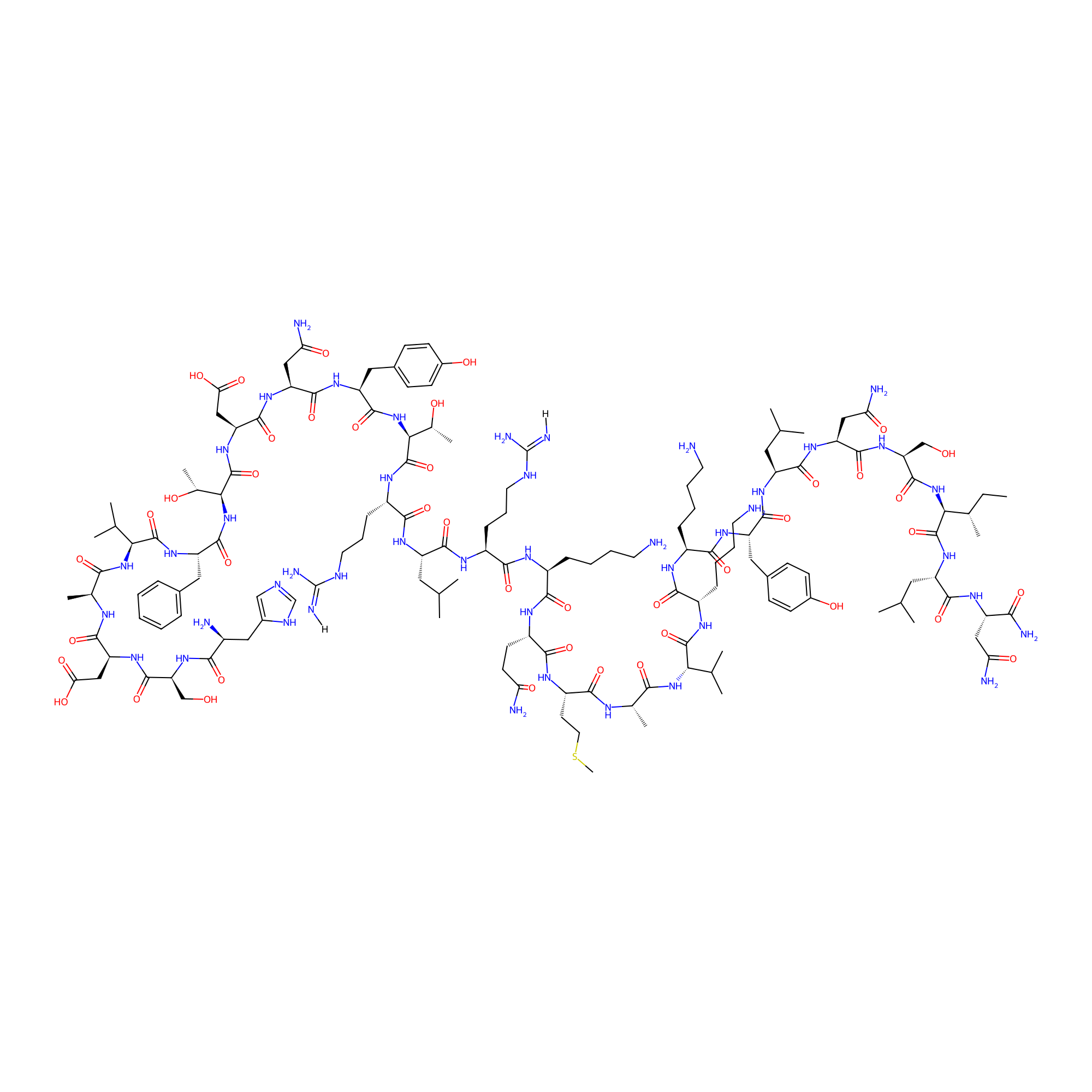
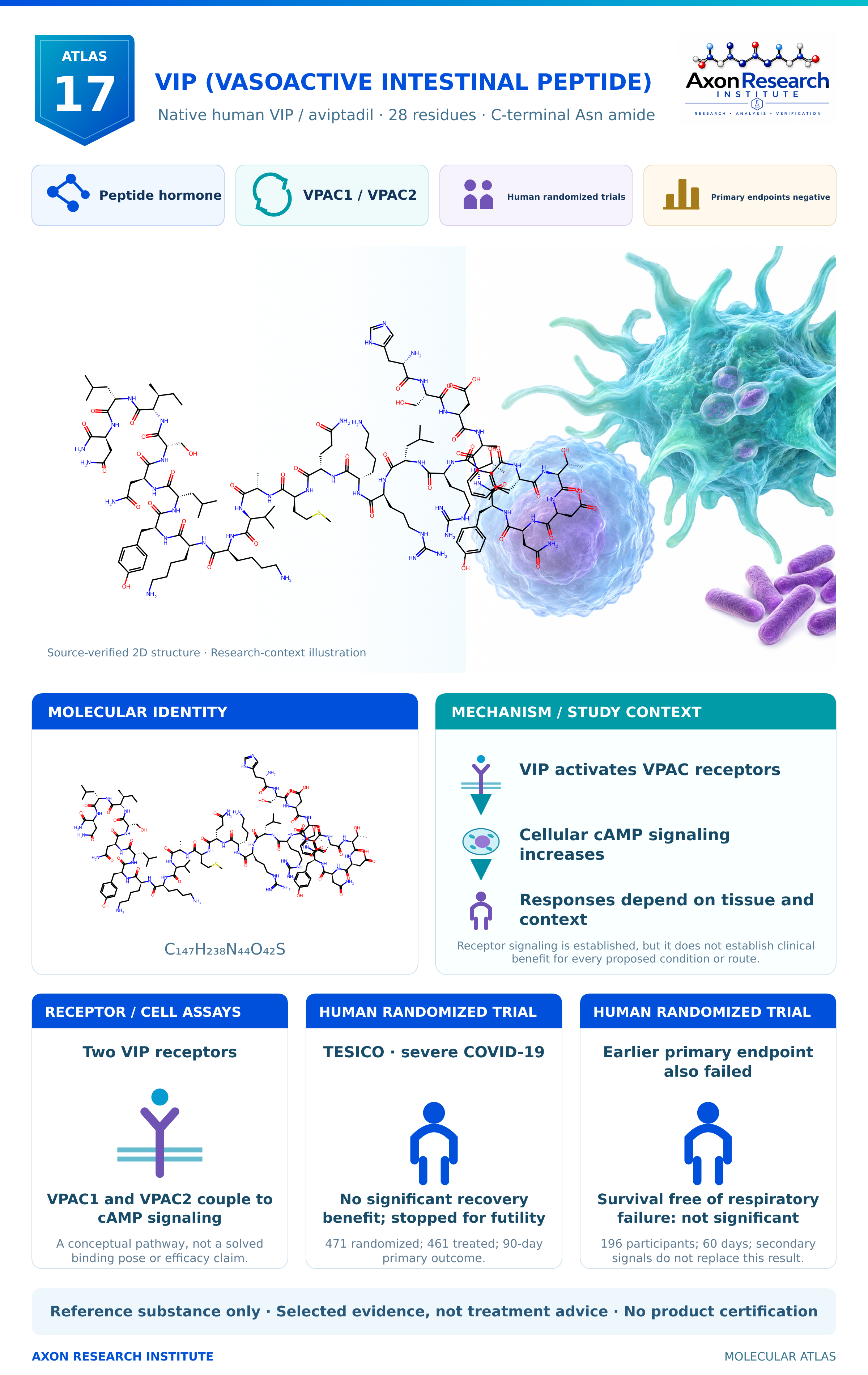
The chemical drawing shows source-verified two-dimensional connectivity and stereochemistry, not an experimental three-dimensional conformation. The biological setting is an illustration. Original study diagrams summarize cited research without reproducing publication artwork or inventing quantitative results.
VIP (vasoactive intestinal peptide)
VPAC1 / VPAC2 receptors
Native human VIP / aviptadil reference peptide, C-terminal amide- Molecular formula
- C147H238N44O42S
- Molecular weight
- 3325.8 g/mol
- Class
- Amidated neuropeptide
- Identity
- HSDAVFTDNYTRLRKQMAVKKYLNSILN-NH2
Research snapshot
VIP is a 28-residue signaling peptide. Its VPAC receptors regulate cellular cAMP and diverse physiological functions. Synthetic VIP, aviptadil, has been investigated clinically, with negative major respiratory-failure trial results.
Cell pharmacology; human trials
Identity & representation
Literature reference substance only; no equivalence to a catalog product or tested supplier lot is asserted. 28 all-L residues; free N terminus and Asn28 carboxamide. Not the free-acid PubChem aviptadil entry.
Educational reference only. Not a dosing guide, treatment recommendation or product endorsement.
Native human VIP / aviptadil · 28 residues · C-terminal Asn amide[5]
View the chemical structure →Sources checked: 2026-11-06. Identity and evidence limits are stated above. Independent specialist review is pending.
What researchers study
VIP is a 28-residue signaling peptide. Its VPAC receptors regulate cellular cAMP and diverse physiological functions. Synthetic VIP, aviptadil, has been investigated clinically, with negative major respiratory-failure trial results.
VPAC receptor binding and cellular signaling
Vascular and secretory physiology
Synthetic VIP in respiratory-failure trials
Mechanism / evidence map
- VIP activates VPAC receptors
- Receptor signaling increases cellular cAMP
- Responses vary across tissues
Receptor signaling is established, but it does not establish clinical benefit for every proposed condition or route.
Simplified publication-grounded schematic, not a solved protein structure or proof of clinical benefit.
Selected evidence
Human aviptadil trials should be read by formulation, route and disease; the selected large respiratory trial was negative.
Intravenous aviptadil and remdesivir for treatment of COVID-19-associated hypoxaemic respiratory failure in the USA (TESICO): a randomised, placebo-controlled trial.[2]
Randomized placebo-controlled multicenter trial · Adults with COVID-19 acute hypoxaemic respiratory failure · 90-day primary outcome · Reported n: 461
Observed: Aviptadil did not improve the primary ordinal recovery endpoint: OR 1.11, 95% CI 0.80–1.55, P=.54; trial stopped for futility.
Limit: 461 received treatment in the modified intention-to-treat population; 471 were randomized. Severe COVID-19 context, not general respiratory benefit.
The Use of IV Vasoactive Intestinal Peptide (Aviptadil) in Patients With Critical COVID-19 Respiratory Failure: Results of a 60-Day Randomized Controlled Trial.[3]
Multicenter placebo-controlled randomized trial · Adults with critical COVID-19 respiratory failure · 60 days · Reported n: 196
Observed: The primary endpoint of survival free of respiratory failure was not statistically significant; secondary survival and subgroup signals were reported.
Limit: Secondary/subgroup findings do not overturn the failed primary endpoint or larger later negative trial.
Reference identity in detail
Sequences and form distinctions describe the cited reference substance, not a verified supplier preparation.
Safety & evidence limits
Vasoactive effects can include hypotension and gastrointestinal effects; receptor activity is not evidence of a favorable clinical benefit–risk balance.
The larger TESICO aviptadil trial stopped for futility and did not improve recovery or mortality endpoints.
Native amidated VIP differs chemically from the free-acid graph carried under some popular database synonyms.
Practical identity notes
- 28 residues with C-terminal Asn amide.
- Use PubChem 16140438 only for this cleared amidated reference form.
- Source 3D conformer unavailable; use verified 2D structure or sequence schematic.
- Physiology plus mixed/negative clinical trials • Reference form only
The 10-second takeaway
VIP has clear receptor biology, while major aviptadil respiratory trials did not establish clinical benefit.
What the visual panels show
Original diagrams summarize the cited research or documented evidence search. They are not copied publication figures or claims of treatment benefit.
MECHANISM / STUDY CONTEXT[1]
Publication-grounded mechanism schematic · Original publication-grounded diagram
VIP activates VPAC receptors · Cellular cAMP signaling increases · Responses depend on tissue and context
Interpretation: Receptor signaling is established, but it does not establish clinical benefit for every proposed condition or route.
Two VIP receptors[1]
RECEPTOR / CELL ASSAYS · Original publication-grounded diagram
VPAC1 and VPAC2 couple to cAMP signaling
A conceptual pathway, not a solved binding pose or efficacy claim.
Interpretation: A conceptual pathway, not a solved binding pose or efficacy claim. Original conceptual illustration only; no fabricated data, docking geometry or clinical extrapolation.
TESICO · severe COVID-19[2]
HUMAN RANDOMIZED TRIAL · Original publication-grounded diagram
No significant recovery benefit; stopped for futility
471 randomized; 461 treated; 90-day primary outcome.
Interpretation: 471 randomized; 461 treated; 90-day primary outcome. Original conceptual illustration only; no fabricated data, docking geometry or clinical extrapolation.
Earlier primary endpoint also failed[3]
HUMAN RANDOMIZED TRIAL · Original publication-grounded diagram
Survival free of respiratory failure: not significant
196 participants; 60 days; secondary signals do not replace this result.
Interpretation: 196 participants; 60 days; secondary signals do not replace this result. Original conceptual illustration only; no fabricated data, docking geometry or clinical extrapolation.
Follow the evidence
Sources & what they support
- Identification of key residues for interaction of vasoactive intestinal peptide with human VPAC1 and VPAC2 receptors and development of a highly selective VPAC1 receptor agonist. Alanine scanning and molecular modeling of the peptide.
Supports: Human VPAC1/VPAC2 receptor binding and adenylyl cyclase assays
- Intravenous aviptadil and remdesivir for treatment of COVID-19-associated hypoxaemic respiratory failure in the USA (TESICO): a randomised, placebo-controlled trial.
Supports: Negative TESICO clinical result and safety composite
- The Use of IV Vasoactive Intestinal Peptide (Aviptadil) in Patients With Critical COVID-19 Respiratory Failure: Results of a 60-Day Randomized Controlled Trial.
Supports: Earlier trial failed primary endpoint
- UniProt P01282, human VIP precursor
Supports: Mature VIP residues 125–152 and terminal amidation
- PubChem CID16140438
Supports: Amidated reference chemical graph independently verified
Original structure record · Download source SDF
Original PubChem 2D source structure record.
← Explore the Molecular Atlas Continue to the research library →