
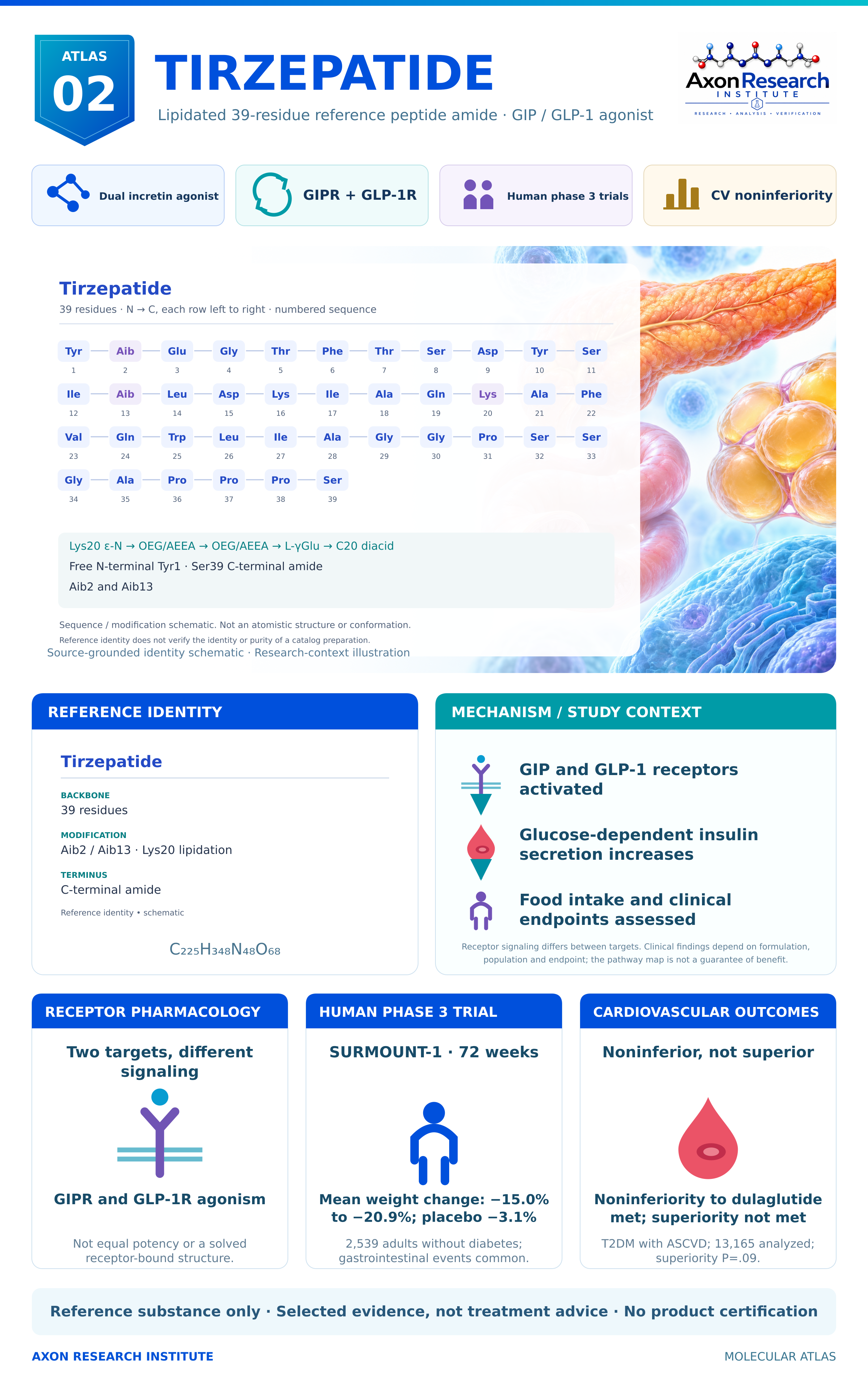
Visual summary only. The research findings, limitations and references accompany the card on this page.
Verified numbered backbone and locus-specific modification map. Sequence transcribed from specified verified source dossier. Linker blocks show identity and ordering, not atomic bonding geometry. Standard chiral amino acids are L; Gly and Aib are achiral. Biological settings and research diagrams are illustrations, not measured anatomy or clinical outcomes.
Tirzepatide
GIPR + GLP-1R
Tirzepatide reference parent, lipidated 39-residue peptide amide- Backbone
- 39 residues
- Modification
- Aib2 / Aib13 · Lys20 lipidation
- Terminus
- C-terminal amide
Research snapshot
Tirzepatide is a lipidated dual GIP/GLP-1 receptor agonist. Large clinical trials support weight and glycemic effects in defined populations; its cardiovascular comparison with dulaglutide met noninferiority, not superiority.
Large human randomized trials
Identity & representation
Literature reference substance only; no equivalence to a catalog product or tested supplier lot is asserted. Aib at positions 2 and 13; Lys20 epsilon-N bears a C20 diacid through two OEG/AEEA spacers and L-gamma-Glu. C-terminal Ser39 amide. All standard chiral residues are L.
Educational reference only. Not a dosing guide, treatment recommendation or product endorsement.
Verified numbered backbone and locus-specific modification map.[1][5]
Sources checked: 2026-11-06. Identity and evidence limits are stated above. Independent specialist review is pending.
What researchers study
Tirzepatide is a lipidated dual GIP/GLP-1 receptor agonist. Large clinical trials support weight and glycemic effects in defined populations; its cardiovascular comparison with dulaglutide met noninferiority, not superiority.
Glycemic control in type 2 diabetes
Weight-management randomized trials
Cardiovascular outcomes against an active comparator
Mechanism / evidence map
- GIP and GLP-1 receptors activated
- Glucose-dependent insulin secretion increases
- Food intake and metabolic outcomes change
Receptor signaling differs between targets. Clinical findings depend on formulation, population and endpoint; the pathway map is not a guarantee of benefit.
Simplified publication-grounded schematic, not a solved protein structure or proof of clinical benefit.
Selected evidence
Large randomized studies exist for tested clinical formulations. The selected cardiovascular trial supports noninferiority to dulaglutide, not superiority.
Tirzepatide Once Weekly for the Treatment of Obesity.[2]
Phase3 randomized double-blind placebo-controlled trial · Adults with obesity/overweight and a weight-related condition, excluding diabetes · 72 weeks · Reported n: 2539
Observed: Mean weight change ranged from −15.0% to −20.9% across tirzepatide arms versus −3.1% with placebo.
Limit: Adults without diabetes; gastrointestinal events were common. Trial-arm results are not individual predictions.
Cardiovascular Outcomes with Tirzepatide versus Dulaglutide in Type 2 Diabetes.[3]
Active-comparator double-blind noninferiority randomized trial · Adults with type 2 diabetes and established atherosclerotic cardiovascular disease · Event-driven cardiovascular follow-up · Reported n: 13165
Observed: Major cardiovascular events occurred in 12.2% versus 13.1% with dulaglutide; HR 0.92, 95.3% CI 0.83–1.01. Noninferiority was met; superiority was not(P=.09).
Limit: 13, 299 randomized; 134 excluded for eligibility. Active comparator already reduces cardiovascular risk; do not call this proven superiority.
Reference identity in detail
Sequences and form distinctions describe the cited reference substance, not a verified supplier preparation.
Safety & evidence limits
Gastrointestinal adverse events are common; labeling also addresses pancreatitis, gallbladder disease, volume-depletion kidney injury and aspiration risk.
The label includes a thyroid C-cell tumor warning based on rodent findings; human relevance remains uncertain.
Do not translate investigational or catalog material into an approved-product identity or generalize trial averages to an individual.
Practical identity notes
- 39 residues, Aib2/Aib13, C-terminal amide.
- Lys20 carries C20 diacid via two OEG spacers and gamma-Glu.
- FDA reference-parent formula C225H348N48O68; mass 4813.53 g/mol.
- Indication-specific clinical evidence • Reference form only
The 10-second takeaway
A clinically studied dual-incretin molecule with strong metabolic evidence and a noninferior, not superior, cardiovascular comparison against dulaglutide.
What the visual panels show
Original diagrams summarize the cited research or documented evidence search. They are not copied publication figures or claims of treatment benefit.
MECHANISM / STUDY CONTEXT[1][5]
Publication-grounded mechanism schematic · Original publication-grounded diagram
GIP and GLP-1 receptors activated · Glucose-dependent insulin secretion increases · Food intake and clinical endpoints assessed
Interpretation: Receptor signaling differs between targets. Clinical findings depend on formulation, population and endpoint; the pathway map is not a guarantee of benefit.
Two targets, different signaling[1][4]
RECEPTOR PHARMACOLOGY · Original publication-grounded diagram
GIPR and GLP-1R agonism
Not equal potency or a solved receptor-bound structure.
Interpretation: Not equal potency or a solved receptor-bound structure. Original conceptual illustration only; no fabricated data, docking geometry or clinical extrapolation.
SURMOUNT-1 · 72 weeks[2]
HUMAN PHASE 3 TRIAL · Original publication-grounded diagram
Mean weight change: −15.0% to −20.9%; placebo −3.1%
2,539 adults without diabetes; gastrointestinal events common.
Interpretation: 2,539 adults without diabetes; gastrointestinal events common. Original conceptual illustration only; no fabricated data, docking geometry or clinical extrapolation.
Noninferior, not superior[3]
CARDIOVASCULAR OUTCOMES · Original publication-grounded diagram
Noninferiority to dulaglutide met; superiority not met
T2DM with ASCVD; 13,165 analyzed; superiority P=.09.
Interpretation: T2DM with ASCVD; 13,165 analyzed; superiority P=.09. Original conceptual illustration only; no fabricated data, docking geometry or clinical extrapolation.
Follow the evidence
Sources & what they support
- LY3298176, a novel dual GIP and GLP-1 receptor agonist for the treatment of type 2 diabetes mellitus: From discovery to clinical proof of concept.
Supports: Discovery, receptor assays and sequence/lipidated design
- Tirzepatide Once Weekly for the Treatment of Obesity.
Supports: SURMOUNT-1 trial
- Cardiovascular Outcomes with Tirzepatide versus Dulaglutide in Type 2 Diabetes.
Supports: SURPASS-CVOT primary noninferiority result
- Tirzepatide is an imbalanced and biased dual GIP and GLP-1 receptor agonist.
Supports: Receptor signaling bias; cellular mechanism
- Mounjaro prescribing information (2025)
Supports: Exact structure/sequence features, formula/mass and clinical safety
← Explore the Molecular Atlas Continue to the research library →