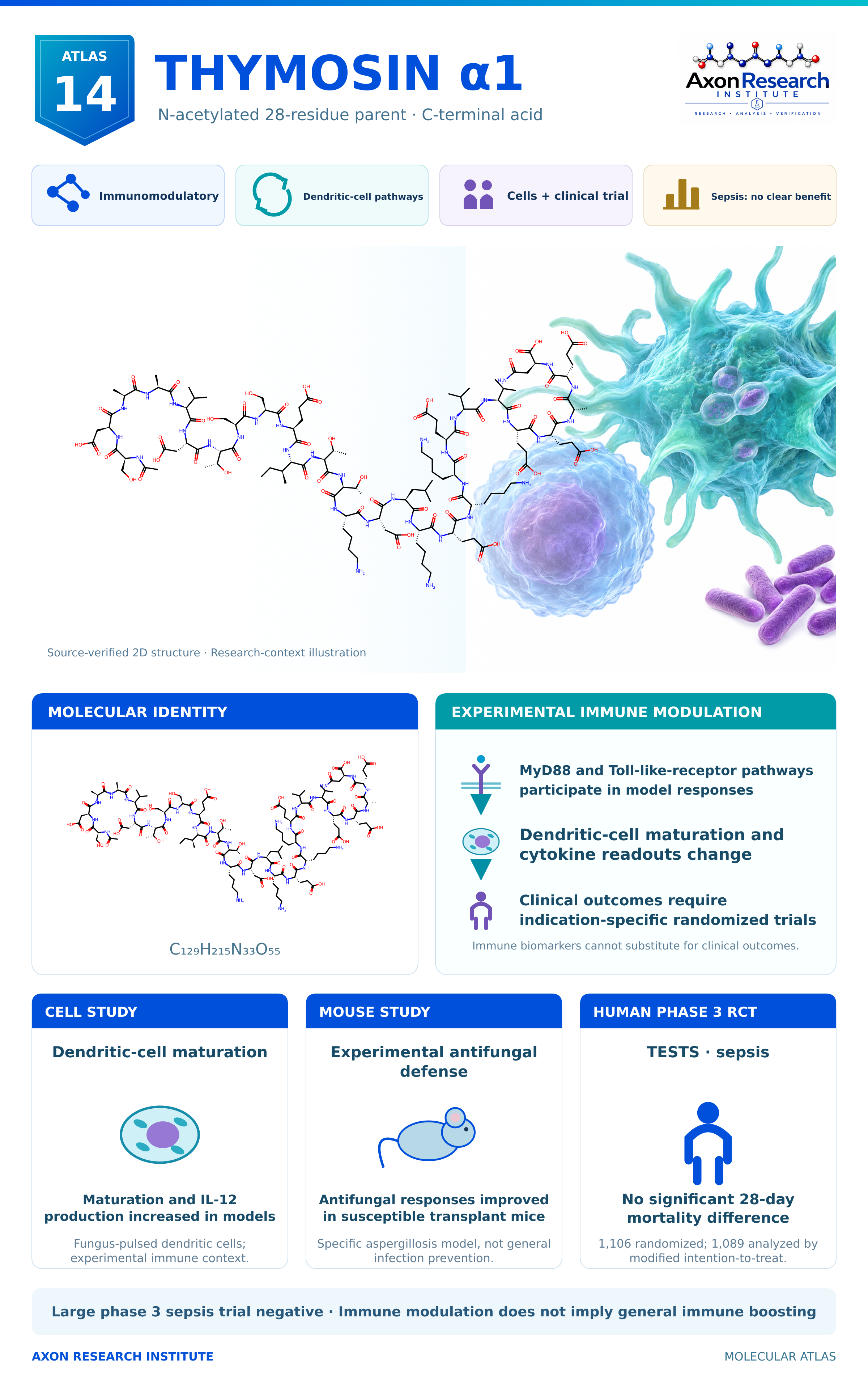
Visual summary only. The research findings, limitations and references accompany the card on this page.
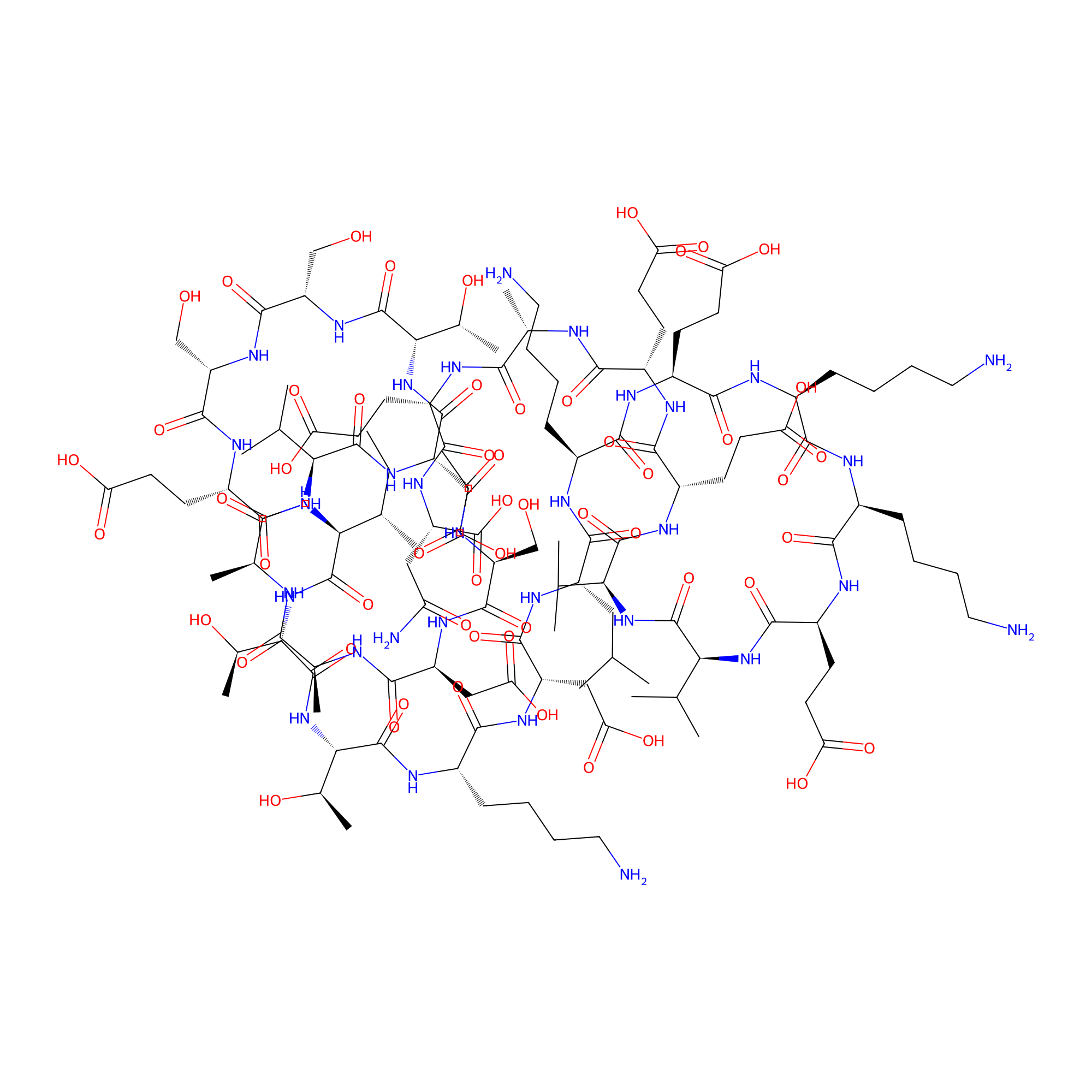
The chemical drawing shows source-verified two-dimensional connectivity and stereochemistry, not an experimental three-dimensional conformation. The biological setting is an illustration. Original study diagrams summarize cited research without reproducing publication artwork or inventing quantitative results.
Thymosin α1
Dendritic-cell / T-cell pathways
N-acetylated 28-residue peptide; Ac-SDAAVDTSSEITTKDLKEKKEVVEEAEN-OH- Molecular formula
- C129H215N33O55
- Molecular weight
- 3108.3 g/mol
- Class
- Immunomodulatory peptide
- Identity
- Ac-SDAAVDTSSEITTKDLKEKKEVVEEAEN-OH
Research snapshot
Thymosin alpha-1 is a 28-residue, N-acetylated peptide studied for immunomodulation. Experimental immune effects do not imply general “immune boosting”; the large TESTS trial did not demonstrate a mortality benefit in sepsis.
Mechanistic work and large sepsis trial
Identity & representation
Literature reference identity only. AXON product composition, salt, purity, sterility and equivalence were not verified. Exact depicted parent/reference form; excludes counterions and excipients unless expressly stated.
Educational reference only. Not a dosing guide, treatment recommendation or product endorsement.
N-acetylated 28-residue parent · C-terminal acid[1]
View the chemical structure →Sources checked: 2026-11-06. Identity and evidence limits are stated above. Independent specialist review is pending.
What researchers study
Thymosin alpha-1 is a 28-residue, N-acetylated peptide studied for immunomodulation. Experimental immune effects do not imply general “immune boosting”; the large TESTS trial did not demonstrate a mortality benefit in sepsis.
Dendritic-cell maturation and antifungal immune responses in experimental models
Sepsis mortality and immune-state measurements in randomized clinical trials
Peptide sequence, N-terminal modification and immune-response relationships
Mechanism in context
- Experimental immune-cell signaling involves MyD88 and Toll-like receptors
- Dendritic-cell maturation and cytokine patterns change in models
- Clinical outcomes must be established separately for each indication
These mechanistic findings are model-dependent. They do not mean indiscriminate immune activation is beneficial, and biomarker changes cannot substitute for clinical outcomes.
Simplified publication-grounded schematic, not a solved protein structure or proof of clinical benefit.
Selected evidence
Mechanistic work and large sepsis trial
The efficacy and safety of thymosin α1 for sepsis (TESTS): multicentre, double blinded, randomised, placebo controlled, phase 3 trial.[4]
Multicentre double-blind randomized placebo-controlled phase 3 TESTS · 1106 randomized;1089 modified intention-to-treat · 7-day treatment;28-day primary mortality outcome
Observed: 28-day mortality 23.4% versus 24.1%; hazard ratio 0.99,95%CI 0.77–1.27; no clear benefit.
TESTS randomized 1,106 adults with sepsis; 1,089 entered the modified intention-to-treat analysis. At 28 days, mortality was 23.4% with thymosin alpha-1 and 24.1% with placebo. The trial found no clear overall survival benefit; subgroup signals should not override that result.
Limit: Sepsis-specific trial; subgroup effects are exploratory and not a substitute for overall null result.
Reference identity in detail
Sequences and form distinctions describe the cited reference substance, not a verified supplier preparation.
Safety & evidence limits
The large phase 3 sepsis trial did not demonstrate overall mortality benefit, despite mechanistic rationale and earlier exploratory findings.
Immune modulation is context-dependent; evidence for a specific illness cannot justify nonspecific “immune boosting” in healthy individuals.
FDA highlights compounded-product immunogenicity and characterization concerns, with inadequate information to define the full safety profile.
Practical identity notes
- 28 residues; the first serine is N-acetylated and the terminal asparagine retains a free carboxyl group.
- Thymalfasin denotes the defined synthetic peptide, unlike heterogeneous thymus extracts such as thymalin.
- Formula and mass refer to this parent peptide, excluding counterions.
The 10-second takeaway
A defined immunomodulatory peptide; a large rigorous sepsis trial found no overall survival benefit.
What the visual panels show
Original diagrams summarize the cited research or documented evidence search. They are not copied publication figures or claims of treatment benefit.
EXPERIMENTAL IMMUNE MODULATION[3][4]
Publication-grounded mechanism schematic · Original publication-grounded diagram
MyD88 and Toll-like-receptor pathways participate in model responses · Dendritic-cell maturation and cytokine readouts change · Clinical outcomes require indication-specific randomized trials
Interpretation: Immune biomarkers cannot substitute for clinical outcomes.
Dendritic-cell maturation[3]
CELL STUDY · Original publication-grounded diagram
Maturation and IL-12 production increased in models
Fungus-pulsed dendritic cells; experimental immune context.
Interpretation: No unqualified immune-boosting claim; pathway involvement does not establish direct receptor binding.
Experimental antifungal defense[3]
MOUSE STUDY · Original publication-grounded diagram
Antifungal responses improved in susceptible transplant mice
Specific aspergillosis model, not general infection prevention.
Interpretation: Retain transplant-mouse model; do not substitute healthy human immunity or sepsis survival.
TESTS · sepsis[4]
HUMAN PHASE 3 RCT · Original publication-grounded diagram
No significant 28-day mortality difference
1,106 randomized; 1,089 analyzed by modified intention-to-treat.
Interpretation: The overall null result takes priority over exploratory subgroup signals; no survival plot is fabricated.
Follow the evidence
Sources & what they support
- PubChem compound record 16130571
Supports: identity; structure; formula; molecular_weight; stereochemistry
Original structure record · Download depicted structure SDF
Generated 2D layout from the verified reference graph; not an original 2D source-record download.
- Thymosin alpha1: isolation and sequence analysis of an immunologically active thymic polypeptide.
Supports: identity history; 28-residue peptide
- Thymosin alpha 1 activates dendritic cells for antifungal Th1 resistance through toll-like receptor signaling.
Supports: mechanism; preclinical immune context
- The efficacy and safety of thymosin α1 for sepsis (TESTS): multicentre, double blinded, randomised, placebo controlled, phase 3 trial.
Supports: human trial; limitations
- FDA compounding safety concerns
Supports: safety limitation
← Explore the Molecular Atlas Continue to the research library →