
Visual summary only. The research findings, limitations and references accompany the card on this page.
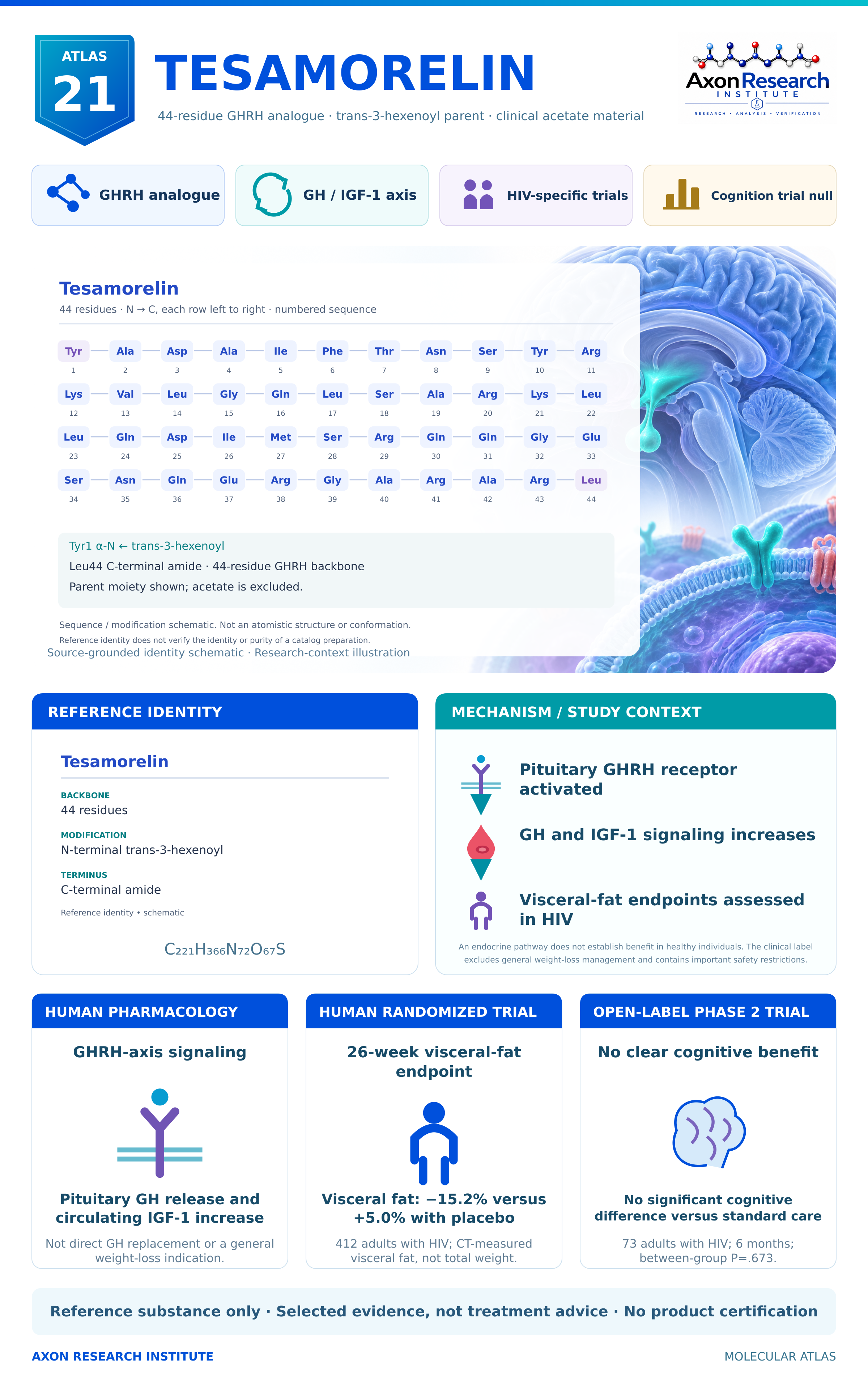
Verified numbered backbone and locus-specific modification map. Sequence transcribed from specified verified source dossier. Linker blocks show identity and ordering, not atomic bonding geometry. Standard chiral amino acids are L; Gly and Aib are achiral. Biological settings and research diagrams are illustrations, not measured anatomy or clinical outcomes.
Tesamorelin
Pituitary GHRH receptor / GH–IGF-1
Tesamorelin parent moiety; clinical material is acetate salt- Backbone
- 44 residues
- Modification
- N-terminal trans-3-hexenoyl
- Terminus
- C-terminal amide
Research snapshot
Tesamorelin is a modified GHRH analogue studied and used in specific HIV-associated abdominal-fat contexts. It increases GH/IGF-1 signaling; this is not a general weight-loss or cognitive-enhancement indication.
Disease-specific human trials
Identity & representation
Literature reference substance only; no equivalence to a catalog product or tested supplier lot is asserted. 44-residue human GHRH(1–44) sequence with trans-3-hexenoyl acylation at Tyr1 alpha-amino group and C-terminal Leu44 amide. Displayed formula/mass excludes acetate.
Educational reference only. Not a dosing guide, treatment recommendation or product endorsement.
Verified numbered backbone and locus-specific modification map.[3][4]
Sources checked: 2026-11-06. Identity and evidence limits are stated above. Independent specialist review is pending.
What researchers study
Tesamorelin is a modified GHRH analogue studied and used in specific HIV-associated abdominal-fat contexts. It increases GH/IGF-1 signaling; this is not a general weight-loss or cognitive-enhancement indication.
Visceral adiposity in HIV-associated lipodystrophy
Metabolic and hepatic-fat endpoints in HIV
Exploratory neurocognitive outcomes with negative between-group result
Mechanism / evidence map
- Pituitary GHRH receptor activated
- GH and IGF-1 signaling increases
- Visceral-fat endpoints assessed in HIV
An endocrine pathway does not establish benefit in healthy individuals. The clinical label excludes general weight-loss management and contains important safety restrictions.
Simplified publication-grounded schematic, not a solved protein structure or proof of clinical benefit.
Selected evidence
Clinical evidence and labeling are specific to HIV-associated lipodystrophy; a 2025 cognitive trial did not show significant between-group benefit.
Metabolic effects of a growth hormone-releasing factor in patients with HIV.[1]
Randomized placebo-controlled trial · Adults with HIV and accumulated abdominal fat · 26 weeks · Reported n: 412
Observed: Visceral adipose tissue decreased 15.2% with tesamorelin and increased 5.0% with placebo; IGF-1 increased 81.0% versus −5.0%.
Limit: HIV-associated abdominal-fat population, 86%men. Surrogate body-composition outcome, not proof of cardiovascular benefit or general weight loss.
Effects of Tesamorelin on Neurocognitive Impairment in Persons With HIV and Abdominal Obesity.[2]
Randomized open-label phase 2 trial · Virally suppressed adults with HIV, abdominal obesity and neurocognitive impairment · 6 months · Reported n: 73
Observed: Neurocognitive performance change did not significantly differ between tesamorelin and standard care(P=.673), despite reduced waist circumference.
Limit: Small, no placebo arm and limited power; no clear cognitive benefit was demonstrated.
Reference identity in detail
Sequences and form distinctions describe the cited reference substance, not a verified supplier preparation.
Safety & evidence limits
Label warnings include elevated IGF-1, glucose intolerance/diabetes, fluid retention, hypersensitivity and malignancy-related precautions.
The US label states it is not indicated for weight-loss management and long-term cardiovascular safety has not been established.
Different approved tesamorelin formulations are not automatically substitutable; a catalog peptide is not an approved product.
Practical identity notes
- 44 residues with N-terminal trans-3-hexenoyl and C-terminal amide.
- Reference-parent formula C221H366N72O67S; mass 5135.9 g/mol.
- Clinical acetate material and formulated products must be distinguished from the depicted parent moiety.
- HIV-lipodystrophy evidence • Reference form only
The 10-second takeaway
Tesamorelin has specific HIV-lipodystrophy evidence, endocrine safety limits and no demonstrated cognitive benefit in the selected 2025 trial.
What the visual panels show
Original diagrams summarize the cited research or documented evidence search. They are not copied publication figures or claims of treatment benefit.
MECHANISM / STUDY CONTEXT[3]
Publication-grounded mechanism schematic · Original publication-grounded diagram
Pituitary GHRH receptor activated · GH and IGF-1 signaling increases · Visceral-fat endpoints assessed in HIV
Interpretation: An endocrine pathway does not establish benefit in healthy individuals. The clinical label excludes general weight-loss management and contains important safety restrictions.
GHRH-axis signaling[3]
HUMAN PHARMACOLOGY · Original publication-grounded diagram
Pituitary GH release and circulating IGF-1 increase
Not direct GH replacement or a general weight-loss indication.
Interpretation: Not direct GH replacement or a general weight-loss indication. Original conceptual illustration only; no fabricated data, docking geometry or clinical extrapolation.
26-week visceral-fat endpoint[1]
HUMAN RANDOMIZED TRIAL · Original publication-grounded diagram
Visceral fat: −15.2% versus +5.0% with placebo
412 adults with HIV; CT-measured visceral fat, not total weight.
Interpretation: 412 adults with HIV; CT-measured visceral fat, not total weight. Original conceptual illustration only; no fabricated data, docking geometry or clinical extrapolation.
No clear cognitive benefit[2]
OPEN-LABEL PHASE 2 TRIAL · Original publication-grounded diagram
No significant cognitive difference versus standard care
73 adults with HIV; 6 months; between-group P=.673.
Interpretation: 73 adults with HIV; 6 months; between-group P=.673. Original conceptual illustration only; no fabricated data, docking geometry or clinical extrapolation.
Follow the evidence
Sources & what they support
- Metabolic effects of a growth hormone-releasing factor in patients with HIV.
Supports: 412-person 26-week visceral-fat trial
- Effects of Tesamorelin on Neurocognitive Impairment in Persons With HIV and Abdominal Obesity.
Supports: Negative between-group cognitive trial, 2025
- Egrifta WR US prescribing information (2025)
Supports: Indication limits, safety, formulation distinctions and mechanism
- FDA original tesamorelin chemistry review
Supports: Exact 44-residue sequence, trans-3-hexenoyl, parent formula/mass
← Explore the Molecular Atlas Continue to the research library →