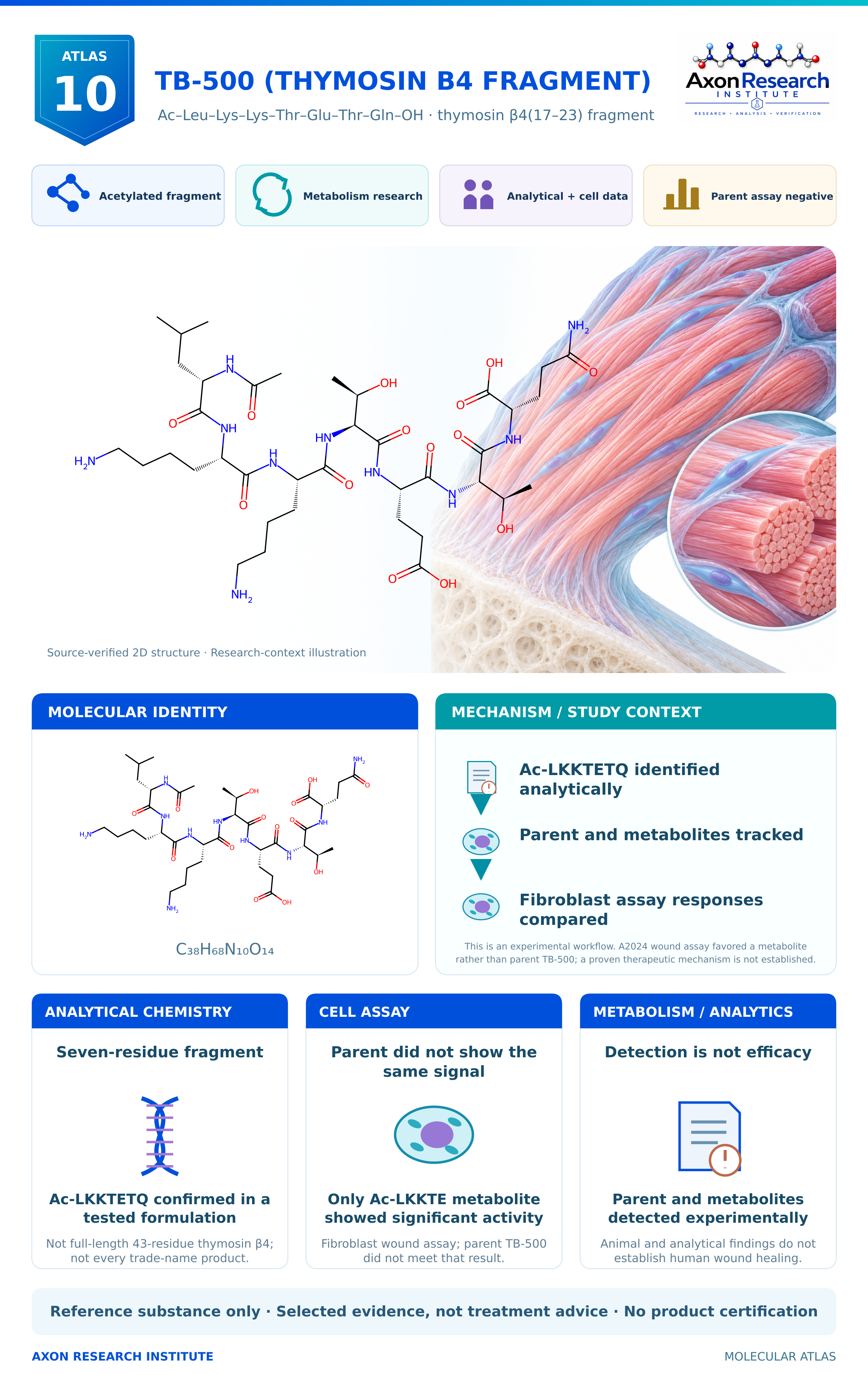
Visual summary only. The research findings, limitations and references accompany the card on this page.
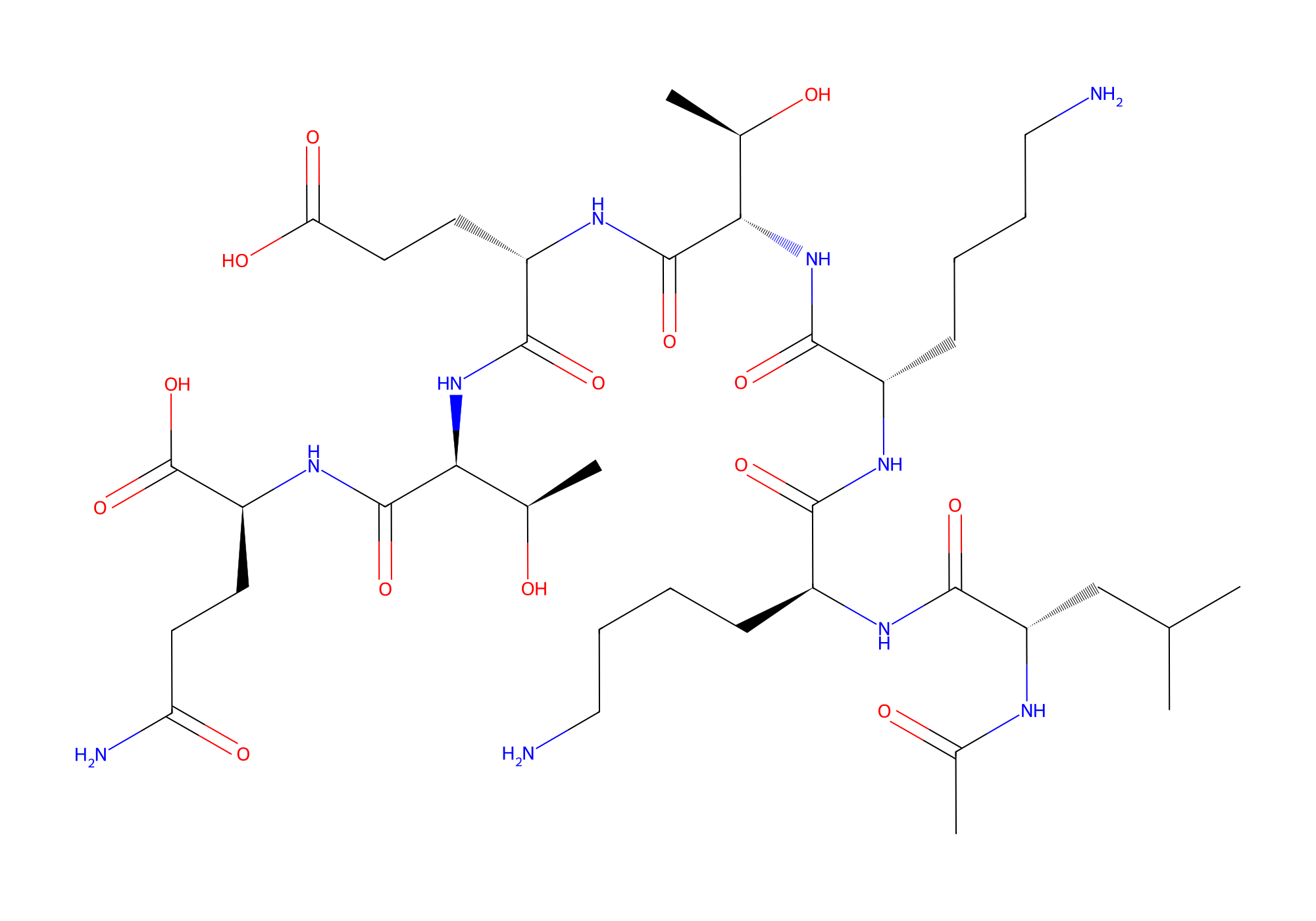
The chemical drawing shows source-verified two-dimensional connectivity and stereochemistry, not an experimental three-dimensional conformation. The biological setting is an illustration. Original study diagrams summarize cited research without reproducing publication artwork or inventing quantitative results.
TB-500 (thymosin β4 fragment)
Fragment/metabolite biology under study
N-acetylated thymosin-beta4(17–23) fragment, free C-terminal acid- Molecular formula
- C38H68N10O14
- Molecular weight
- 889 g/mol
- Class
- Acetylated heptapeptide fragment
- Identity
- Ac-LKKTETQ-OH
Research snapshot
This card defines TB-500 as the N-acetylated thymosin β4(17–23) fragment Ac-LKKTETQ. Analytical identification and metabolism studies exist; full-length thymosin β4 benefits cannot be assigned to this fragment.
Analytical; cell and animal metabolism
Identity & representation
Literature reference substance only; no equivalence to a catalog product or tested supplier lot is asserted. Seven all-L residues, N-terminal acetyl group. This fragment is not full-length 43-residue thymosin beta4. Trade-name product contents can vary.
Educational reference only. Not a dosing guide, treatment recommendation or product endorsement.
Ac–Leu–Lys–Lys–Thr–Glu–Thr–Gln–OH · thymosin β4(17–23) fragment[4]
View the chemical structure →Sources checked: 2026-11-06. Identity and evidence limits are stated above. Independent specialist review is pending.
What researchers study
This card defines TB-500 as the N-acetylated thymosin β4(17–23) fragment Ac-LKKTETQ. Analytical identification and metabolism studies exist; full-length thymosin β4 benefits cannot be assigned to this fragment.
Mass-spectrometry identification of fragment products
Serum/enzyme and animal metabolism
Fibroblast assay comparisons of parent and metabolites
Mechanism / evidence map
- Ac-LKKTETQ identity confirmed analytically
- Parent and metabolites tracked
- Metabolites compared in cell assays
This is an experimental workflow. A2024 wound assay favored a metabolite rather than parent TB-500; a proven therapeutic mechanism is not established.
Simplified publication-grounded schematic, not a solved protein structure or proof of clinical benefit.
Selected evidence
No efficacy trial for this exact Ac-LKKTETQ fragment was verified in the selected primary evidence.
Synthesis and characterization of the N-terminal acetylated 17-23 fragment of thymosin beta 4 identified in TB-500, a product suspected to possess doping potential.[1]
Analytical chemical identification and synthesis · Tested TB-500 formulation and synthetic reference · Laboratory analysis
Observed: High-resolution mass spectrometry identified Ac-LKKTETQ in the tested TB-500 formulation and confirmed a synthesized reference.
Limit: Establishes the analyzed product identity, not every trade-name product or clinical efficacy.
Simultaneous quantification of TB-500 and its metabolites in in-vitro experiments and rats by UHPLC-Q-Exactive orbitrap MS/MS and their screening by wound healing activities in-vitro.[3]
In-vitro metabolism, rat excretion and fibroblast assays · Enzyme/serum systems, rats and fibroblast cultures · Metabolite detection through72hours in the reported experiments
Observed: Only metabolite Ac-LKKTE showed significant wound-healing assay activity versus control; parent TB-500 did not show that significant result.
Limit: In-vitro assay, not clinical wound healing; biological effects cannot be inferred from full-length thymosin β4.
Reference identity in detail
Sequences and form distinctions describe the cited reference substance, not a verified supplier preparation.
Safety & evidence limits
Full-length thymosin β4, unacetylated LKKTETQ and Ac-LKKTETQ are distinct materials; their findings must not be merged.
The 2024 fibroblast assay detected significant activity for Ac-LKKTE metabolite rather than parent TB-500.
Doping-control detection and animal pharmacokinetics do not establish human efficacy, safety or suitability.
Practical identity notes
- Seven-residue N-acetylated peptide; free C-terminal acid.
- Reference formula C38H68N10O14.
- Exact Ac-LKKTETQ graph cleared; no source 3D conformer returned.
- Exact Ac-LKKTETQ fragment only • Reference form only
The 10-second takeaway
TB-500 here means Ac-LKKTETQ, a fragment with limited direct biological evidence and a notable parent-versus-metabolite distinction.
What the visual panels show
Original diagrams summarize the cited research or documented evidence search. They are not copied publication figures or claims of treatment benefit.
MECHANISM / STUDY CONTEXT[1][3]
Publication-grounded mechanism schematic · Original publication-grounded diagram
Ac-LKKTETQ identified analytically · Parent and metabolites tracked · Fibroblast assay responses compared
Interpretation: This is an experimental workflow. A2024 wound assay favored a metabolite rather than parent TB-500; a proven therapeutic mechanism is not established.
Seven-residue fragment[1]
ANALYTICAL CHEMISTRY · Original publication-grounded diagram
Ac-LKKTETQ confirmed in a tested formulation
Not full-length 43-residue thymosin β4; not every trade-name product.
Interpretation: Not full-length 43-residue thymosin β4; not every trade-name product. Original conceptual illustration only; no fabricated data, docking geometry or clinical extrapolation.
Parent did not show the same signal[3]
CELL ASSAY · Original publication-grounded diagram
Only Ac-LKKTE metabolite showed significant activity
Fibroblast wound assay; parent TB-500 did not meet that result.
Interpretation: Fibroblast wound assay; parent TB-500 did not meet that result. Original conceptual illustration only; no fabricated data, docking geometry or clinical extrapolation.
Detection is not efficacy[2][3]
METABOLISM / ANALYTICS · Original publication-grounded diagram
Parent and metabolites detected experimentally
Animal and analytical findings do not establish human wound healing.
Interpretation: Animal and analytical findings do not establish human wound healing. Original conceptual illustration only; no fabricated data, docking geometry or clinical extrapolation.
Follow the evidence
Sources & what they support
- Synthesis and characterization of the N-terminal acetylated 17-23 fragment of thymosin beta 4 identified in TB-500, a product suspected to possess doping potential.
Supports: Exact fragment chemical identification
- Doping control analysis of TB-500, a synthetic version of an active region of thymosin β₄, in equine urine and plasma by liquid chromatography-mass spectrometry.
Supports: Equine analytical/metabolite detection, not efficacy
- Simultaneous quantification of TB-500 and its metabolites in in-vitro experiments and rats by UHPLC-Q-Exactive orbitrap MS/MS and their screening by wound healing activities in-vitro.
Supports: Parent-versus-metabolite fibroblast findings
- PubChem CID62707662
Supports: N-acetylated seven-residue reference graph
Original structure record · Download source SDF
Original PubChem 2D source structure record.
← Explore the Molecular Atlas Continue to the research library →