
Visual summary only. The research findings, limitations and references accompany the card on this page.
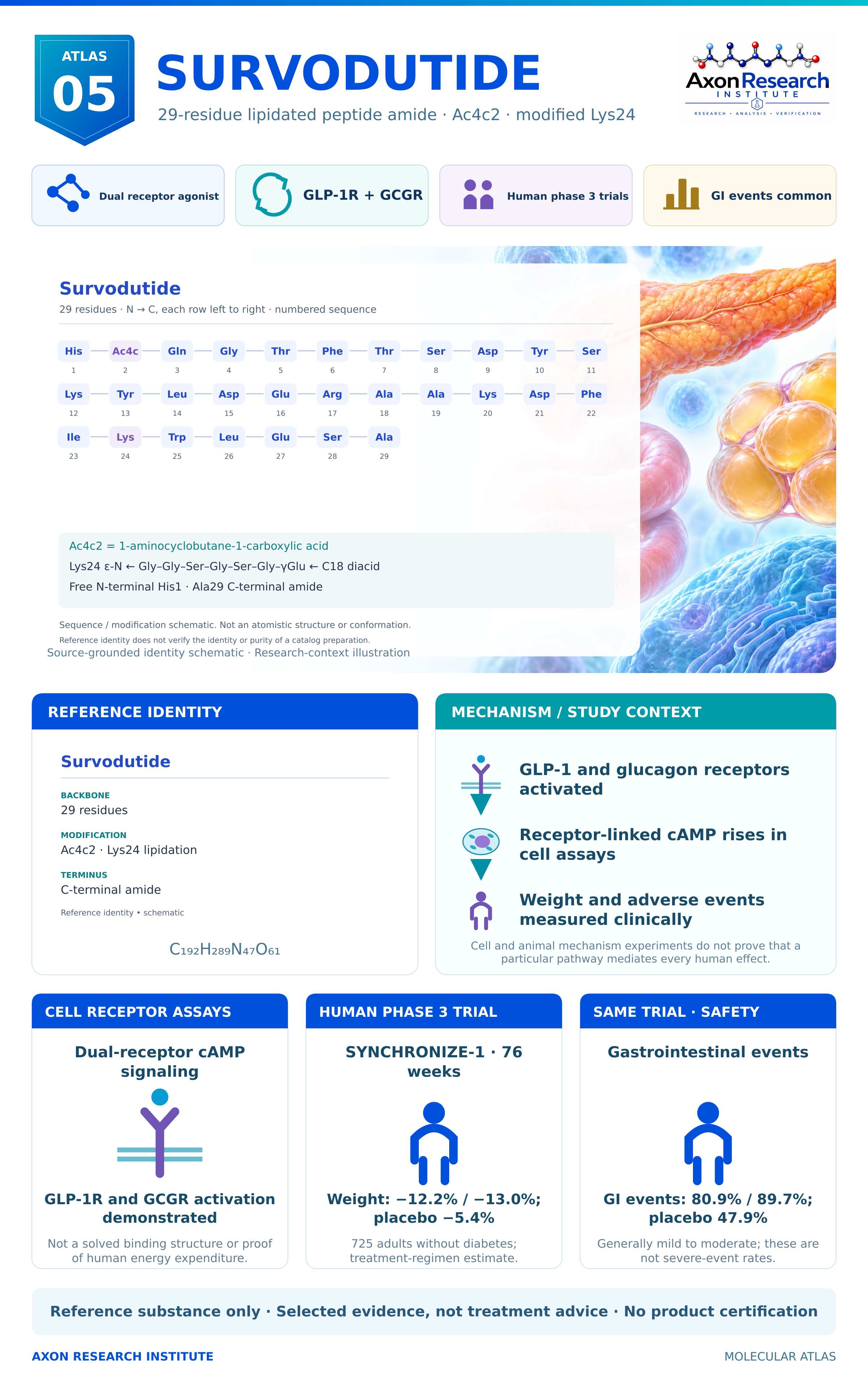
Verified numbered backbone and locus-specific modification map. Sequence transcribed from specified verified source dossier. Linker blocks show identity and ordering, not atomic bonding geometry. Standard chiral amino acids are L; Gly and Aib are achiral. Biological settings and research diagrams are illustrations, not measured anatomy or clinical outcomes.
Survodutide
GLP-1R + GCGR
Survodutide reference parent, counterions and solvates excluded- Backbone
- 29 residues
- Modification
- Ac4c2 · Lys24 lipidation
- Terminus
- C-terminal amide
Research snapshot
Survodutide is an engineered glucagon-based dual GLP-1/glucagon receptor agonist. Ac 4c substitution, a branched lipid-bearing peptide linker and C-terminal amidation distinguish it from endogenous glucagon and other incretin medicines.
Phase 3 human trials
Identity & representation
Literature reference molecule only. Does not certify the identity, salt, purity, sterility, formulation or suitability of a research product. X2 is 1-aminocyclobutane-1-carboxylic acid (Ac4c), not Aib. All named chiral amino acids are L. The Ala29 C-terminus is amidated. Lys24 epsilon amino group is linked to the C-terminal glycine carbonyl of the seven-residue side chain.
Educational reference only. Not a dosing guide, treatment recommendation or product endorsement.
Verified numbered backbone and locus-specific modification map.[1][2]
Sources checked: 2026-11-06. Identity and evidence limits are stated above. Independent specialist review is pending.
What researchers study
Survodutide is an engineered glucagon-based dual GLP-1/glucagon receptor agonist. Ac 4c substitution, a branched lipid-bearing peptide linker and C-terminal amidation distinguish it from endogenous glucagon and other incretin medicines.
Glucagon/GLP-1 receptor balance
Peptide modification and albumin-binding design
Obesity and diabetes trials
MRI liver-fat outcomes in MASLD
Dual-receptor pharmacology[2]
- Activates GLP-1 and glucagon receptors
- Stimulates receptor-linked cAMP in cell assays
- Clinical trials assess weight, glycemia and liver-fat outcomes
Cell and animal mechanism experiments do not prove that a particular pathway mediates every human effect.
Simplified publication-grounded schematic, not a solved protein structure or proof of clinical benefit.
Selected evidence
Updated with primary phase 3 publications available by 2026-11-06. These are selected studies, not a systematic review.
Survodutide Once Weekly for the Treatment of Adults with Obesity.[3]
Phase 3 randomized double-blind placebo-controlled trial (SYNCHRONIZE-1) · Adults with obesity, or overweight with an obesity-related complication, without diabetes · 76 weeks · Reported n: 725
Observed: Treatment-regimen mean weight change: −12.2% and −13.0% in the two survodutide groups, versus −5.4% with placebo. At least 5% weight loss occurred in 72.6%, 71.9% and 46.3%, respectively; all active-placebo comparisons P<0.001.
Limit: Treatment-regimen estimates incorporate discontinuation, additional obesity therapies and prolonged dose escalation. GI events occurred in 80.9%, 89.7% and 47.9%, respectively. This study was not powered to establish long-term cardiovascular benefit.
Survodutide Once Weekly in Adults with Obesity and Type 2 Diabetes.[4]
Multinational phase 3 randomized double-blind placebo-controlled trial (SYNCHRONIZE-2) · Adults with type 2 diabetes and BMI at least 27 · 76 weeks · Reported n: 752
Observed: Treatment-regimen mean weight change: −8.2% and −9.8% with survodutide versus −3.9% with placebo. HbA1c changes were −0.9, −0.8 and −0.2 percentage points, respectively.
Limit: GI events occurred in 72.8%, 77.7% and 38.6%. The population differs from SYNCHRONIZE-1, so between-trial numerical differences are not randomized comparisons.
Survodutide in adults with obesity and metabolic dysfunction-associated steatotic liver disease: SYNCHRONIZE-MASLD, a randomized, double-blind, placebo-controlled phase 3 trial.[5]
Phase 3 randomized double-blind placebo-controlled trial (SYNCHRONIZE-MASLD) · Adults with obesity and at-risk metabolic dysfunction-associated steatotic liver disease · 48 weeks · Reported n: 216
Observed: At least 30% MRI-measured liver-fat reduction occurred in 68.5% with survodutide versus 28.6% with placebo using the treatment-regimen estimand. Mean weight change was −8.7% versus −1.4% by that estimand.
Limit: MRI liver-fat change is a surrogate, not proof of improved clinical liver outcomes or fibrosis reversal. The trial was short and recruited only in the United States and Spain. Efficacy-estimand percentages differ and must not be mixed with treatment-regimen values.
Reference identity in detail
Sequences and form distinctions describe the cited reference substance, not a verified supplier preparation.
Safety & evidence limits
Clinical trial findings concern the tested pharmaceutical formulations, populations and supervised study conditions. They cannot establish equivalence or safety of a catalog preparation.
Gastrointestinal adverse events are common. Selected study summaries are not a complete safety assessment or a treatment recommendation.
No head-to-head superiority claim may be inferred by comparing these studies with a different drug, population, duration or estimand.
SYNCHRONIZE-MASLD reports MRI liver-fat changes, not proof of reduced cirrhosis, liver failure or mortality.
Investigational status is stated in the cited 2026 primary trial reports; this is not a jurisdiction-by-jurisdiction regulatory review.
Practical identity notes
- 29-residue backbone plus a seven-residue side-chain linker; do not call it simply a 36-residue linear peptide.
- Ac 4c at position 2 is chemically different from the Aib in mazdutide.
- Formula describes the full reference parent, not a salt, solvate or commercial preparation.
- Educational molecular reference • Selected studies, not a systematic review • No dosing guidance
The 10-second takeaway
A precisely modified dual-receptor peptide with phase 3 weight-loss evidence and frequent gastrointestinal effects. Research-product identity is a separate question.
What the visual panels show
Original diagrams summarize the cited research or documented evidence search. They are not copied publication figures or claims of treatment benefit.
MECHANISM / STUDY CONTEXT[2][3]
Publication-grounded mechanism schematic · Original publication-grounded diagram
GLP-1 and glucagon receptors activated · Receptor-linked cAMP rises in cell assays · Weight and adverse events measured clinically
Interpretation: Cell and animal mechanism experiments do not prove that a particular pathway mediates every human effect.
Dual-receptor cAMP signaling[2]
CELL RECEPTOR ASSAYS · Original publication-grounded diagram
GLP-1R and GCGR activation demonstrated
Not a solved binding structure or proof of human energy expenditure.
Interpretation: Not a solved binding structure or proof of human energy expenditure. Original conceptual illustration only; no fabricated data, docking geometry or clinical extrapolation.
SYNCHRONIZE-1 · 76 weeks[3]
HUMAN PHASE 3 TRIAL · Original publication-grounded diagram
Weight: −12.2% / −13.0%; placebo −5.4%
725 adults without diabetes; treatment-regimen estimate.
Interpretation: 725 adults without diabetes; treatment-regimen estimate. Original conceptual illustration only; no fabricated data, docking geometry or clinical extrapolation.
Gastrointestinal events[3]
SAME TRIAL · SAFETY · Original publication-grounded diagram
GI events: 80.9% / 89.7%; placebo 47.9%
Generally mild to moderate; these are not severe-event rates.
Interpretation: Generally mild to moderate; these are not severe-event rates. Original conceptual illustration only; no fabricated data, docking geometry or clinical extrapolation.
Follow the evidence
Sources & what they support
- Survodutide: WHO Recommended INN List 90
Supports: 29-residue backbone, Ac4c2, C-terminal amide, Lys24 side-chain linkage, stereochemistry and formula C192H289N47O61
- BI 456906: Discovery and preclinical pharmacology of a novel GCGR/GLP-1R dual agonist with robust anti-obesity efficacy.
Supports: Exact peptide design; Figure1 receptor/cAMP pharmacology and preclinical albumin-binding rationale
- Survodutide Once Weekly for the Treatment of Adults with Obesity.
Supports: SYNCHRONIZE-1 design, n 725, week 76 weight outcomes and gastrointestinal event rates
- Survodutide Once Weekly in Adults with Obesity and Type 2 Diabetes.
Supports: SYNCHRONIZE-2 n 752, week 76 weight and glycemic outcomes; safety
- Survodutide in adults with obesity and metabolic dysfunction-associated steatotic liver disease: SYNCHRONIZE-MASLD, a randomized, double-blind, placebo-controlled phase 3 trial.
Supports: SYNCHRONIZE-MASLD n 216, MRI liver fat outcomes, estimand differences and study limitations
← Explore the Molecular Atlas Continue to the research library →
