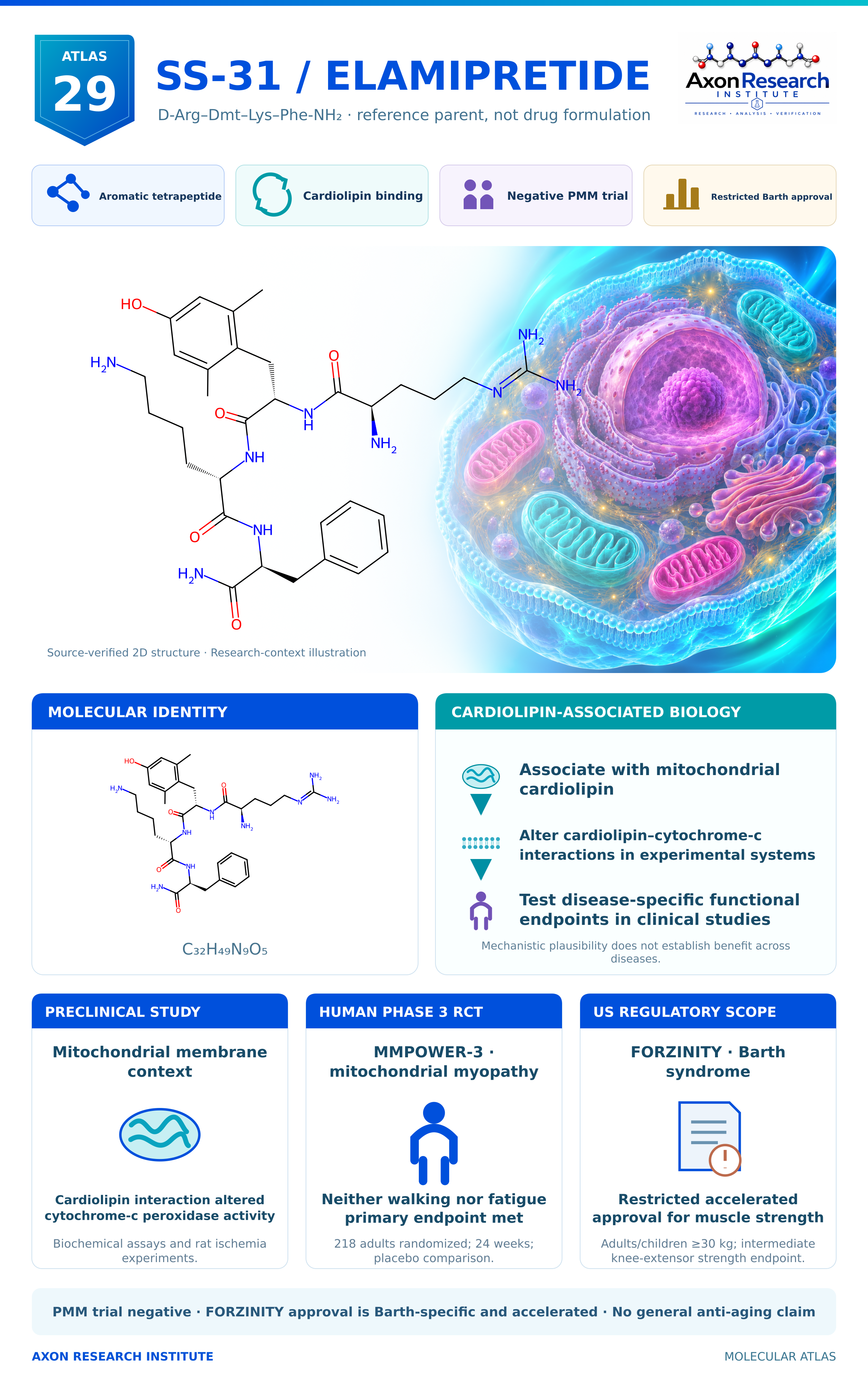
Visual summary only. The research findings, limitations and references accompany the card on this page.
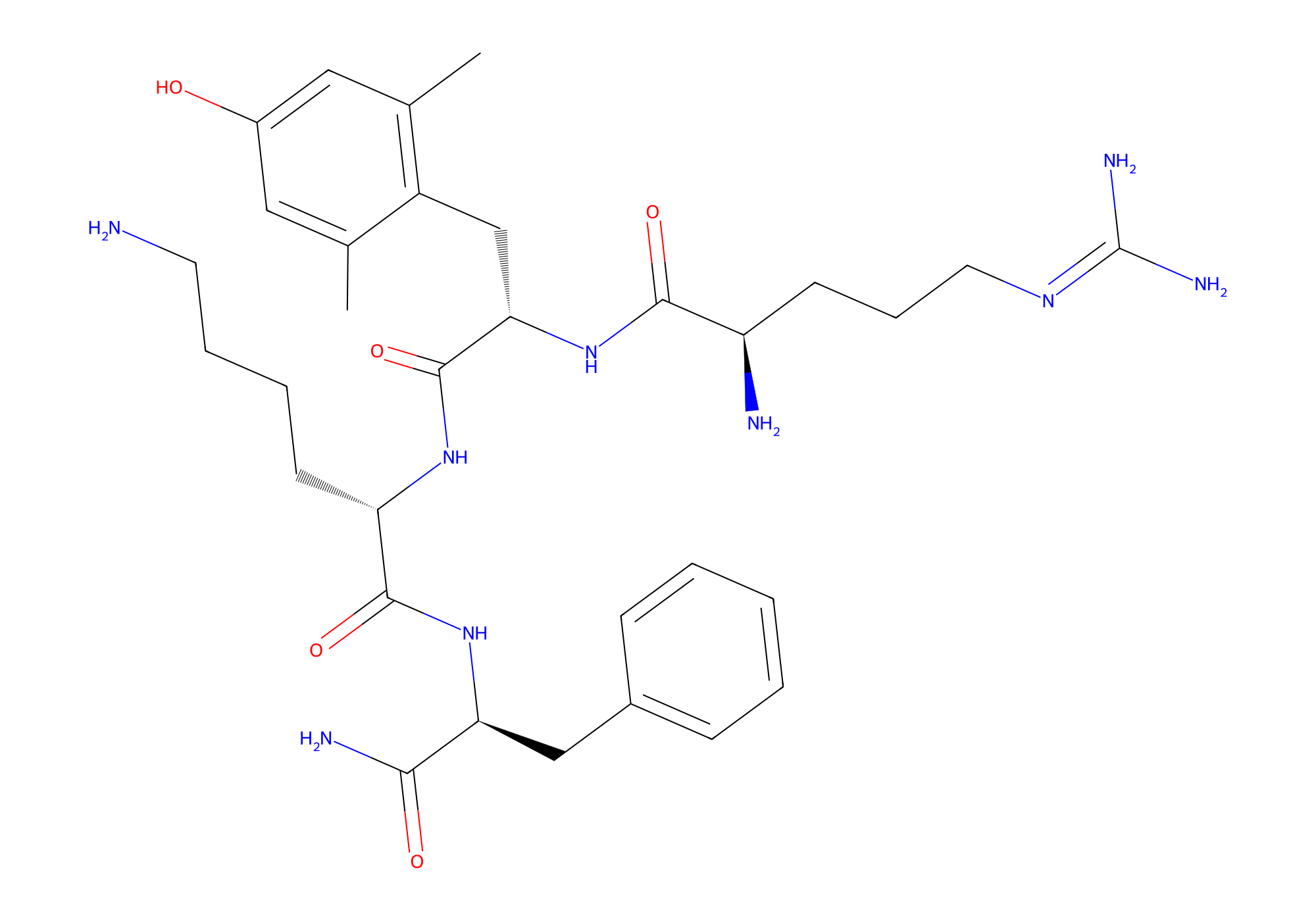
The chemical drawing shows source-verified two-dimensional connectivity and stereochemistry, not an experimental three-dimensional conformation. The biological setting is an illustration. Original study diagrams summarize cited research without reproducing publication artwork or inventing quantitative results.
SS-31 / elamipretide
Mitochondrial cardiolipin
Elamipretide parent: H-D-Arg-(2,6-dimethyl-L-Tyr)-L-Lys-L-Phe-NH2- Molecular formula
- C32H49N9O5
- Molecular weight
- 639.8 g/mol
- Class
- Aromatic-cationic tetrapeptide
- Identity
- D-Arg-Dmt-Lys-Phe-NH2
Research snapshot
Elamipretide binds mitochondrial cardiolipin and is studied for membrane and bioenergetic effects. Clinical findings are indication-specific: a major primary-mitochondrial-myopathy trial was negative, while FORZINITY received accelerated approval for Barth syndrome.
Mechanistic studies and indication-specific trials
Identity & representation
Literature reference identity only. AXON product composition, salt, purity, sterility and equivalence were not verified. Exact depicted parent/reference form; excludes counterions and excipients unless expressly stated.
Educational reference only. Not a dosing guide, treatment recommendation or product endorsement.
D-Arg–Dmt–Lys–Phe-NH₂ · reference parent, not drug formulation[1]
View the chemical structure →Sources checked: 2026-11-06. Identity and evidence limits are stated above. Independent specialist review is pending.
What researchers study
Elamipretide binds mitochondrial cardiolipin and is studied for membrane and bioenergetic effects. Clinical findings are indication-specific: a major primary-mitochondrial-myopathy trial was negative, while FORZINITY received accelerated approval for Barth syndrome.
Cardiolipin–cytochrome-c interactions and mitochondrial membrane function in experimental systems
Walking performance and fatigue in genetically confirmed primary mitochondrial myopathy
Muscle strength and confirmatory clinical evidence in Barth syndrome
Mechanism in context
- Peptide associates with mitochondrial cardiolipin
- Cardiolipin–cytochrome-c interactions change in experimental systems
- Mitochondrial bioenergetic effects are tested clinically
Mechanistic plausibility does not establish efficacy across diseases. Barth-syndrome accelerated approval relies on an intermediate endpoint and does not validate general anti-aging or fatigue claims.
Simplified publication-grounded schematic, not a solved protein structure or proof of clinical benefit.
Selected evidence
Mechanistic studies and indication-specific trials
Efficacy and Safety of Elamipretide in Individuals With Primary Mitochondrial Myopathy: The MMPOWER-3 Randomized Clinical Trial.[3]
Phase 3 randomized double-blind placebo-controlled MMPOWER-3 · 218 adults with primary mitochondrial myopathy · 24 weeks
Observed: Neither six-minute walk distance nor fatigue primary endpoint improved versus placebo.
MMPOWER-3 randomized 218 adults with primary mitochondrial myopathy for 24 weeks. Elamipretide did not improve either primary endpoint: six-minute walking distance or disease-specific fatigue. This negative result should remain prominent and must not be replaced with favorable secondary or post-hoc signals.
Limit: Result concerns PMM and does not negate or establish efficacy in every other indication.
Reference identity in detail
Sequences and form distinctions describe the cited reference substance, not a verified supplier preparation.
Safety & evidence limits
FDA accelerated approval is limited to the FORZINITY product for muscle strength in Barth syndrome, not broad mitochondrial enhancement.
MMPOWER-3 failed its prespecified primary efficacy endpoints; mechanistic and subgroup observations cannot replace that overall result.
The medicinal product has hypersensitivity and formulation-specific warnings; its assessment does not establish safety of research preparations.
Practical identity notes
- Dmt means 2,6-dimethyl-L-tyrosine; D-Arg and C-terminal amidation are essential identity details.
- Formula and mass shown are the parent, not the trihydrochloride medicinal ingredient.
- FORZINITY approval: September 19, 2025; patients with Barth syndrome weighing at least 30 kg.
The 10-second takeaway
A cardiolipin-binding peptide with sharply indication-specific evidence, including a negative PMM trial and restricted accelerated approval for Barth syndrome.
What the visual panels show
Original diagrams summarize the cited research or documented evidence search. They are not copied publication figures or claims of treatment benefit.
CARDIOLIPIN-ASSOCIATED BIOLOGY[2]
Publication-grounded mechanism schematic · Original publication-grounded diagram
Associate with mitochondrial cardiolipin · Alter cardiolipin–cytochrome-c interactions in experimental systems · Test disease-specific functional endpoints in clinical studies
Interpretation: Mechanistic plausibility does not establish benefit across diseases.
Mitochondrial membrane context[2]
PRECLINICAL STUDY · Original publication-grounded diagram
Cardiolipin interaction altered cytochrome-c peroxidase activity
Biochemical assays and rat ischemia experiments.
Interpretation: Symbolic membrane only, not measured cristae images. No universal mitochondrial enhancement claim.
MMPOWER-3 · mitochondrial myopathy[3]
HUMAN PHASE 3 RCT · Original publication-grounded diagram
Neither walking nor fatigue primary endpoint met
218 adults randomized; 24 weeks; placebo comparison.
Interpretation: Keep both failed primary endpoints prominent; do not substitute post-hoc or secondary signals.
FORZINITY · Barth syndrome[4][5]
US REGULATORY SCOPE · Original publication-grounded diagram
Restricted accelerated approval for muscle strength
Adults/children ≥30 kg; intermediate knee-extensor strength endpoint.
Interpretation: Approval applies only to the medicinal product and stated Barth population. Clinical benefit requires confirmation; no research-product equivalence.
Follow the evidence
Sources & what they support
- PubChem compound record 11764719
Supports: identity; structure; formula; molecular_weight; stereochemistry
Original structure record · Download depicted structure SDF
Generated 2D layout from the verified reference graph; not an original 2D source-record download.
- The mitochondrial-targeted compound SS-31 re-energizes ischemic mitochondria by interacting with cardiolipin.
Supports: mechanism
- Efficacy and Safety of Elamipretide in Individuals With Primary Mitochondrial Myopathy: The MMPOWER-3 Randomized Clinical Trial.
Supports: human trial; limitations
- FDA accelerated approval of the first Barth-syndrome treatment
Supports: status
- FORZINITY current prescribing information
Supports: form distinction; approval limits; safety
← Explore the Molecular Atlas Continue to the research library →