Visual summary only. The research findings, limitations and references accompany the card on this page.
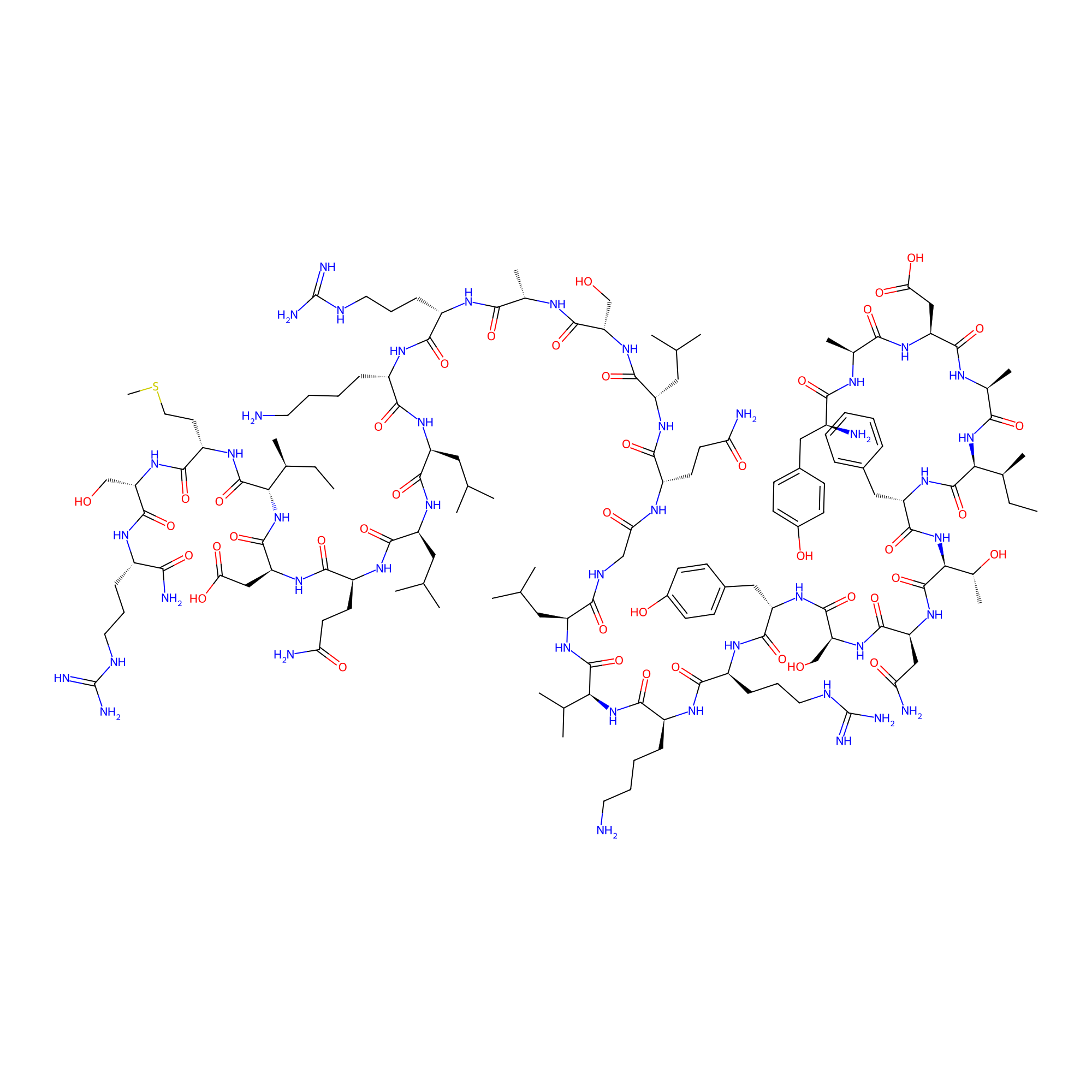
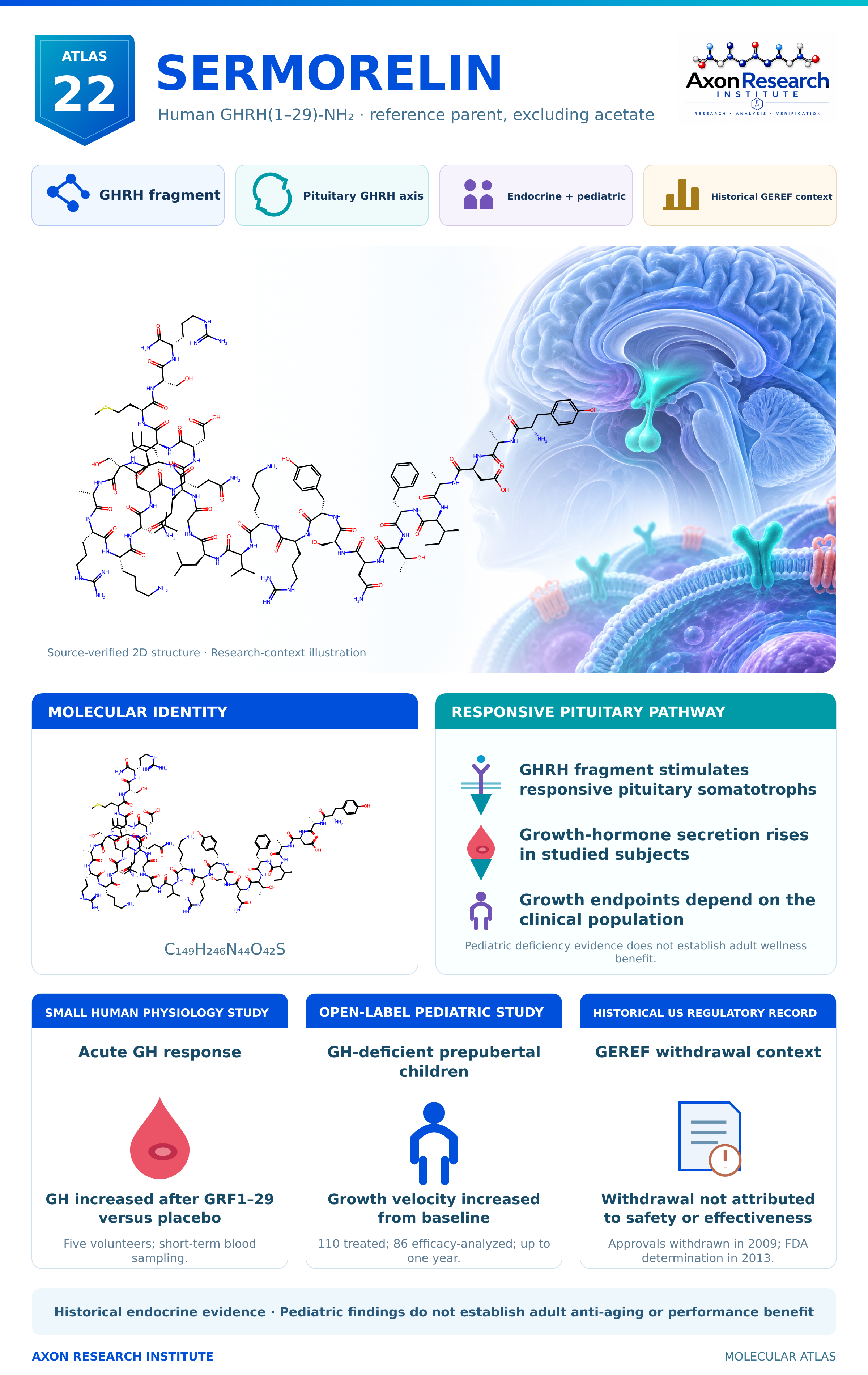
The chemical drawing shows source-verified two-dimensional connectivity and stereochemistry, not an experimental three-dimensional conformation. The biological setting is an illustration. Original study diagrams summarize cited research without reproducing publication artwork or inventing quantitative results.
Sermorelin
Pituitary GHRH receptor / GH axis
Human GHRH(1–29)-NH2 parent; free N-terminus and amidated C-terminus- Molecular formula
- C149H246N44O42S
- Molecular weight
- 3357.9 g/mol
- Class
- GHRH fragment peptide
- Identity
- YADAIFTNSYRKVLGQLSARKLLQDIMSR
Research snapshot
Sermorelin is the amidated first 29 residues of human growth-hormone-releasing hormone. It stimulates pituitary GH release and has historical pediatric and diagnostic research, which does not establish anti-aging or body-composition benefit.
Human endocrine and pediatric studies
Identity & representation
Literature reference identity only. AXON product composition, salt, purity, sterility and equivalence were not verified. Exact depicted parent/reference form; excludes counterions and excipients unless expressly stated.
Educational reference only. Not a dosing guide, treatment recommendation or product endorsement.
Human GHRH(1–29)-NH₂ · reference parent, excluding acetate[1]
View the chemical structure →Sources checked: 2026-11-06. Identity and evidence limits are stated above. Independent specialist review is pending.
What researchers study
Sermorelin is the amidated first 29 residues of human growth-hormone-releasing hormone. It stimulates pituitary GH release and has historical pediatric and diagnostic research, which does not establish anti-aging or body-composition benefit.
Pituitary GH reserve and physiological responses in endocrine testing
Growth velocity in children with documented growth-hormone deficiency
Relationship between GHRH stimulation and downstream endocrine measurements
Mechanism in context
- GHRH fragment stimulates responsive pituitary somatotrophs
- Growth hormone secretion rises in studied subjects
- Growth and endocrine endpoints depend on clinical context
This action requires a responsive pituitary system. Pediatric growth-deficiency outcomes cannot be generalized to healthy adults, anti-aging, weight loss or athletic performance.
Simplified publication-grounded schematic, not a solved protein structure or proof of clinical benefit.
Selected evidence
Human endocrine and pediatric studies
Once daily subcutaneous growth hormone-releasing hormone therapy accelerates growth in growth hormone-deficient children during the first year of therapy. Geref International Study Group.[2]
Multicentre open-label pediatric study · 110 children treated;86 eligible for efficacy analysis · Up to 1 year
Observed: Growth velocity increased from baseline in GH-deficient prepubertal children.
An open-label multicentre study treated 110 GH-deficient prepubertal children, with 86 in the efficacy analysis, for up to one year. Growth velocity increased from baseline. The uncontrolled design and highly specific pediatric population do not establish anti-aging or body-composition benefit in healthy adults.
Limit: No randomized control group; selected pediatric deficiency population.
Reference identity in detail
Sequences and form distinctions describe the cited reference substance, not a verified supplier preparation.
Safety & evidence limits
The cited growth study was open-label and uncontrolled; changes from baseline are less conclusive than randomized comparisons.
Treatment of pediatric GH deficiency does not validate use for general wellness, adult weight loss or performance enhancement.
GEREF’s historical approval and withdrawal history do not establish approval or equivalence of present compounded or research products.
Practical identity notes
- 29 residues with C-terminal amidation; do not depict a free-carboxyl GHRH fragment.
- The parent formula excludes acetate counterions, which are present in sermorelin acetate materials.
- FDA determined in 2013 that GEREF was not withdrawn for safety or effectiveness reasons; approvals had been withdrawn in 2009.
The 10-second takeaway
A GHRH fragment with historical endocrine uses; pediatric evidence should not be repurposed into adult anti-aging claims.
What the visual panels show
Original diagrams summarize the cited research or documented evidence search. They are not copied publication figures or claims of treatment benefit.
RESPONSIVE PITUITARY PATHWAY[3][2]
Publication-grounded mechanism schematic · Original publication-grounded diagram
GHRH fragment stimulates responsive pituitary somatotrophs · Growth-hormone secretion rises in studied subjects · Growth endpoints depend on the clinical population
Interpretation: Pediatric deficiency evidence does not establish adult wellness benefit.
Acute GH response[3]
SMALL HUMAN PHYSIOLOGY STUDY · Original publication-grounded diagram
GH increased after GRF1–29 versus placebo
Five volunteers; short-term blood sampling.
Interpretation: The experiment compared several GRF lengths. Hormone release is not proof of adult therapeutic benefit.
GH-deficient prepubertal children[2]
OPEN-LABEL PEDIATRIC STUDY · Original publication-grounded diagram
Growth velocity increased from baseline
110 treated; 86 efficacy-analyzed; up to one year.
Interpretation: Uncontrolled study in a specific deficient pediatric population; no adult anti-aging or body-composition claim.
GEREF withdrawal context[4]
HISTORICAL US REGULATORY RECORD · Original publication-grounded diagram
Withdrawal not attributed to safety or effectiveness
Approvals withdrawn in 2009; FDA determination in 2013.
Interpretation: Historical GEREF status does not establish current approval or equivalence of compounded or research products.
Follow the evidence
Sources & what they support
- PubChem compound record 16132413
Supports: identity; structure; formula; molecular_weight; stereochemistry
Original structure record · Download depicted structure SDF
Generated 2D layout from the verified reference graph; not an original 2D source-record download.
- Once daily subcutaneous growth hormone-releasing hormone therapy accelerates growth in growth hormone-deficient children during the first year of therapy. Geref International Study Group.
Supports: human growth study; limitations
- Stimulation of growth hormone secretion with human growth hormone releasing factors (GRF1-44, GRF1-40, GRF1-29) in normal subjects.
Supports: GH-release mechanism; small human physiology study
- FDA determination regarding GEREF withdrawal
Supports: historical regulatory status
← Explore the Molecular Atlas Continue to the research library →