Visual summary only. The research findings, limitations and references accompany the card on this page.
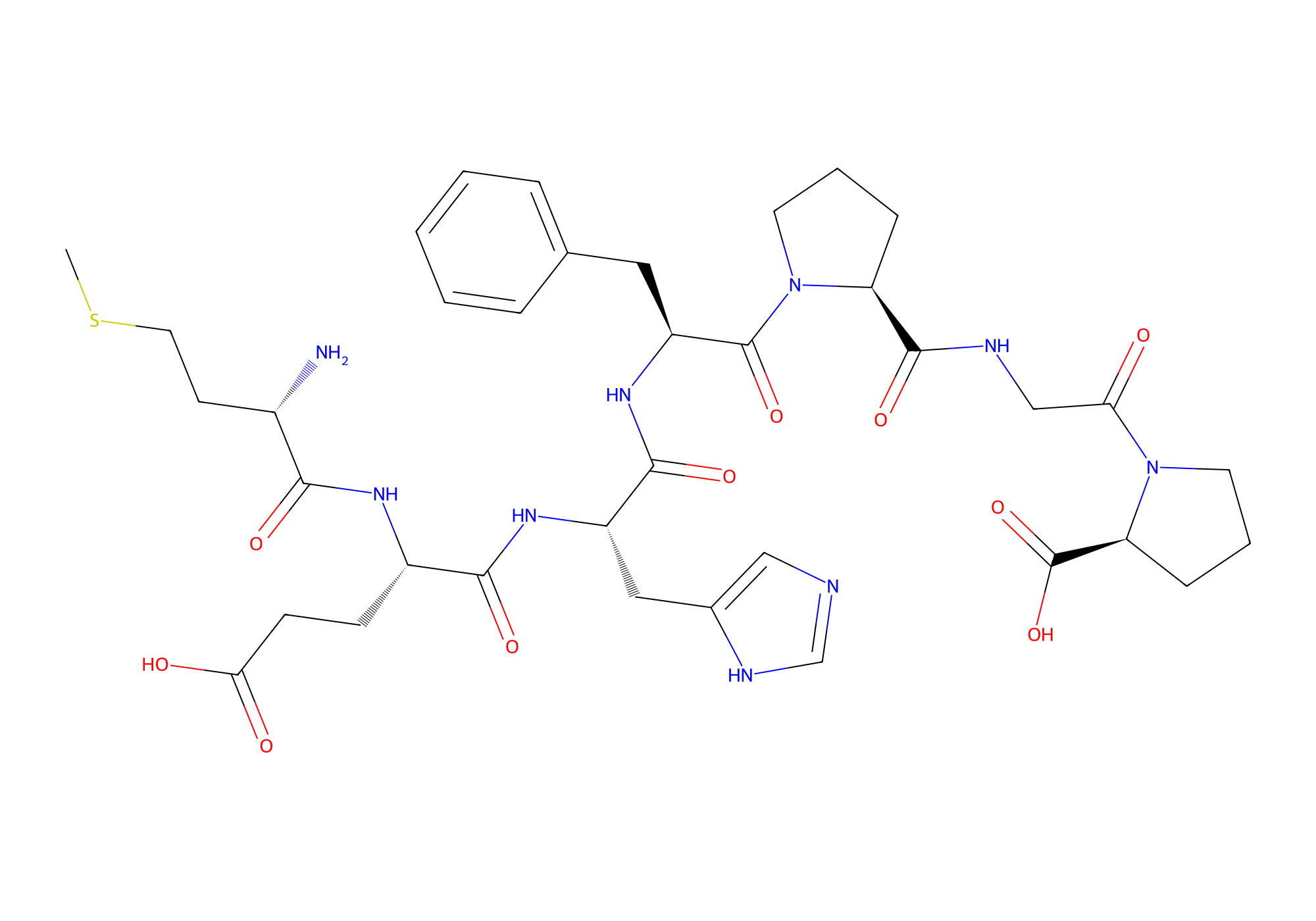
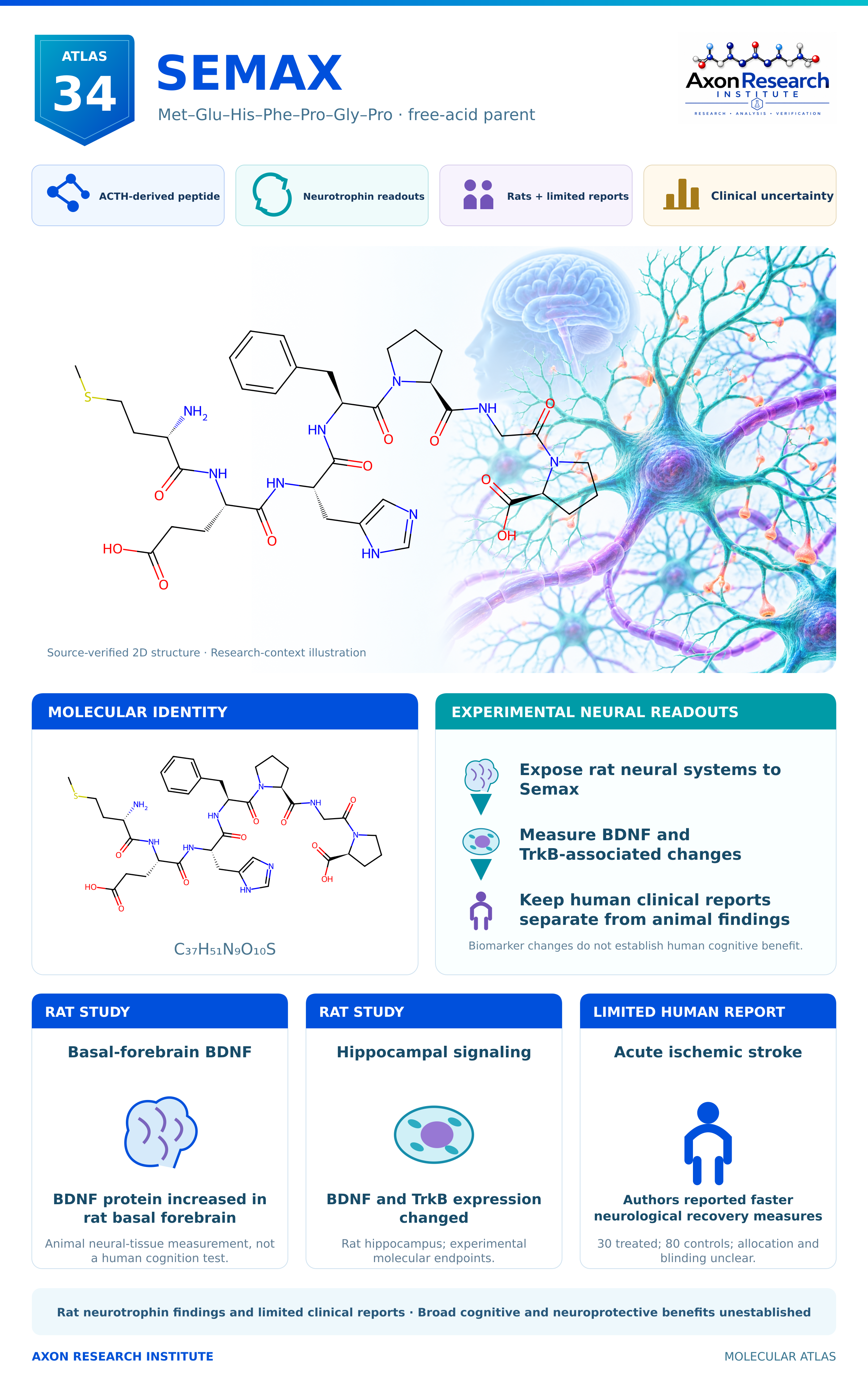
The chemical drawing shows source-verified two-dimensional connectivity and stereochemistry, not an experimental three-dimensional conformation. The biological setting is an illustration. Original study diagrams summarize cited research without reproducing publication artwork or inventing quantitative results.
Semax
Neurotrophin-associated responses
H-L-Met-L-Glu-L-His-L-Phe-L-Pro-Gly-L-Pro-OH- Molecular formula
- C37H51N9O10S
- Molecular weight
- 813.9 g/mol
- Class
- ACTH-derived heptapeptide
- Identity
- MEHFPGP
Research snapshot
Semax joins ACTH residues 4–7 to Pro-Gly-Pro. Research examines neurotrophin signaling and experimental cerebral ischemia; limited clinical reports should be separated from stronger claims about cognition or neuroprotection.
Animal studies; limited stroke reports
Identity & representation
Literature reference identity only. AXON product composition, salt, purity, sterility and equivalence were not verified. Exact depicted parent/reference form; excludes counterions and excipients unless expressly stated.
Educational reference only. Not a dosing guide, treatment recommendation or product endorsement.
Met–Glu–His–Phe–Pro–Gly–Pro · free-acid parent[1]
View the chemical structure →Sources checked: 2026-11-06. Identity and evidence limits are stated above. Independent specialist review is pending.
What researchers study
Semax joins ACTH residues 4–7 to Pro-Gly-Pro. Research examines neurotrophin signaling and experimental cerebral ischemia; limited clinical reports should be separated from stronger claims about cognition or neuroprotection.
BDNF and TrkB regulation in rat neural tissue and cultures
Experimental cerebral ischemia and associated molecular or functional responses
Clinical and electrophysiological observations in acute ischemic-stroke reports
Mechanism in context
- Peptide exposure alters neural-cell signaling in experimental models
- BDNF and TrkB measures change in rat brain
- Behavioral or ischemia-associated endpoints are assessed
The BDNF/TrkB findings come from rats and do not define a fully established human mechanism. Biomarker changes are not proof of cognitive or stroke-recovery benefit.
Simplified publication-grounded schematic, not a solved protein structure or proof of clinical benefit.
Selected evidence
Animal studies; limited stroke reports
[Effectiveness of semax in acute period of hemispheric ischemic stroke (a clinical and electrophysiological study)].[4]
Controlled clinical/electrophysiological report; randomization not established by abstract · 30 Semax-treated and 80 conventional-therapy controls · 5- or 10-day courses reported
Observed: Authors reported faster neurological recovery measures with adjunctive Semax.
An older clinical report compared 30 Semax-treated stroke patients with 80 conventionally treated controls over short treatment courses. The authors reported improved neurological recovery measures. The abstract does not establish adequate randomization or blinding, so the result cannot support strong efficacy conclusions.
Limit: Non-equivalent group sizes; unclear randomization/blinding; accessible abstract lacks robust numerical outcome estimates.
Reference identity in detail
Sequences and form distinctions describe the cited reference substance, not a verified supplier preparation.
Safety & evidence limits
Clinical reports with incompletely described allocation and blinding are vulnerable to bias and do not establish broad neuroprotective efficacy.
Rat BDNF changes and learning responses cannot be translated directly into human cognitive enhancement or prevention of neurological disease.
FDA flags immunogenicity concerns and insufficient safety information for compounded Semax preparations; long-term safety remains inadequately established.
Practical identity notes
- The exact sequence is MEHFPGP, not native ACTH(4–10).
- The reference is a free acid; N-acetyl Semax and amidated variants are separate chemical forms.
- Methionine-containing parent identity should be distinguished from oxidized material during analytical characterization.
The 10-second takeaway
A defined ACTH-derived research peptide; animal neurotrophin results and limited clinical reports do not establish broad cognitive benefit.
What the visual panels show
Original diagrams summarize the cited research or documented evidence search. They are not copied publication figures or claims of treatment benefit.
EXPERIMENTAL NEURAL READOUTS[2][3][4]
Publication-grounded mechanism schematic · Original publication-grounded diagram
Expose rat neural systems to Semax · Measure BDNF and TrkB-associated changes · Keep human clinical reports separate from animal findings
Interpretation: Biomarker changes do not establish human cognitive benefit.
Basal-forebrain BDNF[2]
RAT STUDY · Original publication-grounded diagram
BDNF protein increased in rat basal forebrain
Animal neural-tissue measurement, not a human cognition test.
Interpretation: No depicted human brain enhancement or quantitative trend invented from the abstract.
Hippocampal signaling[3]
RAT STUDY · Original publication-grounded diagram
BDNF and TrkB expression changed
Rat hippocampus; experimental molecular endpoints.
Interpretation: Keep findings as expression readouts; do not assert a clinically validated direct target.
Acute ischemic stroke[4]
LIMITED HUMAN REPORT · Original publication-grounded diagram
Authors reported faster neurological recovery measures
30 treated; 80 controls; allocation and blinding unclear.
Interpretation: Do not label this a rigorous randomized trial or infer broad stroke efficacy; numerical effects were not robustly available.
Follow the evidence
Sources & what they support
- PubChem compound record 9811102
Supports: identity; structure; formula; molecular_weight; stereochemistry
Original structure record · Download depicted structure SDF
Generated 2D layout from the verified reference graph; not an original 2D source-record download.
- Semax, an analogue of adrenocorticotropin (4-10), binds specifically and increases levels of brain-derived neurotrophic factor protein in rat basal forebrain.
Supports: mechanism; preclinical findings
- Semax, an analog of ACTH(4-10) with cognitive effects, regulates BDNF and trkB expression in the rat hippocampus.
Supports: rat BDNF and TrkB
- [Effectiveness of semax in acute period of hemispheric ischemic stroke (a clinical and electrophysiological study)].
Supports: human report; limitations
- FDA compounding safety concerns
Supports: safety limitation
← Explore the Molecular Atlas Continue to the research library →