
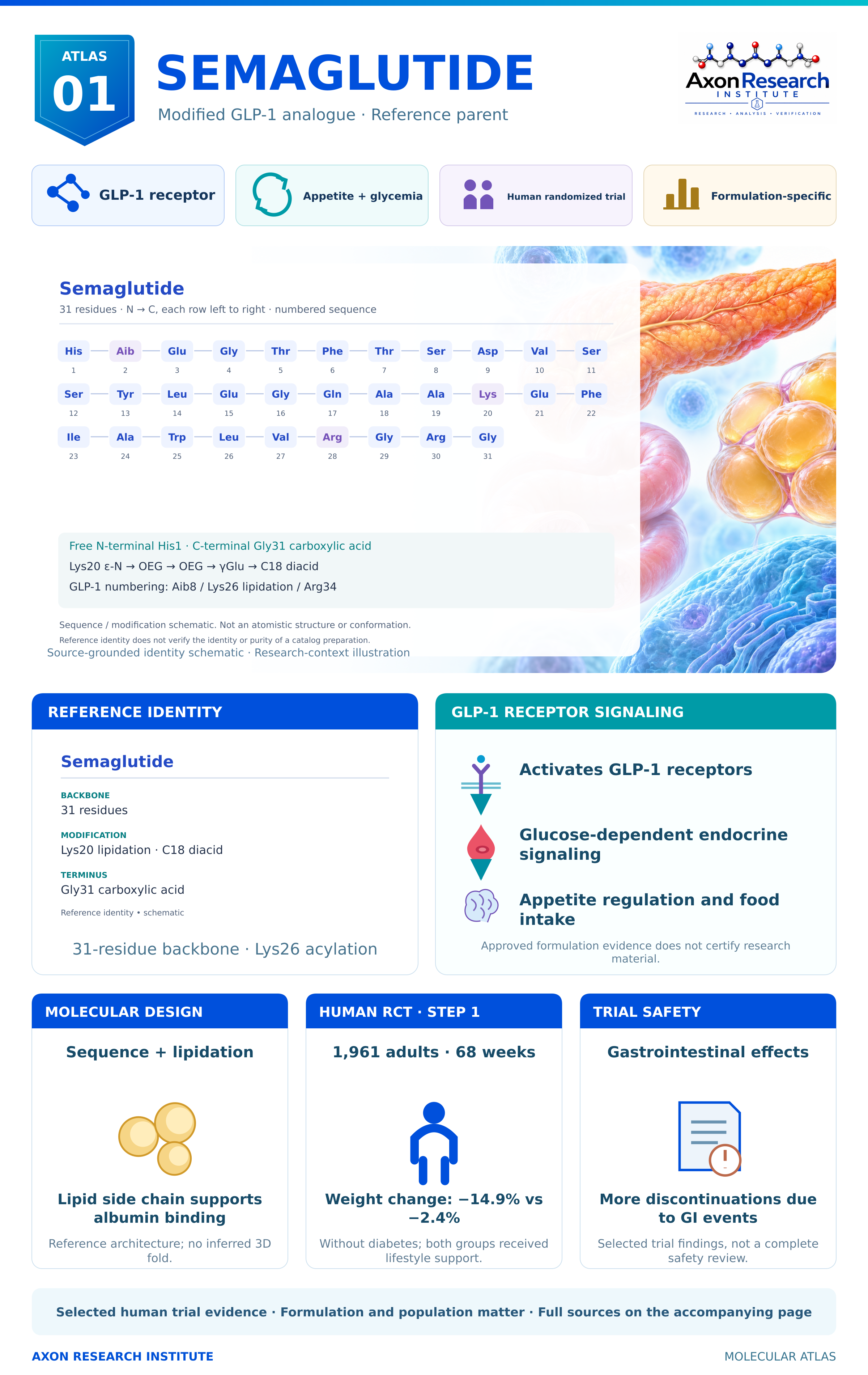
Visual summary only. The research findings, limitations and references accompany the card on this page.
Verified numbered backbone and locus-specific modification map. Sequence transcribed from specified verified source dossier. Linker blocks show identity and ordering, not atomic bonding geometry. Standard chiral amino acids are L; Gly and Aib are achiral. Biological settings and research diagrams are illustrations, not measured anatomy or clinical outcomes.
Semaglutide
GLP-1 receptor
Semaglutide reference parent, not sodium/acetate salt- Backbone
- 31 residues
- Modification
- Lys20 lipidation · C18 diacid
- Terminus
- Gly31 carboxylic acid
Research snapshot
Semaglutide is a modified GLP-1 analogue designed for sustained receptor activation. Its peptide substitutions and lipid side chain alter degradation and albumin binding; clinical findings concern specific pharmaceutical formulations.
Randomized human trials
Identity & representation
Literature reference molecule. Catalog naming is not analytical confirmation of AXON contents, salt, purity or formulation. GLP-1 numbering: Aib8, Arg34; Lys26 side-chain lipidation through two OEG spacers and γGlu to a C18 diacid. Aib is achiral.
Educational reference only. Not a dosing guide, treatment recommendation or product endorsement.
Verified numbered backbone and locus-specific modification map.[4][1]
Sources checked: 2026-11-06. Identity and evidence limits are stated above. Independent specialist review is pending.
What researchers study
Semaglutide is a modified GLP-1 analogue designed for sustained receptor activation. Its peptide substitutions and lipid side chain alter degradation and albumin binding; clinical findings concern specific pharmaceutical formulations.
GLP-1 receptor pharmacology and structure–activity relationships
Albumin binding and resistance to enzymatic degradation
Controlled studies of glycemic and body-weight outcomes
Mechanism in context
- Engages GLP-1 receptors
- Changes glucose-dependent endocrine signaling and appetite regulation
- Clinical trials measure glycemia, body weight and safety
Receptor activity explains biological plausibility, not the quality or suitability of an unverified research preparation.
Simplified publication-grounded schematic, not a solved protein structure or proof of clinical benefit.
Selected evidence
Selected human evidence is summarized above; this is not an exhaustive clinical or regulatory review.
Once-Weekly Semaglutide in Adults with Overweight or Obesity.[2]
Phase 3 randomized double-blind placebo-controlled trial · Adults with overweight or obesity without diabetes · 68 weeks · Reported n: 1961
Observed: Mean weight change was −14.9% with semaglutide and −2.4% with placebo, both alongside lifestyle intervention.
Limit: The study does not establish equivalence of research material; gastrointestinal adverse events caused more discontinuations.
Reference identity in detail
Sequences and form distinctions describe the cited reference substance, not a verified supplier preparation.
Safety & evidence limits
Trial outcomes apply to the studied population, formulation and clinical oversight, not automatically to a catalog vial.
Clinical labeling includes pancreatitis and severe gastrointestinal warnings, plus a rodent thyroid-tumor warning; this card is not a complete safety assessment.
Identity, purity, salt form and formulation cannot be established from a product name or a molecular diagram.
Practical identity notes
- GLP-1 numbering: Aib8, Arg34; Lys26 side-chain lipidation through two OEG spacers and γGlu to a C18 diacid. Aib is achiral.
- Formula and mass apply only to the named reference form, excluding unspecified counterions, solvent and water.
- Educational molecular reference • Selected studies, not a systematic review • No dosing guidance
The 10-second takeaway
A precisely engineered GLP-1 analogue with substantial human trial evidence; that evidence does not validate research-product quality.
What the visual panels show
Original diagrams summarize the cited research or documented evidence search. They are not copied publication figures or claims of treatment benefit.
GLP-1 RECEPTOR SIGNALING[4]
Publication-grounded mechanism schematic · Original publication-grounded diagram
Activates GLP-1 receptors · Glucose-dependent endocrine signaling · Appetite regulation and food intake
Interpretation: Approved formulation evidence does not certify research material.
Sequence + lipidation[1]
MOLECULAR DESIGN · Original publication-grounded diagram
Lipid side chain supports albumin binding
Reference architecture; no inferred 3D fold.
Interpretation: Do not portray the incorrect candidate PubChem graph.
1,961 adults · 68 weeks[2]
HUMAN RCT · STEP 1 · Original publication-grounded diagram
Weight change: −14.9% vs −2.4%
Without diabetes; both groups received lifestyle support.
Interpretation: Percent body-weight changes, not kilograms. Selected studied formulation and population.
Gastrointestinal effects[2][4]
TRIAL SAFETY · Original publication-grounded diagram
More discontinuations due to GI events
Selected trial findings, not a complete safety review.
Interpretation: No implication of suitability, dosing or research product equivalence.
Follow the evidence
Sources & what they support
- Discovery of the Once-Weekly Glucagon-Like Peptide-1 (GLP-1) Analogue Semaglutide.
Supports: Peptide substitutions, Lys26 derivatization and albumin-binding design
- Once-Weekly Semaglutide in Adults with Overweight or Obesity.
Supports: STEP 1 trial design, weight outcome and gastrointestinal events
- PubChem CID 56843331
Supports: Candidate record examined and withheld after an independent stereochemical mismatch; not used for the displayed sequence/modification schematic.
- Ozempic US prescribing information, Description and Clinical Pharmacology
Supports: Reference sequence/structural formula, GLP-1 receptor mechanism, formula and 4113.58 g/mol mass; major clinical safety warnings
← Explore the Molecular Atlas Continue to the research library →
