Visual summary only. The research findings, limitations and references accompany the card on this page.
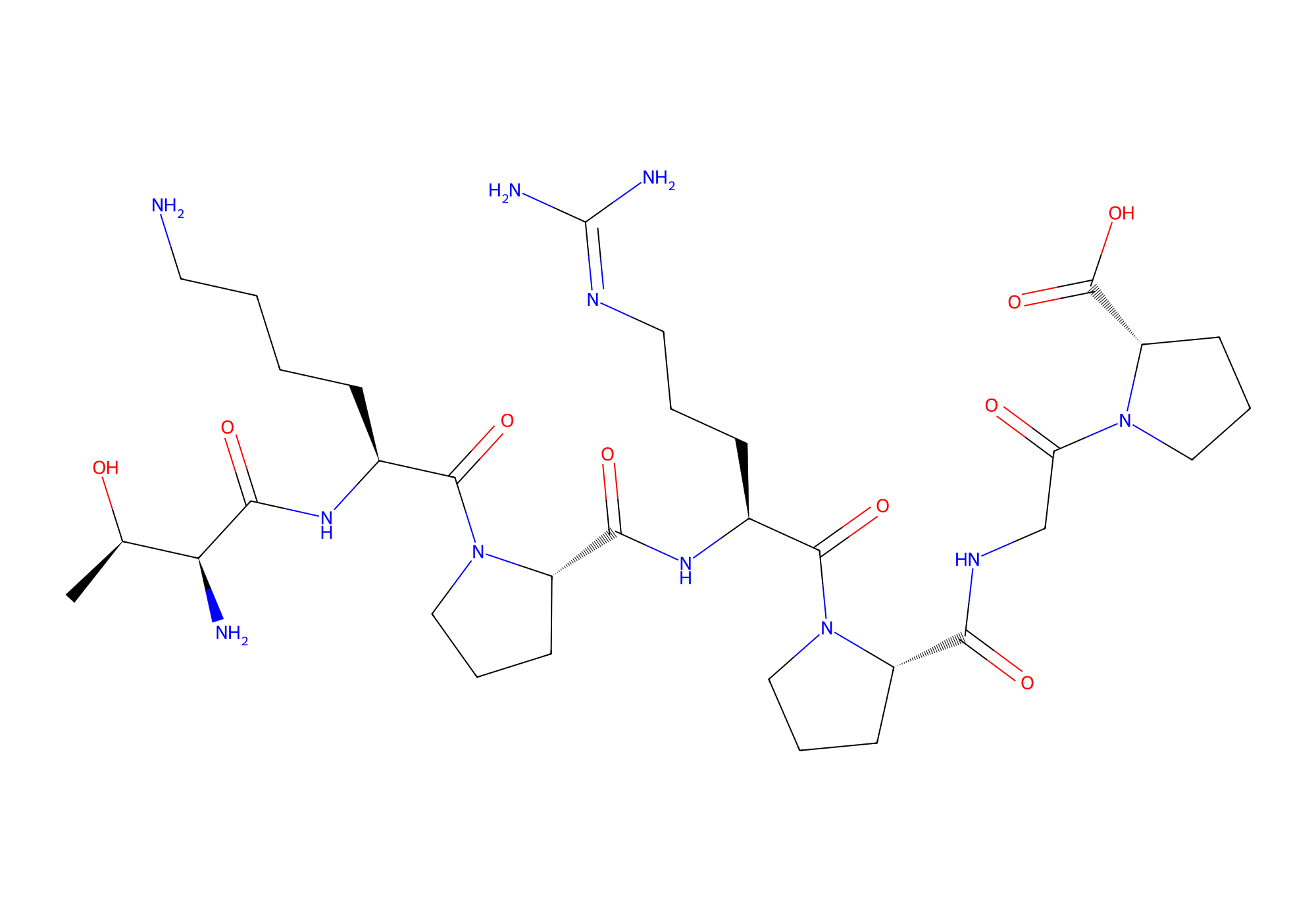
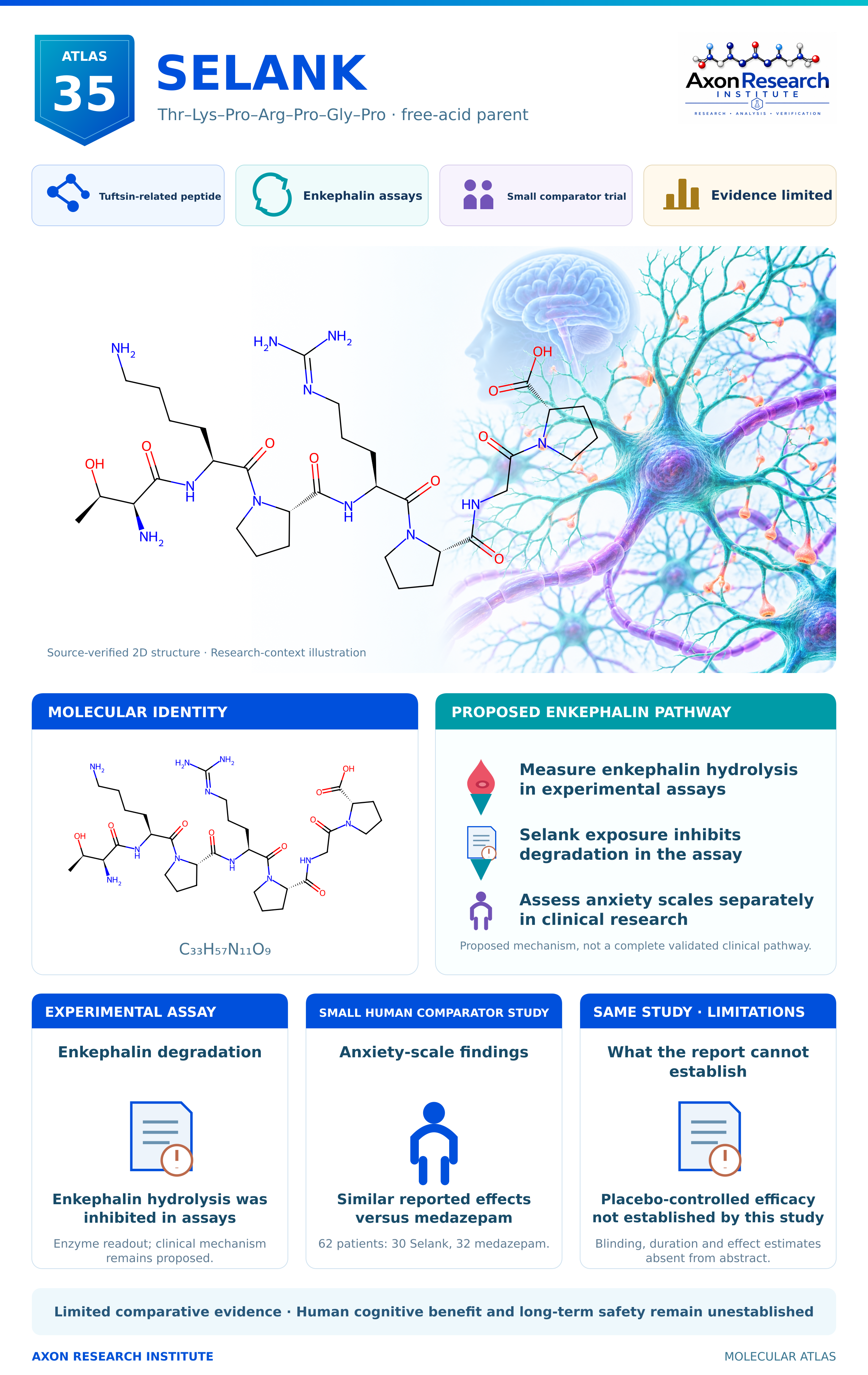
The chemical drawing shows source-verified two-dimensional connectivity and stereochemistry, not an experimental three-dimensional conformation. The biological setting is an illustration. Original study diagrams summarize cited research without reproducing publication artwork or inventing quantitative results.
Selank
Enkephalin metabolism; neural signaling
H-L-Thr-L-Lys-L-Pro-L-Arg-L-Pro-Gly-L-Pro-OH- Molecular formula
- C33H57N11O9
- Molecular weight
- 751.9 g/mol
- Class
- Tuftsin-derived heptapeptide
- Identity
- TKPRPGP
Research snapshot
Selank is a synthetic tuftsin-related heptapeptide. Research explores enkephalin breakdown, neural signaling and anxiety measures; limited comparative human evidence does not establish robust efficacy or long-term safety.
Preclinical studies; small comparative trial
Identity & representation
Literature reference identity only. AXON product composition, salt, purity, sterility and equivalence were not verified. Exact depicted parent/reference form; excludes counterions and excipients unless expressly stated.
Educational reference only. Not a dosing guide, treatment recommendation or product endorsement.
Thr–Lys–Pro–Arg–Pro–Gly–Pro · free-acid parent[1]
View the chemical structure →Sources checked: 2026-11-06. Identity and evidence limits are stated above. Independent specialist review is pending.
What researchers study
Selank is a synthetic tuftsin-related heptapeptide. Research explores enkephalin breakdown, neural signaling and anxiety measures; limited comparative human evidence does not establish robust efficacy or long-term safety.
Enkephalin degradation and peptide-enzyme interactions in experimental assays
Anxiety rating scales in limited comparative human clinical research
Learning retention and serotonin metabolism in rat experimental models
Mechanism in context
- Selank inhibits enkephalin hydrolysis in experimental assays
- Peptide signaling and neural responses may be altered
- Anxiety measures are assessed in small clinical studies
Enkephalin inhibition is a proposed mechanism, not a complete validated pathway. Animal learning findings and comparator-controlled clinical results do not establish broad human cognitive benefit.
Simplified publication-grounded schematic, not a solved protein structure or proof of clinical benefit.
Selected evidence
Preclinical studies; small comparative trial
[Efficacy and possible mechanisms of action of a new peptide anxiolytic selank in the therapy of generalized anxiety disorders and neurasthenia].[3]
Small comparative trial indexed as randomized; active comparator · 62 patients: 30 Selank and 32 medazepam · Not stated in accessible PubMed abstract
Observed: Similar reported anxiolytic effects; serum leu-enkephalin half-life also assessed.
A 62-patient comparative study evaluated Selank against medazepam in generalized anxiety disorder or neurasthenia. It reported similar anxiety-scale effects. The accessible abstract does not supply duration, detailed blinding or effect estimates, and an active-comparator finding is not proof of placebo-controlled efficacy.
Limit: No placebo arm reported; blinding, duration and numerical effect estimates absent from abstract.
Reference identity in detail
Sequences and form distinctions describe the cited reference substance, not a verified supplier preparation.
Safety & evidence limits
The small comparator study does not provide the detailed reporting or replication needed for confident broad clinical conclusions.
Experimental changes in enkephalin breakdown or rat memory do not establish sustained cognitive enhancement in healthy people.
FDA flags immunogenicity concerns and insufficient human safety information for compounded Selank acetate; that salt differs from the depicted parent.
Practical identity notes
- Seven residues; the four-residue tuftsin motif TKPR is extended by PGP.
- The displayed structure has a free C-terminal acid, not a C-terminal amide.
- Acetate and other counterions are excluded from the parent molecular formula.
The 10-second takeaway
A defined neuroactive research peptide with limited human evidence; mechanism proposals and small trials require cautious interpretation.
What the visual panels show
Original diagrams summarize the cited research or documented evidence search. They are not copied publication figures or claims of treatment benefit.
PROPOSED ENKEPHALIN PATHWAY[2][3]
Publication-grounded mechanism schematic · Original publication-grounded diagram
Measure enkephalin hydrolysis in experimental assays · Selank exposure inhibits degradation in the assay · Assess anxiety scales separately in clinical research
Interpretation: Proposed mechanism, not a complete validated clinical pathway.
Enkephalin degradation[2]
EXPERIMENTAL ASSAY · Original publication-grounded diagram
Enkephalin hydrolysis was inhibited in assays
Enzyme readout; clinical mechanism remains proposed.
Interpretation: No invented receptor interaction or assured anxiolytic mechanism in people.
Anxiety-scale findings[3]
SMALL HUMAN COMPARATOR STUDY · Original publication-grounded diagram
Similar reported effects versus medazepam
62 patients: 30 Selank, 32 medazepam.
Interpretation: Active-comparator result does not establish equivalence or placebo-controlled efficacy.
What the report cannot establish[3]
SAME STUDY · LIMITATIONS · Original publication-grounded diagram
Placebo-controlled efficacy not established by this study
Blinding, duration and effect estimates absent from abstract.
Interpretation: Do not invent trial duration, blinding or numerical effect estimates; avoid robust-efficacy language.
Follow the evidence
Sources & what they support
- PubChem compound record 11765600
Supports: identity; structure; formula; molecular_weight; stereochemistry
Original structure record · Download depicted structure SDF
Generated 2D layout from the verified reference graph; not an original 2D source-record download.
- The inhibitory effect of Selank on enkephalin-degrading enzymes as a possible mechanism of its anxiolytic activity.
Supports: mechanism; sequence
- [Efficacy and possible mechanisms of action of a new peptide anxiolytic selank in the therapy of generalized anxiety disorders and neurasthenia].
Supports: human study; limitations
- [Experimental optimization of learning and memory processes by selank].
Supports: rat research
- FDA compounding safety concerns
Supports: safety limitation
← Explore the Molecular Atlas Continue to the research library →