
Visual summary only. The research findings, limitations and references accompany the card on this page.
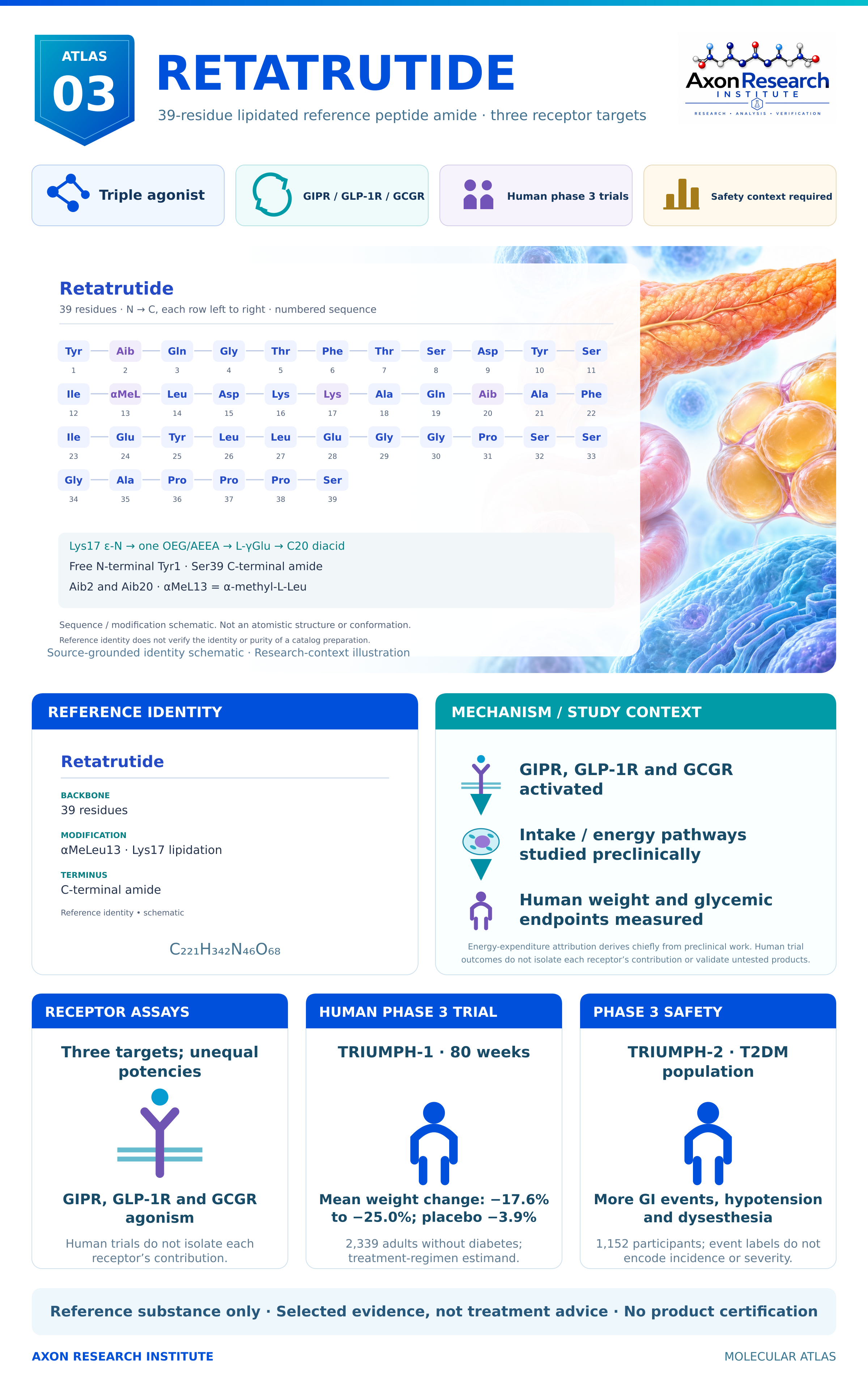
Verified numbered backbone and locus-specific modification map. Sequence transcribed from specified verified source dossier. Linker blocks show identity and ordering, not atomic bonding geometry. Standard chiral amino acids are L; Gly and Aib are achiral. Biological settings and research diagrams are illustrations, not measured anatomy or clinical outcomes.
Retatrutide
GIPR + GLP-1R + GCGR
Retatrutide reference parent, 39-residue lipidated peptide amide- Backbone
- 39 residues
- Modification
- αMeLeu13 · Lys17 lipidation
- Terminus
- C-terminal amide
Research snapshot
Retatrutide is a lipidated triple-receptor agonist. Published 2026 phase 3 trials report substantial metabolic effects in defined populations, while adverse effects and population-specific evidence remain central to interpretation.
Human phase 3 trials published 2026
Identity & representation
Literature reference substance only; no equivalence to a catalog product or tested supplier lot is asserted. Aib2 and Aib20; alpha-methyl-L-Leu13. Lys17 epsilon-N carries one OEG/AEEA spacer, L-gamma-Glu and C20 diacid. C-terminal Ser39 amide. Do not substitute tirzepatide linker/sequence.
Educational reference only. Not a dosing guide, treatment recommendation or product endorsement.
Verified numbered backbone and locus-specific modification map.[6][7]
Sources checked: 2026-11-06. Identity and evidence limits are stated above. Independent specialist review is pending.
What researchers study
Retatrutide is a lipidated triple-receptor agonist. Published 2026 phase 3 trials report substantial metabolic effects in defined populations, while adverse effects and population-specific evidence remain central to interpretation.
Weight outcomes with and without type 2 diabetes
Glycemic control in phase 3 trials
Preclinical multireceptor pharmacology and energy balance
Mechanism / evidence map
- GIPR, GLP-1R and GCGR activated
- Intake and energy pathways investigated
- Weight and glycemic endpoints measured clinically
Energy-expenditure attribution derives chiefly from preclinical work. Human trial outcomes do not isolate each receptor’s contribution or validate untested products.
Simplified publication-grounded schematic, not a solved protein structure or proof of clinical benefit.
Selected evidence
Primary phase 3 publications from 2026 are included. This is a scoped evidence summary, not a claim of regulatory approval or product equivalence.
Retatrutide, a Triple Hormone Receptor Agonist, for Treatment of Obesity.[2]
Phase3 randomized double-blind placebo-controlled trial · Adults with obesity without diabetes(TRIUMPH-1) · 80 weeks · Reported n: 2339
Observed: Mean weight change was −17.6%, −23.7% and −25.0% across retatrutide arms versus −3.9% placebo using the treatment-regimen estimand.
Limit: Population excluded diabetes. OA/OSA subgroup endpoints used additional estimands and must not be conflated with overall weight results.
Retatrutide in adults with obesity and type 2 diabetes (TRIUMPH-2): a double-blind, parallel-group, randomised, placebo-controlled, phase 3 trial.[3]
Phase3 randomized double-blind placebo-controlled trial · Adults with obesity/overweight and type 2 diabetes(TRIUMPH-2) · 80 weeks · Reported n: 1152
Observed: Mean weight changes were −11.9%, −16.8% and −18.8% across retatrutide arms versus −5.1% placebo. GI events, hypotension and dysesthesia were more frequent with retatrutide.
Limit: Obesity/overweight with type 2 diabetes; treatment discontinuation varied across arms. Cannot be directly ranked against other trials.
Efficacy and safety of retatrutide, a GIP, GLP-1, and glucagon receptor agonist, in people with type 2 diabetes and inadequate glycaemic control with diet and exercise (TRANSCEND-T2D-1): a double-blind, randomised, phase 3 trial.[4]
Phase3 randomized double-blind placebo-controlled trial · Adults with type 2 diabetes inadequately controlled by diet/exercise(TRANSCEND-T2D-1) · 40 weeks · Reported n: 537
Observed: HbA1c fell 1.69–1.94 percentage points across retatrutide arms versus 0.81 with placebo; body weight also declined.
Limit: Diet/exercise-treated type 2 diabetes population; no severe hypoglycemia reported, but this does not establish safety across all populations.
Reference identity in detail
Sequences and form distinctions describe the cited reference substance, not a verified supplier preparation.
Safety & evidence limits
GI adverse events are common. TRIUMPH-2 also reported more hypotension and dysesthesia with retatrutide than placebo.
Phase2 documented exposure-related heart-rate increases; long-term benefit–risk cannot be reduced to the largest weight-loss percentage.
Do not compare headline percentages across populations, estimands, durations or compounds as if from one head-to-head trial.
Practical identity notes
- 39 residues; Aib2/Aib20 and alpha-methyl-L-Leu13.
- Lys17 branch has one OEG/AEEA unit, gamma-Glu and C20 diacid.
- Reference formula C221H342N46O68; KEGG molecular mass 4731.34 g/mol.
- Clinical research; exact reference only • Reference form only
The 10-second takeaway
A triple-receptor molecule with 2026 phase 3 results; exact chemistry, trial population, estimand and adverse effects matter as much as headline weight loss.
What the visual panels show
Original diagrams summarize the cited research or documented evidence search. They are not copied publication figures or claims of treatment benefit.
MECHANISM / STUDY CONTEXT[1][2]
Publication-grounded mechanism schematic · Original publication-grounded diagram
GIPR, GLP-1R and GCGR activated · Intake / energy pathways studied preclinically · Human weight and glycemic endpoints measured
Interpretation: Energy-expenditure attribution derives chiefly from preclinical work. Human trial outcomes do not isolate each receptor’s contribution or validate untested products.
Three targets; unequal potencies[1]
RECEPTOR ASSAYS · Original publication-grounded diagram
GIPR, GLP-1R and GCGR agonism
Human trials do not isolate each receptor’s contribution.
Interpretation: Human trials do not isolate each receptor’s contribution. Original conceptual illustration only; no fabricated data, docking geometry or clinical extrapolation.
TRIUMPH-1 · 80 weeks[2]
HUMAN PHASE 3 TRIAL · Original publication-grounded diagram
Mean weight change: −17.6% to −25.0%; placebo −3.9%
2,339 adults without diabetes; treatment-regimen estimand.
Interpretation: 2,339 adults without diabetes; treatment-regimen estimand. Original conceptual illustration only; no fabricated data, docking geometry or clinical extrapolation.
TRIUMPH-2 · T2DM population[3]
PHASE 3 SAFETY · Original publication-grounded diagram
More GI events, hypotension and dysesthesia
1,152 participants; event labels do not encode incidence or severity.
Interpretation: 1,152 participants; event labels do not encode incidence or severity. Original conceptual illustration only; no fabricated data, docking geometry or clinical extrapolation.
Follow the evidence
Sources & what they support
- LY3437943, a novel triple glucagon, GIP, and GLP-1 receptor agonist for glycemic control and weight loss: From discovery to clinical proof of concept.
Supports: Receptor assays and preclinical intake/energy-expenditure mechanism
- Retatrutide, a Triple Hormone Receptor Agonist, for Treatment of Obesity.
Supports: TRIUMPH-1 phase 3 results, 2026
- Retatrutide in adults with obesity and type 2 diabetes (TRIUMPH-2): a double-blind, parallel-group, randomised, placebo-controlled, phase 3 trial.
Supports: TRIUMPH-2 phase 3 efficacy and safety, 2026
- Efficacy and safety of retatrutide, a GIP, GLP-1, and glucagon receptor agonist, in people with type 2 diabetes and inadequate glycaemic control with diet and exercise (TRANSCEND-T2D-1): a double-blind, randomised, phase 3 trial.
Supports: TRANSCEND-T2D-1 phase 3 results, 2026
- Triple-Hormone-Receptor Agonist Retatrutide for Obesity - A Phase 2 Trial.
Supports: Phase2 context and heart-rate findings
- FDA substance identity: retatrutide UNII NOP2Y096GV
Supports: Exact modified sequence and single OEG/AEEA linker; UNII is not approval
- KEGG Drug D12430
Supports: Reference formula and molecular mass
← Explore the Molecular Atlas Continue to the research library →
