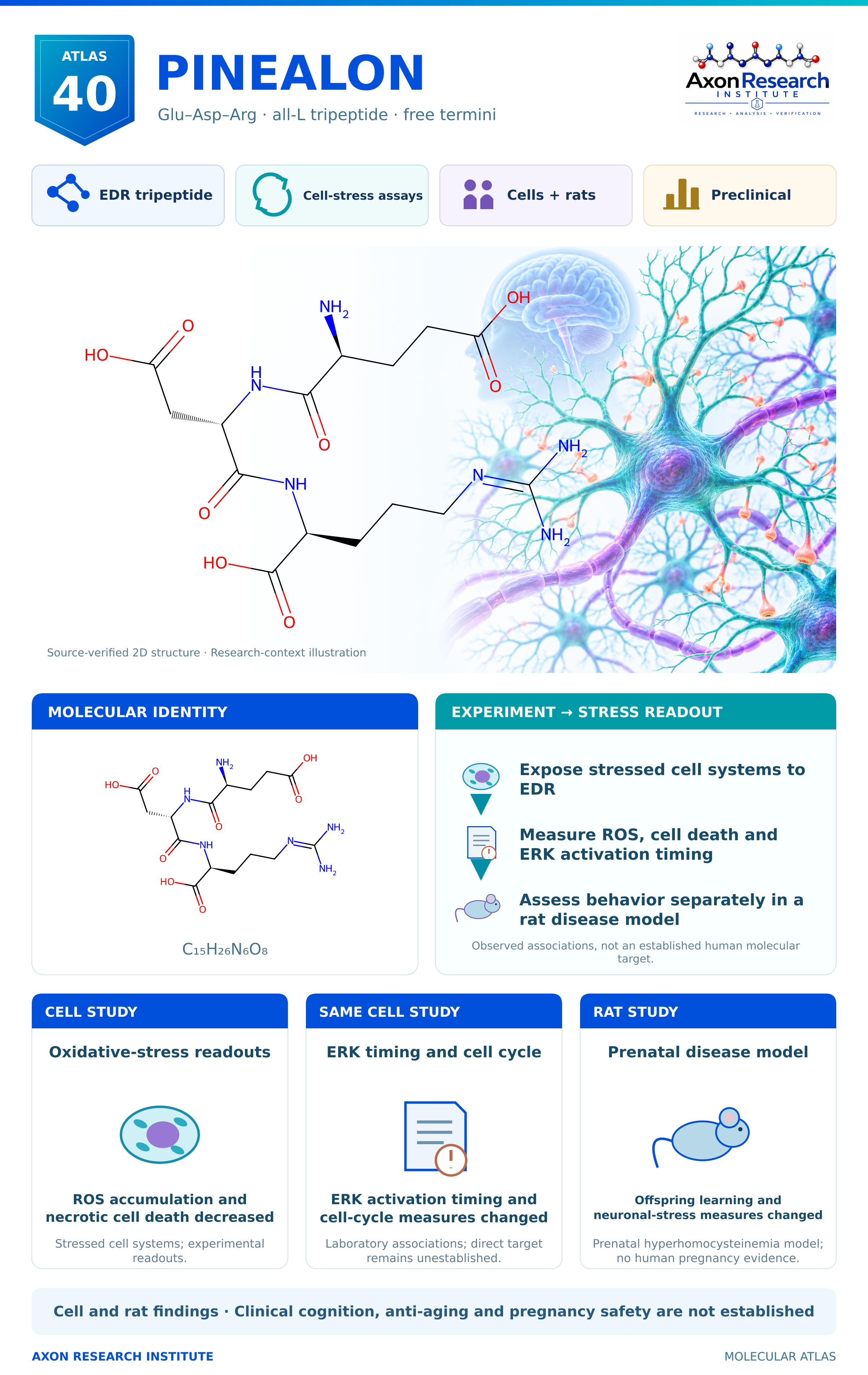
Visual summary only. The research findings, limitations and references accompany the card on this page.
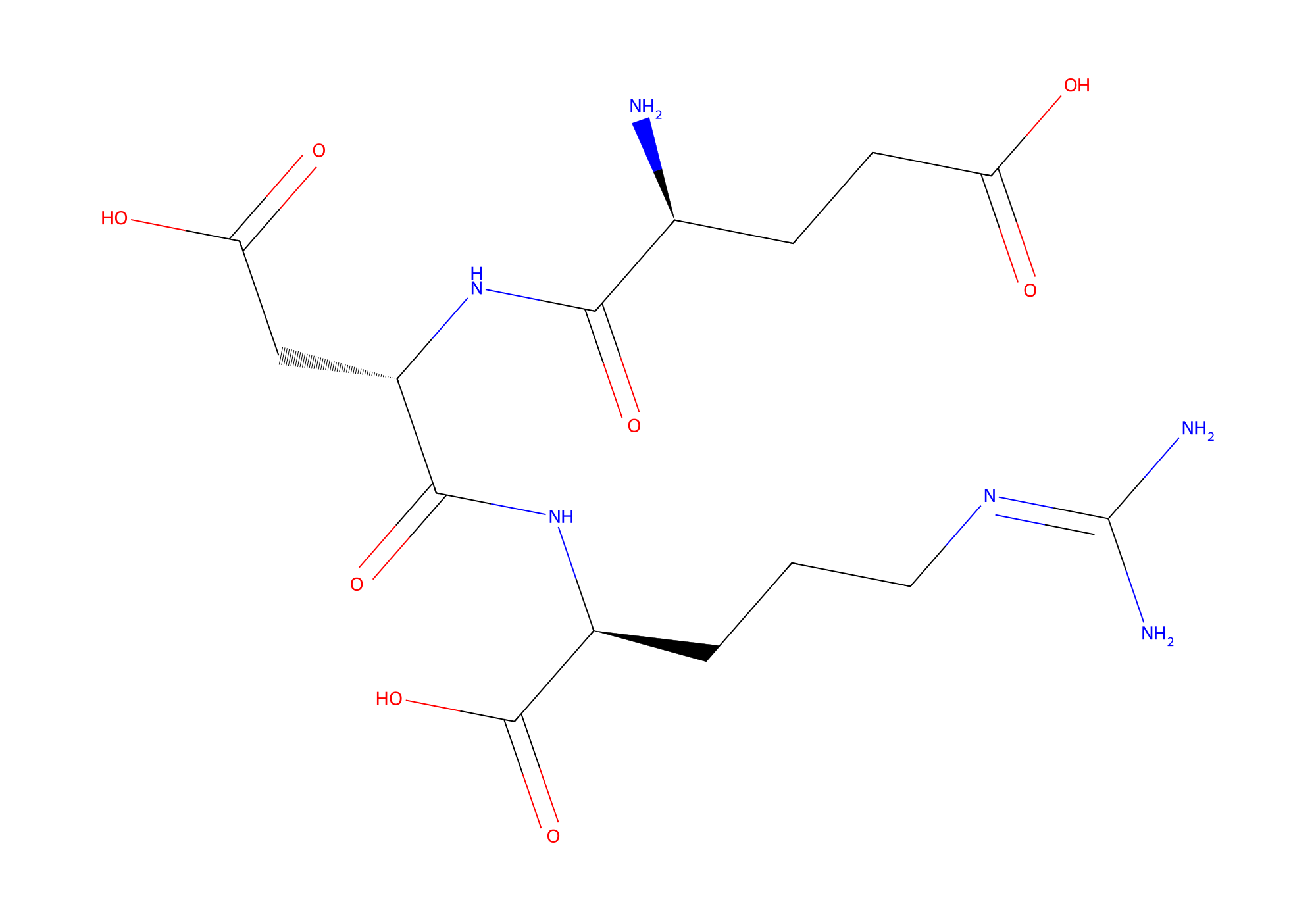
The chemical drawing shows source-verified two-dimensional connectivity and stereochemistry, not an experimental three-dimensional conformation. The biological setting is an illustration. Original study diagrams summarize cited research without reproducing publication artwork or inventing quantitative results.
Pinealon
Oxidative-stress and ERK-associated responses
H-L-Glu-L-Asp-L-Arg-OH (EDR)- Molecular formula
- C15H26N6O8
- Molecular weight
- 418.40 g/mol
- Class
- Synthetic tripeptide
- Identity
- EDR
Research snapshot
Pinealon is the synthetic tripeptide Glu-Asp-Arg. Experimental studies examine cell survival, reactive oxygen species and stress responses in neural and other cell systems, with additional work in rat disease models.
Cell and rat studies
Identity & representation
Literature reference identity only. AXON product composition, salt, purity, sterility and equivalence were not verified. Exact depicted parent/reference form; excludes counterions and excipients unless expressly stated.
Educational reference only. Not a dosing guide, treatment recommendation or product endorsement.
Glu–Asp–Arg · all-L tripeptide · free termini[1]
View the chemical structure →Sources checked: 2026-11-06. Identity and evidence limits are stated above. Independent specialist review is pending.
What researchers study
Pinealon is the synthetic tripeptide Glu-Asp-Arg. Experimental studies examine cell survival, reactive oxygen species and stress responses in neural and other cell systems, with additional work in rat disease models.
Reactive oxygen species and survival in experimentally stressed cell cultures
ERK activation timing and cell-cycle responses in preclinical systems
Learning and neuronal-stress measures in a rat prenatal hyperhomocysteinemia model
Mechanism in context
- Stressed cells are exposed to the EDR tripeptide
- ROS accumulation and ERK activation kinetics change
- Cell-survival or rat behavioral outcomes are measured
This describes observed experimental associations, not an established human target. Claims of direct genome regulation remain mechanistic hypotheses rather than validated clinical effects.
Simplified publication-grounded schematic, not a solved protein structure or proof of clinical benefit.
Selected evidence
Human therapeutic evidence not established in the selected sources
Pinealon increases cell viability by suppression of free radical levels and activating proliferative processes.[2]
Cell-culture oxidative-stress experiments
Observed: EDR reduced ROS accumulation and cell-death readouts in several stressed cell systems, alongside altered ERK activation timing. The observations do not establish a direct genetic target or a clinically effective antioxidant intervention.
Pinealon protects the rat offspring from prenatal hyperhomocysteinemia.[3]
Rat prenatal hyperhomocysteinemia model
Observed: Offspring of experimentally affected rats showed altered learning and neuronal-stress measures after maternal exposure in this model. The findings do not establish human cognitive benefit or safety during pregnancy.
Reference identity in detail
Sequences and form distinctions describe the cited reference substance, not a verified supplier preparation.
Safety & evidence limits
The cited evidence is cellular and animal research, not controlled demonstration of cognitive benefit or anti-aging effects in people.
The rat prenatal-disease experiment cannot establish safety or benefit during human pregnancy, childhood, or other clinical settings.
A change in ROS or gene-associated readouts does not by itself identify a direct molecular target or establish clinical relevance.
Practical identity notes
- Three L-residues joined through conventional α-peptide bonds: Glu-Asp-Arg.
- The reference is a free acid, not an amidated EDR analogue or proprietary mixture.
- Glu-Asp-Arg identity does not verify a product’s purity or formulation.
The 10-second takeaway
A defined tripeptide with preclinical stress-response findings; clinical cognitive and anti-aging claims remain unestablished.
What the visual panels show
Original diagrams summarize the cited research or documented evidence search. They are not copied publication figures or claims of treatment benefit.
EXPERIMENT → STRESS READOUT[2][3]
Publication-grounded mechanism schematic · Original publication-grounded diagram
Expose stressed cell systems to EDR · Measure ROS, cell death and ERK activation timing · Assess behavior separately in a rat disease model
Interpretation: Observed associations, not an established human molecular target.
Oxidative-stress readouts[2]
CELL STUDY · Original publication-grounded diagram
ROS accumulation and necrotic cell death decreased
Stressed cell systems; experimental readouts.
Interpretation: No direct genome binding or clinical antioxidant effect is established by these readouts.
ERK timing and cell cycle[2]
SAME CELL STUDY · Original publication-grounded diagram
ERK activation timing and cell-cycle measures changed
Laboratory associations; direct target remains unestablished.
Interpretation: Use a generic assay symbol. Do not fabricate signaling kinetics, DNA binding or a receptor.
Prenatal disease model[3]
RAT STUDY · Original publication-grounded diagram
Offspring learning and neuronal-stress measures changed
Prenatal hyperhomocysteinemia model; no human pregnancy evidence.
Interpretation: Generic rodent icon denotes rats. No human pregnancy, child-development, cognition or safety claim.
Follow the evidence
Sources & what they support
- PubChem compound record 10273502
Supports: identity; structure; formula; molecular_weight; stereochemistry
Original structure record · Download depicted structure SDF
Generated 2D layout from the verified reference graph; not an original 2D source-record download.
- Pinealon increases cell viability by suppression of free radical levels and activating proliferative processes.
Supports: sequence; cell findings; mechanism qualification
- Pinealon protects the rat offspring from prenatal hyperhomocysteinemia.
Supports: rat study; limitations
← Explore the Molecular Atlas Continue to the research library →