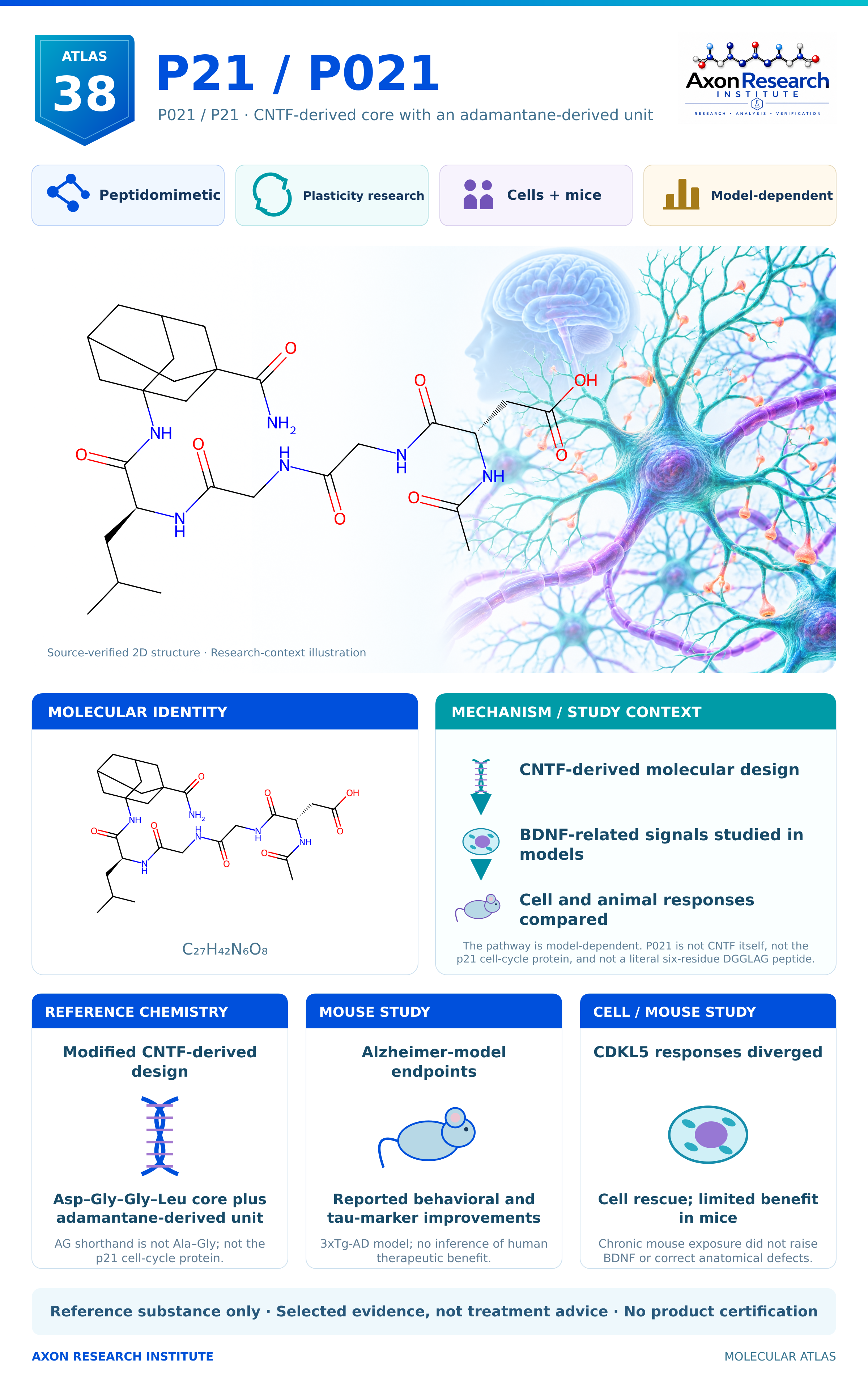
Visual summary only. The research findings, limitations and references accompany the card on this page.
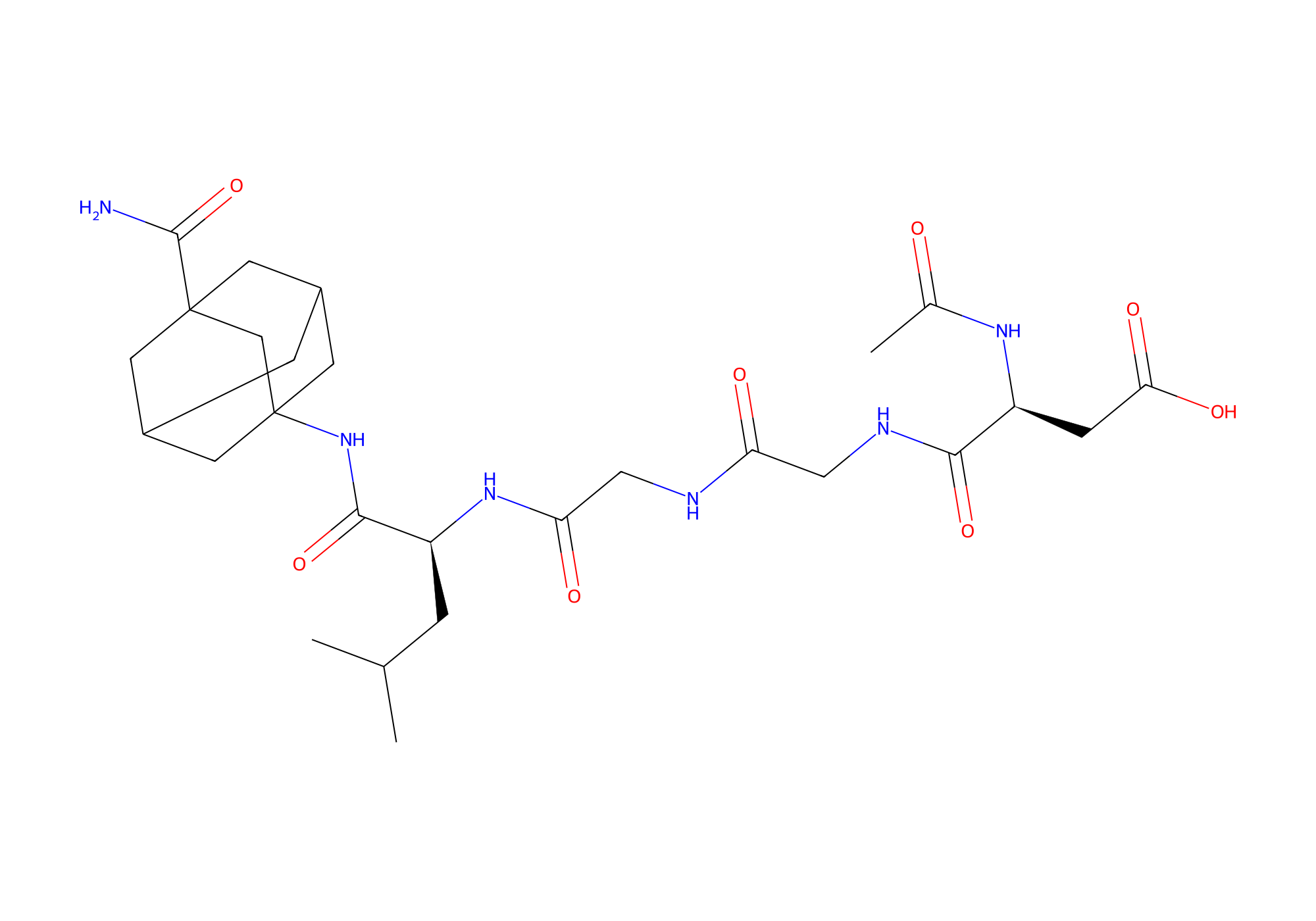
The chemical drawing shows source-verified two-dimensional connectivity and stereochemistry, not an experimental three-dimensional conformation. The biological setting is an illustration. Original study diagrams summarize cited research without reproducing publication artwork or inventing quantitative results.
P21 / P021
BDNF / plasticity research
N-acetylated CNTF-core peptidomimetic with C-terminal adamantane amino-carboxamide unit- Molecular formula
- C27H42N6O8
- Molecular weight
- 578.7 g/mol
- Class
- Modified peptide mimetic
- Identity
- Ac-Asp-Gly-Gly-Leu-(adamantane-derived amino-carboxamide); literature shorthand Ac-DGGL(A)G-NH2
Research snapshot
P021 is an adamantane-modified mimetic derived from a short CNTF region. Some animal models showed plasticity and learning effects, but a newer CDKL5 model found limited benefit and failed to increase brain BDNF.
Cells and animal models
Identity & representation
Reference parent, not an AXON formulation or salt.
Educational reference only. Not a dosing guide, treatment recommendation or product endorsement.
P021 / P21 · CNTF-derived core with an adamantane-derived unit[1]
View the chemical structure →Sources checked: 2026-11-06. Identity and evidence limits are stated above. Independent specialist review is pending.
What researchers study
P021 is an adamantane-modified mimetic derived from a short CNTF region. Some animal models showed plasticity and learning effects, but a newer CDKL5 model found limited benefit and failed to increase brain BDNF.
Neurogenesis in rodent models
Synaptic-plasticity measurements
Disease-model-dependent behavioral outcomes
Mechanism in context
- CNTF-derived core carries an adamantane-derived unit
- Selected models show altered BDNF-related signaling
- Neurogenesis and behavior are measured
The pathway is model-dependent. P021 is not CNTF itself, not the p21 cell-cycle protein, and not a literal six-residue DGGLAG peptide.
Simplified publication-grounded schematic, not a solved protein structure or proof of clinical benefit.
Selected evidence
Cells and animal models
Disease modifying effect of chronic oral treatment with a neurotrophic peptidergic compound in a triple transgenic mouse model of Alzheimer's disease.[3]
Transgenic mouse experiment · Female 3xTg-AD and wild-type mice · 12 months
Observed: Reported reduced abnormal tau phosphorylation, some soluble amyloid reduction, and improved behavioral/plasticity measures.
Reported reduced abnormal tau phosphorylation, some soluble amyloid reduction, and improved behavioral/plasticity measures. Animal disease model; no human therapeutic inference.
Limit: Animal disease model; no human therapeutic inference.
Effects of a ciliary neurotrophic factor (CNTF) small-molecule peptide mimetic in an in vitro and in vivo model of CDKL5 deficiency disorder.[4]
Cell culture and Cdkl5-knockout mouse study · SH-CDKL5-KO cells; young/adult Cdkl5-knockout mice · Multiple experimental windows
Observed: Cellular rescue was reported, but chronic mouse treatment did not increase BDNF or correct neuroanatomical defects; behavioral benefit was limited.
Cellular rescue was reported, but chronic mouse treatment did not increase BDNF or correct neuroanatomical defects; behavioral benefit was limited. In-vitro effects did not reliably translate to the in-vivo model.
Limit: In-vitro effects did not reliably translate to the in-vivo model.
Reference identity in detail
Sequences and form distinctions describe the cited reference substance, not a verified supplier preparation.
Research scope
Targeted source verification, not a systematic review. Citation quality and molecule-specific applicability are stated separately.
Safety & evidence limits
Human efficacy, pharmacokinetics and long-term safety are not established in the reviewed sources.
A 2024 CDKL5 mouse study did not reproduce the expected BDNF or anatomical improvements.
Do not infer prenatal safety or human cognitive benefit from developmental mouse experiments.
Practical identity notes
- N-acetylated CNTF-core peptidomimetic with C-terminal adamantane amino-carboxamide unit
- No original PubChem 3D conformer was available for this exact reference in the checked endpoint; use exact 2D structure.
- Reference identity is not confirmation of product contents, purity, sterility or therapeutic equivalence.
- PubChem average mass 578.7 differs from approximately578.3 reported in literature, consistent with differing mass conventions; do not mix values.
The 10-second takeaway
An experimental CNTF-derived mimetic with model-dependent preclinical findings, not established human cognitive therapy.
What the visual panels show
Original diagrams summarize the cited research or documented evidence search. They are not copied publication figures or claims of treatment benefit.
MECHANISM / STUDY CONTEXT[2][3][4]
Publication-grounded mechanism schematic · Original publication-grounded diagram
CNTF-derived molecular design · BDNF-related signals studied in models · Cell and animal responses compared
Interpretation: The pathway is model-dependent. P021 is not CNTF itself, not the p21 cell-cycle protein, and not a literal six-residue DGGLAG peptide.
Modified CNTF-derived design[1][2]
REFERENCE CHEMISTRY · Original publication-grounded diagram
Asp–Gly–Gly–Leu core plus adamantane-derived unit
AG shorthand is not Ala–Gly; not the p21 cell-cycle protein.
Interpretation: AG shorthand is not Ala–Gly; not the p21 cell-cycle protein. Original conceptual illustration only; no fabricated data, docking geometry or clinical extrapolation.
Alzheimer-model endpoints[3]
MOUSE STUDY · Original publication-grounded diagram
Reported behavioral and tau-marker improvements
3xTg-AD model; no inference of human therapeutic benefit.
Interpretation: 3xTg-AD model; no inference of human therapeutic benefit. Original conceptual illustration only; no fabricated data, docking geometry or clinical extrapolation.
CDKL5 responses diverged[4]
CELL / MOUSE STUDY · Original publication-grounded diagram
Cell rescue; limited benefit in mice
Chronic mouse exposure did not raise BDNF or correct anatomical defects.
Interpretation: Chronic mouse exposure did not raise BDNF or correct anatomical defects. Original conceptual illustration only; no fabricated data, docking geometry or clinical extrapolation.
Follow the evidence
Sources & what they support
- PubChem CID 56599151: source reference graph
Supports: Exact reference graph, stereochemistry, formula and mass
Original structure record · Download source SDF
Original PubChem 2D source structure record.
- Neurotrophic peptides incorporating adamantane improve learning and memory, promote neurogenesis and synaptic plasticity in mice.
Supports: Original P21 design and mouse learning/neurogenesis
- Disease modifying effect of chronic oral treatment with a neurotrophic peptidergic compound in a triple transgenic mouse model of Alzheimer's disease.
Supports: Chronic transgenic Alzheimer-model experiment
- Effects of a ciliary neurotrophic factor (CNTF) small-molecule peptide mimetic in an in vitro and in vivo model of CDKL5 deficiency disorder.
Supports: 2024 cell/mouse results and limited in-vivo benefit
← Explore the Molecular Atlas Continue to the research library →