Visual summary only. The research findings, limitations and references accompany the card on this page.
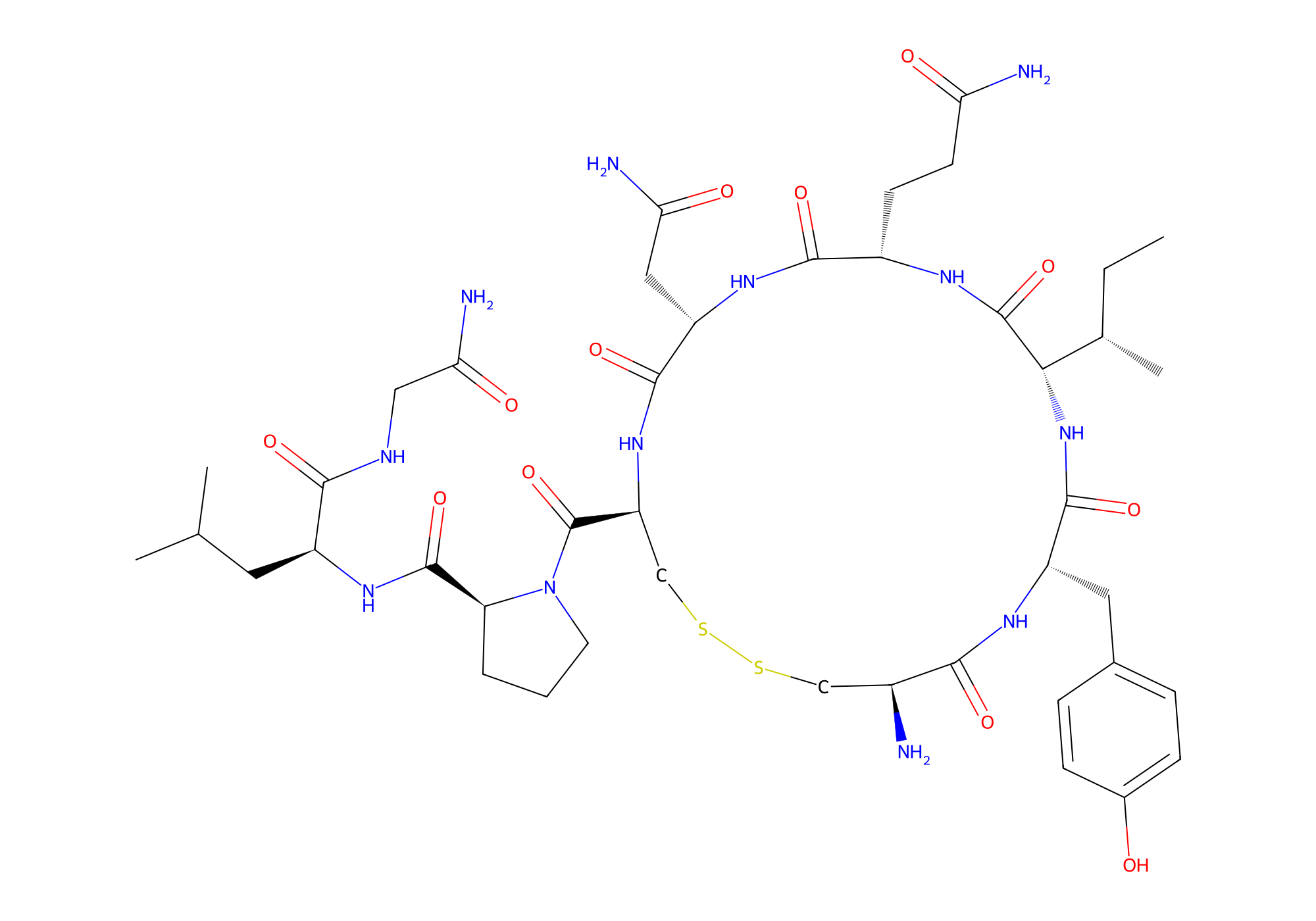
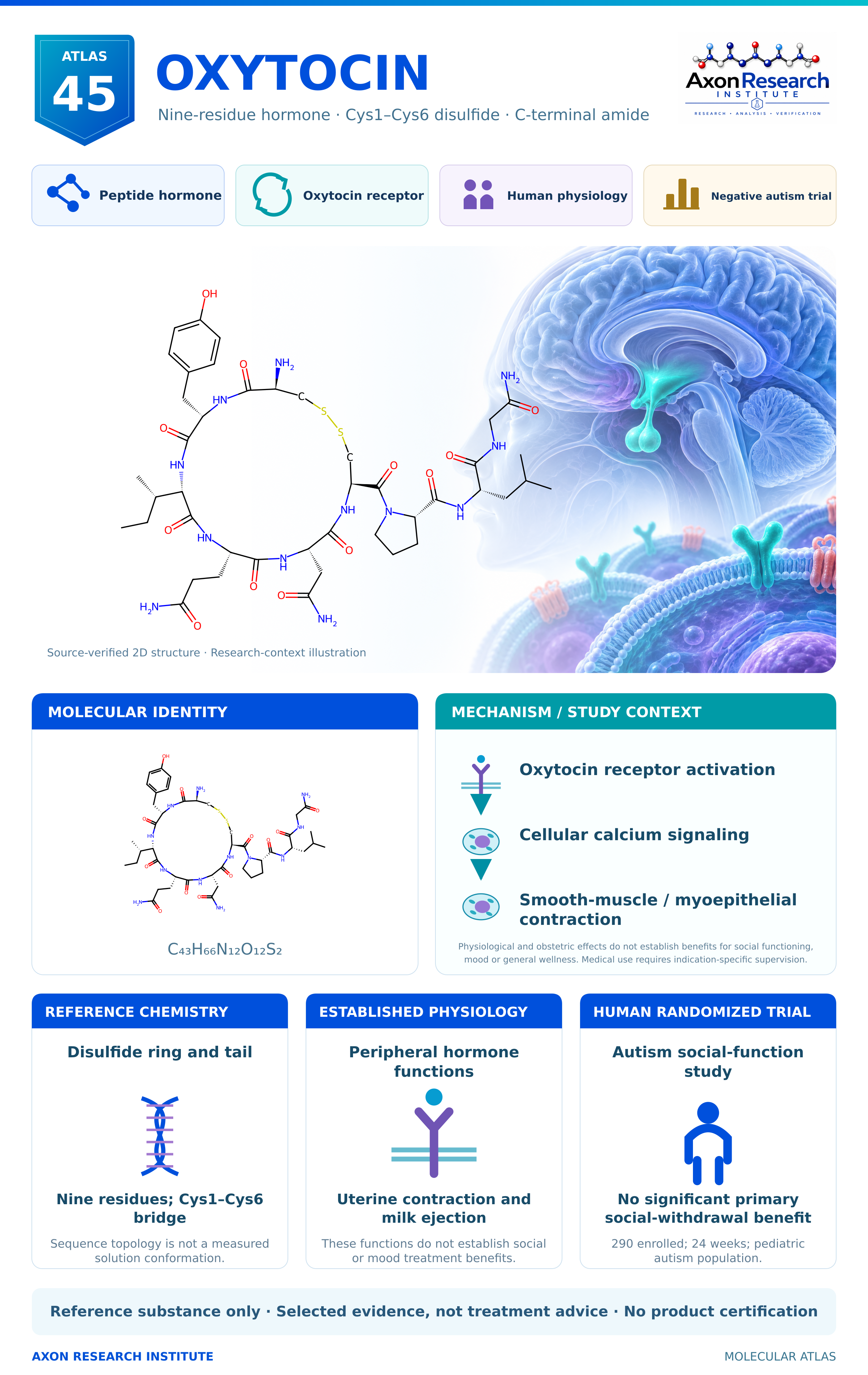
The chemical drawing shows source-verified two-dimensional connectivity and stereochemistry, not an experimental three-dimensional conformation. The biological setting is an illustration. Original study diagrams summarize cited research without reproducing publication artwork or inventing quantitative results.
Oxytocin
Oxytocin receptor
Oxidized human oxytocin parent; Cys1–Cys6 disulfide; C-terminal glycinamide- Molecular formula
- C43H66N12O12S2
- Molecular weight
- 1007.2 g/mol
- Class
- Cyclic nonapeptide hormone
- Identity
- H-Cys-Tyr-Ile-Gln-Asn-Cys-Pro-Leu-Gly-NH2; disulfide Cys1–Cys6
Research snapshot
Oxytocin is an endogenous hormone involved in uterine contraction and milk ejection. Approved obstetric products have specific clinical uses; a large autism trial found no meaningful social-function benefit.
Established physiology + clinical trials
Identity & representation
Reference parent, not an AXON formulation or salt.
Educational reference only. Not a dosing guide, treatment recommendation or product endorsement.
Nine-residue hormone · Cys1–Cys6 disulfide · C-terminal amide[1]
View the chemical structure →Sources checked: 2026-11-06. Identity and evidence limits are stated above. Independent specialist review is pending.
What researchers study
Oxytocin is an endogenous hormone involved in uterine contraction and milk ejection. Approved obstetric products have specific clinical uses; a large autism trial found no meaningful social-function benefit.
Uterine contractility
Milk-ejection physiology
Social-behavior clinical research
Mechanism in context
- Oxytocin binds its receptor
- Cellular calcium signaling changes
- Smooth-muscle and myoepithelial contraction follows
Physiological and obstetric effects do not establish benefits for social functioning, mood or general wellness. Medical use requires indication-specific supervision.
Simplified publication-grounded schematic, not a solved protein structure or proof of clinical benefit.
Selected evidence
Established physiology + clinical trials
Intranasal Oxytocin in Children and Adolescents with Autism Spectrum Disorder.[3]
Randomized double-blind placebo-controlled phase 2 trial · 290 enrolled; 277 in modified intention-to-treat analysis · 24 weeks
Observed: Primary social-withdrawal score difference was not significant; secondary social/cognitive measures generally did not differ.
Primary social-withdrawal score difference was not significant; secondary social/cognitive measures generally did not differ. Children/adolescents with autism; not evidence of universal social enhancement.
Limit: Children/adolescents with autism; not evidence of universal social enhancement.
Reference identity in detail
Sequences and form distinctions describe the cited reference substance, not a verified supplier preparation.
Research scope
Targeted source verification, not a systematic review. Citation quality and molecule-specific applicability are stated separately.
Safety & evidence limits
Uterine hyperstimulation, rupture and water intoxication are recognized medical risks in product labeling.
A 290-participant autism trial found no significant social or cognitive advantage over placebo.
Evidence and approvals for pharmaceutical oxytocin do not validate research products or non-obstetric claims.
Practical identity notes
- Oxidized human oxytocin parent; Cys1–Cys6 disulfide; C-terminal glycinamide
- No original PubChem 3D conformer was available for this exact reference in the checked endpoint; use exact 2D structure.
- Reference identity is not confirmation of product contents, purity, sterility or therapeutic equivalence.
The 10-second takeaway
A potent physiological hormone with established obstetric uses; social-enhancement claims do not follow from that evidence.
What the visual panels show
Original diagrams summarize the cited research or documented evidence search. They are not copied publication figures or claims of treatment benefit.
MECHANISM / STUDY CONTEXT[2][4]
Publication-grounded mechanism schematic · Original publication-grounded diagram
Oxytocin receptor activation · Cellular calcium signaling · Smooth-muscle / myoepithelial contraction
Interpretation: Physiological and obstetric effects do not establish benefits for social functioning, mood or general wellness. Medical use requires indication-specific supervision.
Disulfide ring and tail[1]
REFERENCE CHEMISTRY · Original publication-grounded diagram
Nine residues; Cys1–Cys6 bridge
Sequence topology is not a measured solution conformation.
Interpretation: Sequence topology is not a measured solution conformation. Original conceptual illustration only; no fabricated data, docking geometry or clinical extrapolation.
Peripheral hormone functions[2][4]
ESTABLISHED PHYSIOLOGY · Original publication-grounded diagram
Uterine contraction and milk ejection
These functions do not establish social or mood treatment benefits.
Interpretation: These functions do not establish social or mood treatment benefits. Original conceptual illustration only; no fabricated data, docking geometry or clinical extrapolation.
Autism social-function study[3]
HUMAN RANDOMIZED TRIAL · Original publication-grounded diagram
No significant primary social-withdrawal benefit
290 enrolled; 24 weeks; pediatric autism population.
Interpretation: 290 enrolled; 24 weeks; pediatric autism population. Original conceptual illustration only; no fabricated data, docking geometry or clinical extrapolation.
Follow the evidence
Sources & what they support
- PubChem CID 439302: source reference graph
Supports: Exact reference graph, stereochemistry, formula and mass
Original structure record · Download source SDF
Original PubChem 2D source structure record.
- Oxytocin ligand record
Supports: Receptor pharmacology and identity
- Intranasal Oxytocin in Children and Adolescents with Autism Spectrum Disorder.
Supports: 24-week pediatric autism trial
- Oxytocin injection prescribing information
Supports: Obstetric indication; uterine and water-intoxication risks
← Explore the Molecular Atlas Continue to the research library →