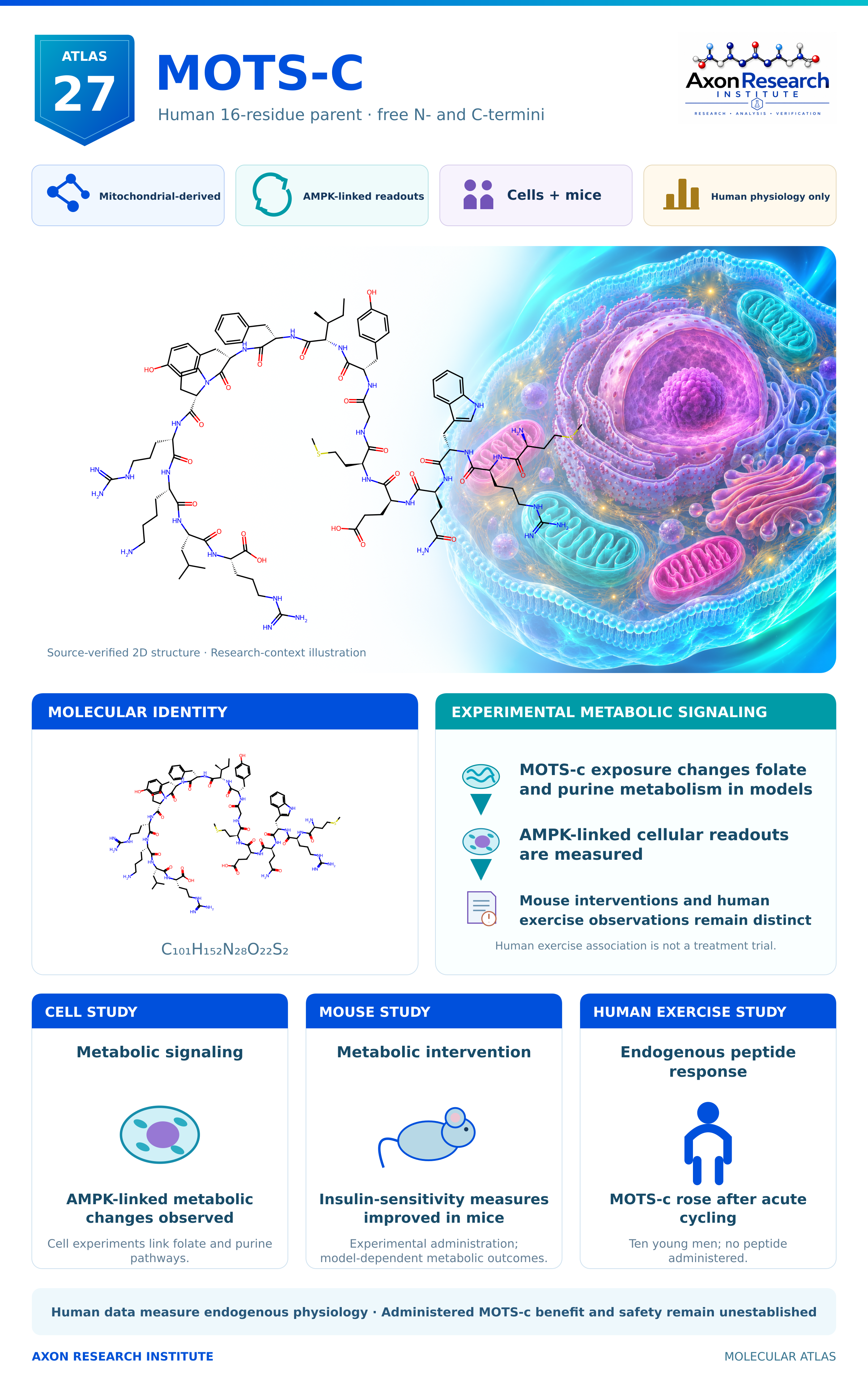
Visual summary only. The research findings, limitations and references accompany the card on this page.
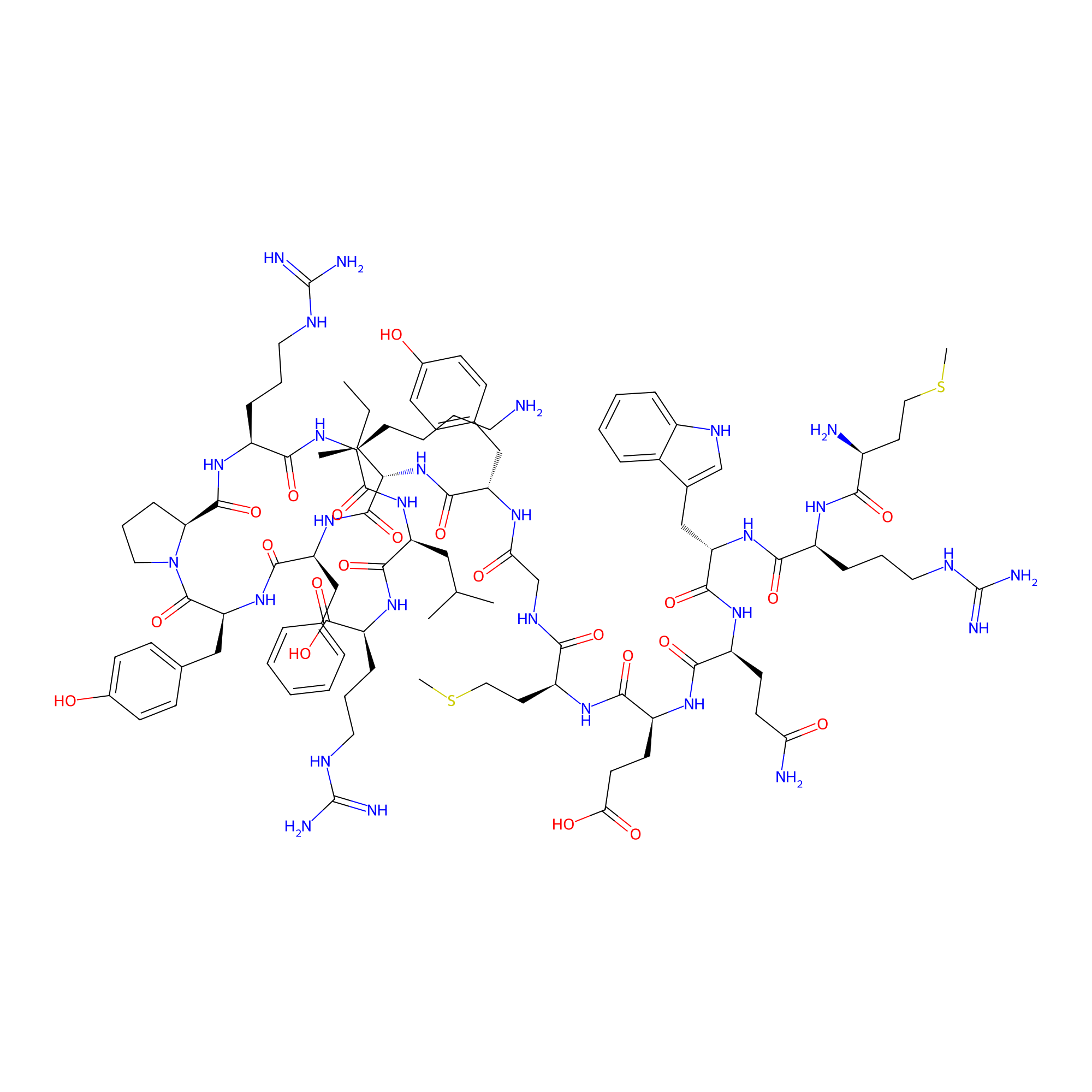
The chemical drawing shows source-verified two-dimensional connectivity and stereochemistry, not an experimental three-dimensional conformation. The biological setting is an illustration. Original study diagrams summarize cited research without reproducing publication artwork or inventing quantitative results.
MOTS-c
Metabolic stress; AMPK pathways
Human MOTS-c parent; H-MRWQEMGYIFYPRKLR-OH- Molecular formula
- C101H152N28O22S2
- Molecular weight
- 2174.6 g/mol
- Class
- Mitochondrial-derived peptide
- Identity
- MRWQEMGYIFYPRKLR
Research snapshot
MOTS-c is a 16-residue mitochondrial-derived peptide studied as a metabolic signal. Cell and mouse experiments investigate AMPK-linked responses; human exercise studies measure endogenous peptide changes rather than therapeutic administration.
Cell/mouse intervention; human physiology
Identity & representation
Literature reference identity only. AXON product composition, salt, purity, sterility and equivalence were not verified. Exact depicted parent/reference form; excludes counterions and excipients unless expressly stated.
Educational reference only. Not a dosing guide, treatment recommendation or product endorsement.
Human 16-residue parent · free N- and C-termini[1]
View the chemical structure →Sources checked: 2026-11-06. Identity and evidence limits are stated above. Independent specialist review is pending.
What researchers study
MOTS-c is a 16-residue mitochondrial-derived peptide studied as a metabolic signal. Cell and mouse experiments investigate AMPK-linked responses; human exercise studies measure endogenous peptide changes rather than therapeutic administration.
Folate and purine metabolism linked to AMPK signaling in cells
Insulin sensitivity and physical-capacity endpoints in mouse intervention models
Endogenous muscle and circulating MOTS-c responses to acute human exercise
Mechanism in context
- Metabolic stress alters MOTS-c-linked signaling
- Folate/purine pathways influence AMPK activity in models
- Cells and mice show context-dependent metabolic responses
These mechanisms are experimental. An endogenous rise during human exercise does not show that administering MOTS-c reproduces exercise or treats metabolic disease.
Simplified publication-grounded schematic, not a solved protein structure or proof of clinical benefit.
Selected evidence
Cell/mouse intervention; human physiology
MOTS-c is an exercise-induced mitochondrial-encoded regulator of age-dependent physical decline and muscle homeostasis[3]
Human exercise physiology experiment plus separate mouse/cell experiments · 10 young men in human exercise component · Acute stationary cycling with four-hour recovery sampling
Observed: Endogenous MOTS-c rose in muscle and circulation after exercise.
In ten young men, acute cycling increased endogenous MOTS-c in muscle and blood, with sampling through four hours of recovery. The same paper tested peptide administration in mice. Its human component was physiological observation, not evidence that MOTS-c treatment improves human performance.
Limit: No MOTS-c administered to human participants; not a treatment trial.
The mitochondrial-derived peptide MOTS-c promotes metabolic homeostasis and reduces obesity and insulin resistance.[2]
Cell metabolomics and mouse metabolic-intervention experiments
Observed: Experiments linked MOTS-c with folate/purine metabolism, AMPK activation and insulin-sensitivity changes in mice. They generated a metabolic-signaling hypothesis, not proof of clinical efficacy for administered human MOTS-c.
Reference identity in detail
Sequences and form distinctions describe the cited reference substance, not a verified supplier preparation.
Safety & evidence limits
The human exercise study measured a naturally occurring response; it did not test administered MOTS-c as a treatment.
Mouse improvements in metabolism or running capacity cannot establish efficacy, longevity benefit or safe exposure in people.
FDA identifies insufficient human exposure information and immunogenicity concerns for compounded MOTS-c preparations.
Practical identity notes
- 16-residue human sequence with unmodified termini in the reference record.
- A database synonym mentioning trifluoroacetate does not make this parent structure a TFA salt.
- The actual TFA salt is a separate record; counterion identity must come from the material specification.
The 10-second takeaway
A promising experimental metabolic signal; human exercise associations are not human treatment evidence.
What the visual panels show
Original diagrams summarize the cited research or documented evidence search. They are not copied publication figures or claims of treatment benefit.
EXPERIMENTAL METABOLIC SIGNALING[2][3]
Publication-grounded mechanism schematic · Original publication-grounded diagram
MOTS-c exposure changes folate and purine metabolism in models · AMPK-linked cellular readouts are measured · Mouse interventions and human exercise observations remain distinct
Interpretation: Human exercise association is not a treatment trial.
Metabolic signaling[2]
CELL STUDY · Original publication-grounded diagram
AMPK-linked metabolic changes observed
Cell experiments link folate and purine pathways.
Interpretation: No direct-receptor claim, artificial pathway certainty or generalized metabolic benefit.
Metabolic intervention[2]
MOUSE STUDY · Original publication-grounded diagram
Insulin-sensitivity measures improved in mice
Experimental administration; model-dependent metabolic outcomes.
Interpretation: Mouse intervention findings are not human treatment evidence; no fabricated glucose curve.
Endogenous peptide response[3]
HUMAN EXERCISE STUDY · Original publication-grounded diagram
MOTS-c rose after acute cycling
Ten young men; no peptide administered.
Interpretation: Make the absence of administered MOTS-c explicit. No exercise-mimetic or performance-treatment claim.
Follow the evidence
Sources & what they support
- PubChem compound record 146675088
Supports: identity; structure; formula; molecular_weight; stereochemistry
Original structure record · Download depicted structure SDF
Generated 2D layout from the verified reference graph; not an original 2D source-record download.
- The mitochondrial-derived peptide MOTS-c promotes metabolic homeostasis and reduces obesity and insulin resistance.
Supports: overview; mechanism; preclinical research
- MOTS-c is an exercise-induced mitochondrial-encoded regulator of age-dependent physical decline and muscle homeostasis
Supports: human exercise study; mouse evidence distinction
- FDA compounding safety concerns
Supports: safety limitation
← Explore the Molecular Atlas Continue to the research library →