Visual summary only. The research findings, limitations and references accompany the card on this page.
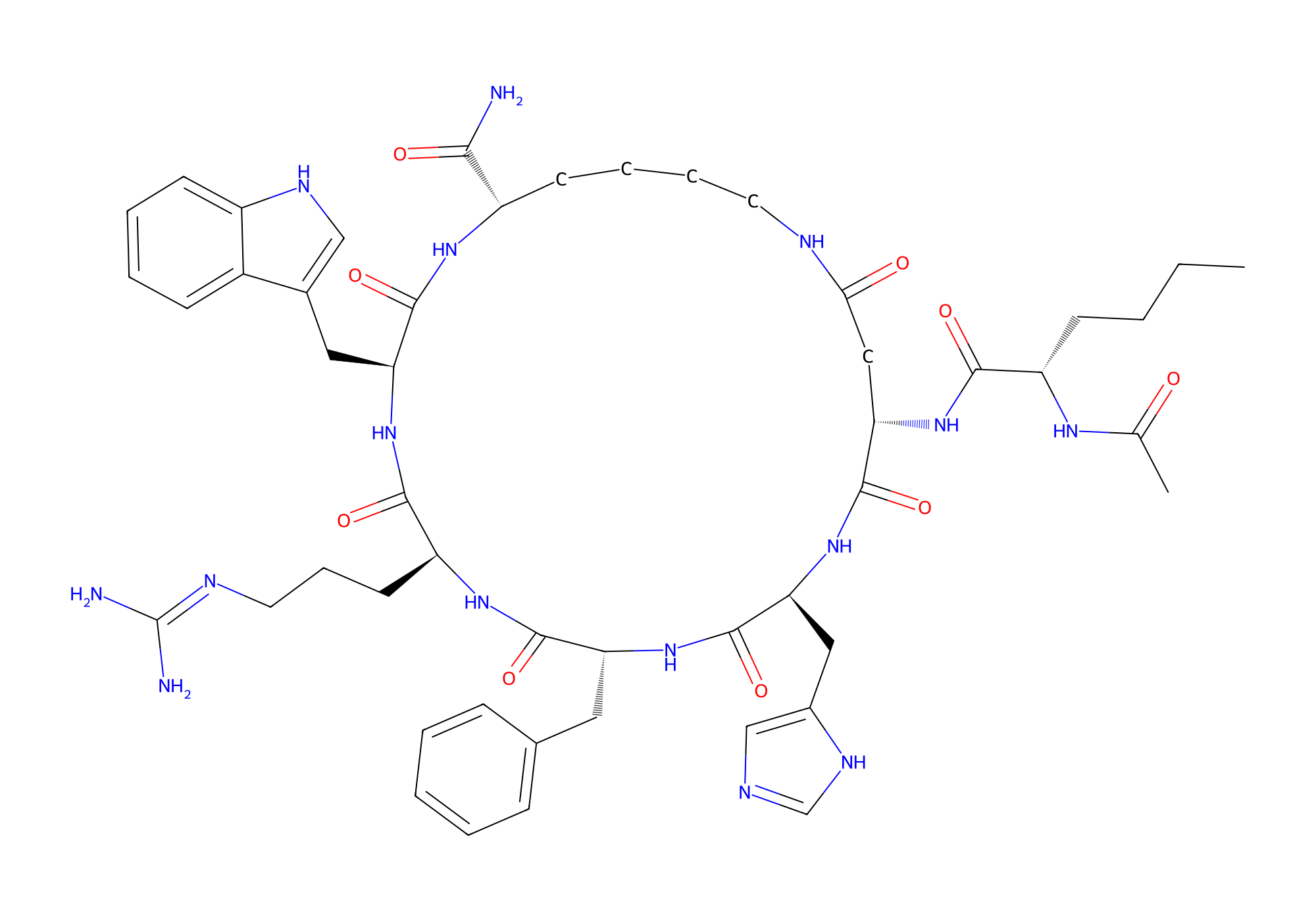
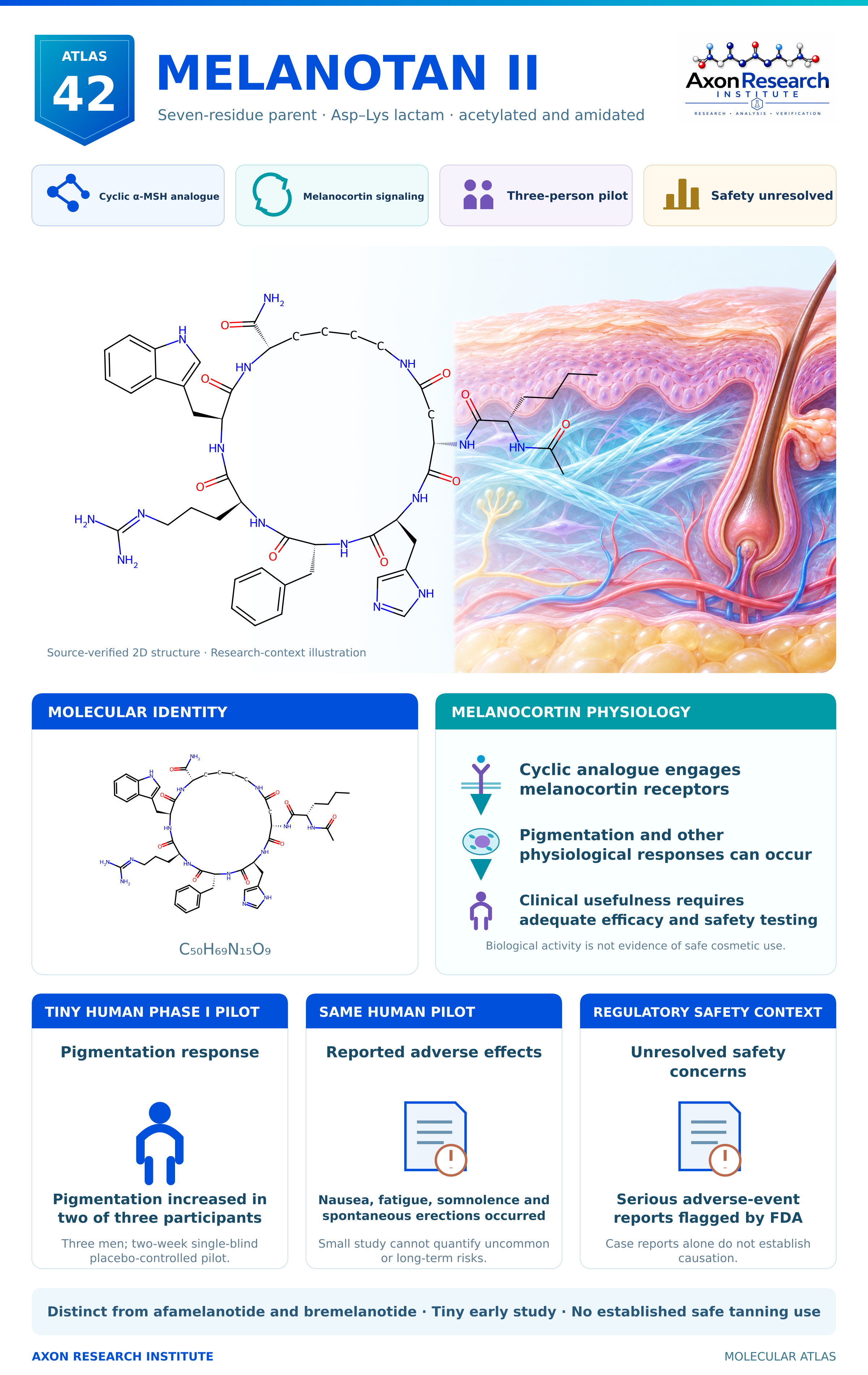
The chemical drawing shows source-verified two-dimensional connectivity and stereochemistry, not an experimental three-dimensional conformation. The biological setting is an illustration. Original study diagrams summarize cited research without reproducing publication artwork or inventing quantitative results.
Melanotan II
Melanocortin-receptor signaling
Ac-Nle-cyclo[Asp-His-D-Phe-Arg-Trp-Lys]-NH2; Asp–Lys side-chain lactam- Molecular formula
- C50H69N15O9
- Molecular weight
- 1024.2 g/mol
- Class
- Cyclic melanocortin analogue
- Identity
- Ac-Nle-cyclo[Asp-His-D-Phe-Arg-Trp-Lys]-NH2
Research snapshot
Melanotan II is a cyclic seven-residue α-MSH analogue, chemically distinct from afamelanotide. Early human work explored pigmentation and physiological responses; these small studies cannot establish safe cosmetic or therapeutic use.
Very small early human studies
Identity & representation
Literature reference identity only. AXON product composition, salt, purity, sterility and equivalence were not verified. Exact depicted parent/reference form; excludes counterions and excipients unless expressly stated.
Educational reference only. Not a dosing guide, treatment recommendation or product endorsement.
Seven-residue parent · Asp–Lys lactam · acetylated and amidated[1]
View the chemical structure →Sources checked: 2026-11-06. Identity and evidence limits are stated above. Independent specialist review is pending.
What researchers study
Melanotan II is a cyclic seven-residue α-MSH analogue, chemically distinct from afamelanotide. Early human work explored pigmentation and physiological responses; these small studies cannot establish safe cosmetic or therapeutic use.
Structure–activity relationships among cyclic melanocortin receptor ligands
Early pigmentation responses and adverse effects in human volunteers
Biophysical stability and analytical characterization of cyclic peptide preparations
Mechanism in context
- Cyclic analogue engages melanocortin signaling
- Pigmentation and other physiological responses occur
- Clinical utility requires adequately powered safety and efficacy trials
Receptor-mediated biological activity is not proof of useful or safe outcomes. This peptide is not interchangeable with linear afamelanotide or bremelanotide.
Simplified publication-grounded schematic, not a solved protein structure or proof of clinical benefit.
Selected evidence
Very small early human studies
Evaluation of melanotan-II, a superpotent cyclic melanotropic peptide in a pilot phase-I clinical study.[2]
Single-blind placebo-controlled alternating-day phase I pilot · 3 male volunteers · 2 weeks; pigmentation assessment after treatment
Observed: Two subjects developed increased pigmentation; nausea, somnolence, fatigue and spontaneous erections occurred.
A two-week phase I pilot included only three men. Pigmentation increased in two participants, and physiological adverse effects included nausea, fatigue, somnolence and spontaneous erections. This establishes a biological signal, not an adequate evidence base for efficacy, long-term safety or cancer prevention.
Limit: Extremely small exploratory study; cannot establish long-term safety or cancer prevention.
Reference identity in detail
Sequences and form distinctions describe the cited reference substance, not a verified supplier preparation.
Safety & evidence limits
Three-person phase I results are far too small to support generalized efficacy or meaningful estimates of uncommon adverse events.
FDA notes serious adverse-event case reports and compounded-product immunogenicity concerns; case reports alone do not prove causality.
Neither tanning activity nor a cyclic structure establishes skin-cancer prevention, protection from ultraviolet harm, or equivalence to afamelanotide.
Practical identity notes
- A side-chain lactam connects Asp and Lys, not a head-to-tail backbone cyclization.
- Contains L-norleucine and D-phenylalanine, plus N-acetyl and C-amide groups.
- The depicted parent excludes acetate; salts have different overall formulas and masses.
The 10-second takeaway
A distinct cyclic melanocortin analogue with tiny early studies and unresolved safety, not a validated tanning or cancer-prevention treatment.
What the visual panels show
Original diagrams summarize the cited research or documented evidence search. They are not copied publication figures or claims of treatment benefit.
MELANOCORTIN PHYSIOLOGY[4][2]
Publication-grounded mechanism schematic · Original publication-grounded diagram
Cyclic analogue engages melanocortin receptors · Pigmentation and other physiological responses can occur · Clinical usefulness requires adequate efficacy and safety testing
Interpretation: Biological activity is not evidence of safe cosmetic use.
Pigmentation response[2]
TINY HUMAN PHASE I PILOT · Original publication-grounded diagram
Pigmentation increased in two of three participants
Three men; two-week single-blind placebo-controlled pilot.
Interpretation: No inference of reliable efficacy, UV safety or cancer prevention from three participants.
Reported adverse effects[2]
SAME HUMAN PILOT · Original publication-grounded diagram
Nausea, fatigue, somnolence and spontaneous erections occurred
Small study cannot quantify uncommon or long-term risks.
Interpretation: Keep adverse effects equally visible; do not convert biological responses into therapeutic benefits.
Unresolved safety concerns[3]
REGULATORY SAFETY CONTEXT · Original publication-grounded diagram
Serious adverse-event reports flagged by FDA
Case reports alone do not establish causation.
Interpretation: No claim that a specific event was proven caused by MT-II; no safe-tanning or pharmaceutical-equivalence claim.
Follow the evidence
Sources & what they support
- PubChem compound record 92432
Supports: identity; structure; formula; molecular_weight; stereochemistry
Original structure record · Download depicted structure SDF
Generated 2D layout from the verified reference graph; not an original 2D source-record download.
- Evaluation of melanotan-II, a superpotent cyclic melanotropic peptide in a pilot phase-I clinical study.
Supports: sequence; pilot human findings; limitations
- FDA compounding safety concerns
Supports: safety
- IUPHAR/BPS Guide to Pharmacology: MT-II
Supports: receptor context; identity
← Explore the Molecular Atlas Continue to the research library →