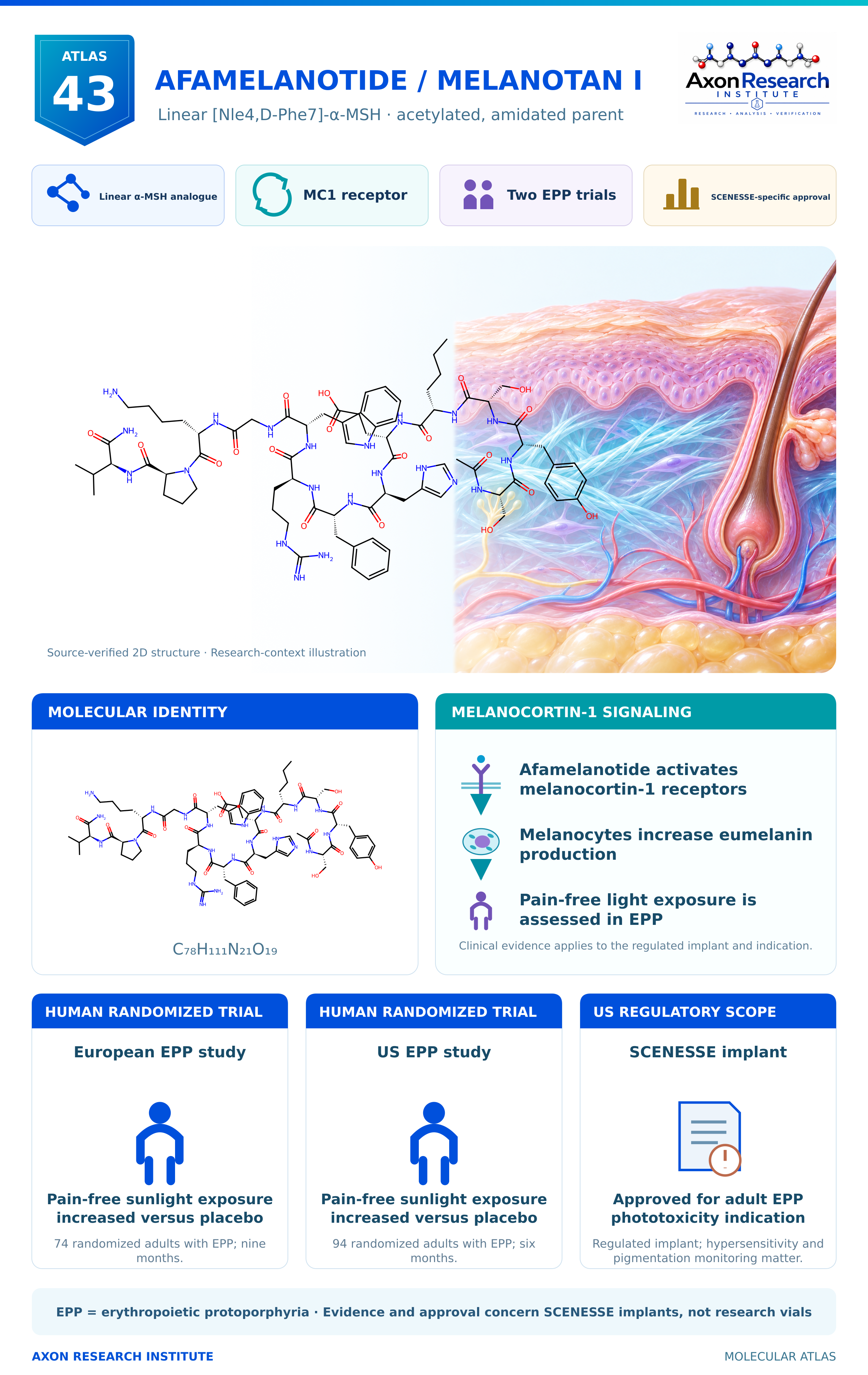
Visual summary only. The research findings, limitations and references accompany the card on this page.
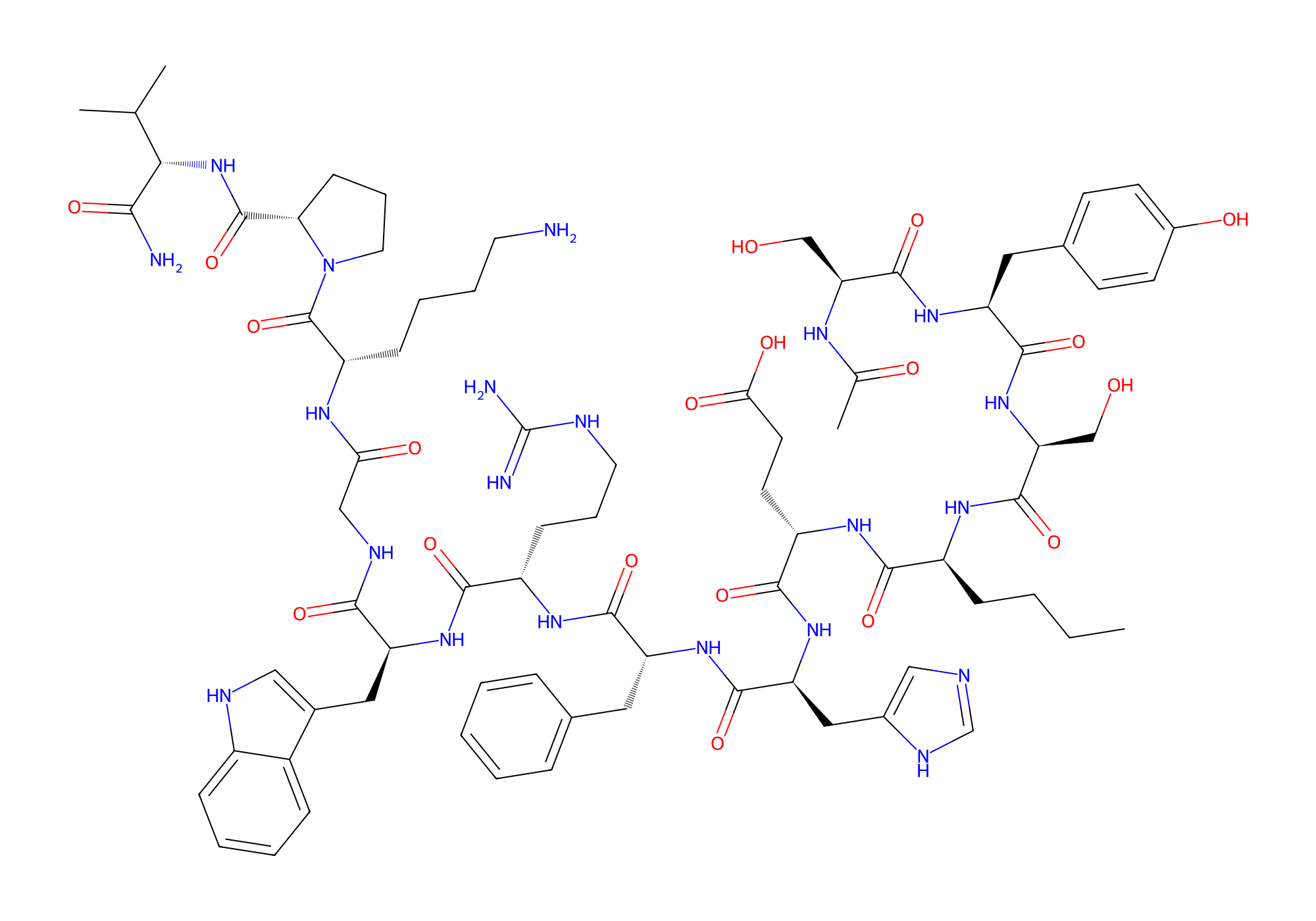
The chemical drawing shows source-verified two-dimensional connectivity and stereochemistry, not an experimental three-dimensional conformation. The biological setting is an illustration. Original study diagrams summarize cited research without reproducing publication artwork or inventing quantitative results.
Afamelanotide / Melanotan I
Melanocortin-1 receptor
Afamelanotide parent: Ac-Ser-Tyr-Ser-Nle-Glu-His-D-Phe-Arg-Trp-Gly-Lys-Pro-Val-NH2- Molecular formula
- C78H111N21O19
- Molecular weight
- 1646.8 g/mol
- Class
- Linear α-MSH analogue
- Identity
- Ac-Ser-Tyr-Ser-Nle-Glu-His-D-Phe-Arg-Trp-Gly-Lys-Pro-Val-NH2
Research snapshot
Afamelanotide is a linear α-MSH analogue that stimulates melanocortin-1 receptors and eumelanin production. A specific implant formulation has clinical evidence and approval for pain-free light exposure in adults with erythropoietic protoporphyria.
Randomized EPP trials
Identity & representation
Literature reference identity only. AXON product composition, salt, purity, sterility and equivalence were not verified. Exact depicted parent/reference form; excludes counterions and excipients unless expressly stated.
Educational reference only. Not a dosing guide, treatment recommendation or product endorsement.
Linear [Nle4,D-Phe7]-α-MSH · acetylated, amidated parent[1]
View the chemical structure →Sources checked: 2026-11-06. Identity and evidence limits are stated above. Independent specialist review is pending.
What researchers study
Afamelanotide is a linear α-MSH analogue that stimulates melanocortin-1 receptors and eumelanin production. A specific implant formulation has clinical evidence and approval for pain-free light exposure in adults with erythropoietic protoporphyria.
Pain-free light exposure and phototoxic reactions in adults with EPP
Melanocortin-1 receptor signaling and eumelanin biology in melanocytes
Longer-term safety and patient-reported quality of life in treated EPP
Mechanism in context
- Afamelanotide activates melanocortin-1 receptors
- Melanocytes increase eumelanin production
- Photoprotection is evaluated through EPP-specific clinical outcomes
Approval and trial findings apply to a defined medicinal implant and indication. They do not validate tanning products or research vials bearing a similar name.
Simplified publication-grounded schematic, not a solved protein structure or proof of clinical benefit.
Selected evidence
Randomized EPP trials
Afamelanotide for Erythropoietic Protoporphyria.[2]
Two multicentre randomized double-blind placebo-controlled trials · 74 European and 94 US participants with EPP · 9 months EU; 6 months US
Observed: Longer pain-free sunlight exposure with afamelanotide in both studies; quality-of-life improvement.
Two randomized trials enrolled 74 European and 94 US adults with EPP for nine and six months. Afamelanotide implants increased pain-free sunlight exposure compared with placebo. Results concern this rare phototoxic disorder and formulation, not cosmetic tanning or unverified injectable products.
Limit: EPP-specific population and implant formulation; partial unblinding from pigmentation was possible.
Reference identity in detail
Sequences and form distinctions describe the cited reference substance, not a verified supplier preparation.
Safety & evidence limits
The clinical evidence and approval concern the regulated SCENESSE implant, not any product labeled “Melanotan I.”
Pigmentation changes may reveal treatment assignment; sun-exposure behavior and self-reported outcomes complicate interpretation of efficacy.
The approved label includes hypersensitivity and skin-pigmentation monitoring considerations; therapeutic evidence does not imply absence of risk.
Practical identity notes
- N-terminal acetylation and C-terminal amidation are part of the reference identity.
- Norleucine replaces Met4 and D-phenylalanine replaces Phe7 of α-MSH.
- Formula and mass exclude acetate counterions and the implant polymer.
- Use the stereospecific afamelanotide CID16197727. Do not substitute melanotan II or an unverified “Scenesse” synonym record.
The 10-second takeaway
Afamelanotide has indication-specific clinical evidence; “Melanotan I” labeling alone does not establish pharmaceutical equivalence.
What the visual panels show
Original diagrams summarize the cited research or documented evidence search. They are not copied publication figures or claims of treatment benefit.
MELANOCORTIN-1 SIGNALING[3][2]
Publication-grounded mechanism schematic · Original publication-grounded diagram
Afamelanotide activates melanocortin-1 receptors · Melanocytes increase eumelanin production · Pain-free light exposure is assessed in EPP
Interpretation: Clinical evidence applies to the regulated implant and indication.
European EPP study[2]
HUMAN RANDOMIZED TRIAL · Original publication-grounded diagram
Pain-free sunlight exposure increased versus placebo
74 randomized adults with EPP; nine months.
Interpretation: EPP means erythropoietic protoporphyria. Possible unblinding from pigmentation; no cosmetic tanning extrapolation.
US EPP study[2]
HUMAN RANDOMIZED TRIAL · Original publication-grounded diagram
Pain-free sunlight exposure increased versus placebo
94 randomized adults with EPP; six months.
Interpretation: Different sunlight-assessment windows preclude casually pooling raw hours across trials; no fabricated comparison plot.
SCENESSE implant[3][4]
US REGULATORY SCOPE · Original publication-grounded diagram
Approved for adult EPP phototoxicity indication
Regulated implant; hypersensitivity and pigmentation monitoring matter.
Interpretation: Approval does not extend to products merely called Melanotan I, research vials, cosmetic tanning or general UV protection.
Follow the evidence
Sources & what they support
- PubChem compound record 16197727
Supports: identity; structure; formula; molecular_weight; stereochemistry
Original structure record · Download depicted structure SDF
Generated 2D layout from the verified reference graph; not an original 2D source-record download.
- Afamelanotide for Erythropoietic Protoporphyria.
Supports: human trials; limitations
- SCENESSE current prescribing information
Supports: mechanism; status; safety; form distinction
- FDA afamelanotide approval record
Supports: approved indication; approval date
← Explore the Molecular Atlas Continue to the research library →