
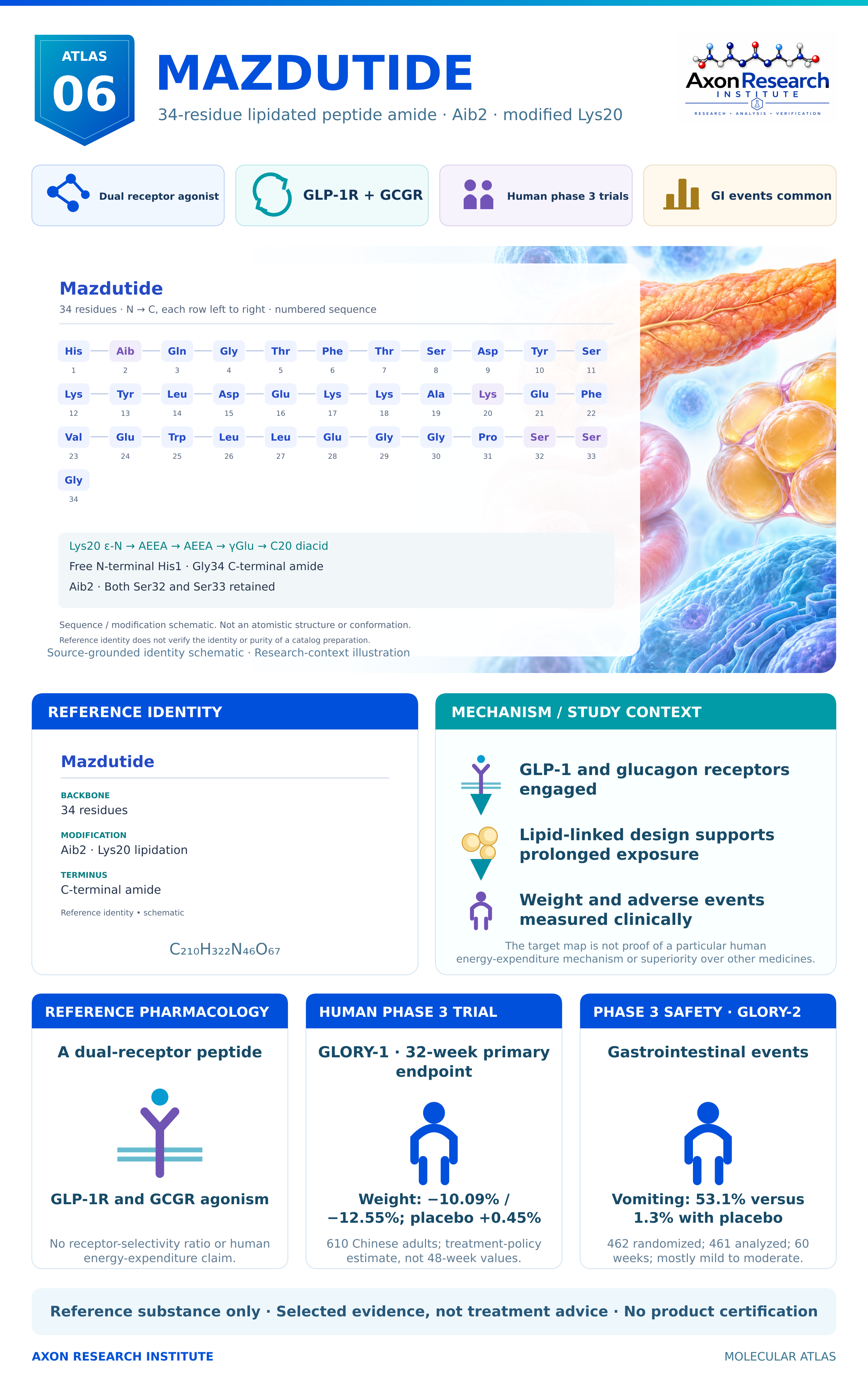
Visual summary only. The research findings, limitations and references accompany the card on this page.
Verified numbered backbone and locus-specific modification map. Sequence transcribed from specified verified source dossier. Linker blocks show identity and ordering, not atomic bonding geometry. Standard chiral amino acids are L; Gly and Aib are achiral. Biological settings and research diagrams are illustrations, not measured anatomy or clinical outcomes.
Mazdutide
GLP-1R + GCGR
Mazdutide reference parent, counterions and solvates excluded- Backbone
- 34 residues
- Modification
- Aib2 · Lys20 lipidation
- Terminus
- C-terminal amide
Research snapshot
Mazdutide is a lipidated oxyntomodulin-family analogue that activates GLP-1 and glucagon receptors. Its 34-residue backbone, Aib substitution, specific Lys 20 linker and amidated terminus distinguish it from survodutide and other incretin peptides.
Phase 3 human trials
Identity & representation
Literature reference molecule only. Does not certify the identity, salt, purity, sterility, formulation or suitability of a research product. X2 is 2-aminoisobutyric acid (Aib), achiral. Lys20 is side-chain acylated. Gly34 terminates as an amide. All ordinary chiral residues are L. Two consecutive serines at positions32 and 33 must both remain.
Educational reference only. Not a dosing guide, treatment recommendation or product endorsement.
Verified numbered backbone and locus-specific modification map.[1][2]
Sources checked: 2026-11-06. Identity and evidence limits are stated above. Independent specialist review is pending.
What researchers study
Mazdutide is a lipidated oxyntomodulin-family analogue that activates GLP-1 and glucagon receptors. Its 34-residue backbone, Aib substitution, specific Lys 20 linker and amidated terminus distinguish it from survodutide and other incretin peptides.
Dual glucagon/GLP-1 pharmacology
Oxyntomodulin-family peptide engineering
Obesity trials in Chinese and US populations
Tolerability across studied formulations and exposures
Dual-receptor pharmacology[1][2][3]
- Engages GLP-1 and glucagon receptors
- A lipid-linked modified peptide supports prolonged exposure
- Human trials measure weight reduction and adverse events
The target map is not proof of a particular human energy-expenditure mechanism or superiority over other medicines.
Simplified publication-grounded schematic, not a solved protein structure or proof of clinical benefit.
Selected evidence
Primary GLORY-1, GLORY-2 and US phase 2 reports were checked. Studies differ in population, duration, exposure and estimand and should not be pooled into a single efficacy percentage.
Once-Weekly Mazdutide in Chinese Adults with Obesity or Overweight.[3]
Phase 3 randomized double-blind placebo-controlled trial (GLORY-1) · Chinese adults aged 18–75 with BMI ≥28, or BMI 24–<28 plus a weight-related condition · 48 weeks; primary endpoints at 32 weeks · Reported n: 610
Observed: At week 32, treatment-policy mean weight changes were −10.09%, −12.55% and +0.45% in the two mazdutide groups and placebo. At least 5% weight loss occurred in 73.9%, 82.0% and 10.5%, respectively. At week 48, weight changes were −11.00%, −14.01% and +0.30%.
Limit: Geography and enrolled BMI range limit extrapolation. Gastrointestinal adverse events predominated. Trial-regimen discontinuation because of adverse events occurred in 1.5%, 0.5% and 1.0%, respectively. Neither this study nor its percentages establish equivalence of a research vial.
Treatment With 9-mg Mazdutide for Weight Reduction in Chinese Adults With Obesity: The GLORY-2 Randomized Clinical Trial.[4]
Phase 3 randomized double-blind placebo-controlled trial (GLORY-2) · Chinese adults with BMI ≥30, with or without type 2 diabetes; 27 hospitals · 60 weeks · Reported n: 462 · Randomized: 462
Observed: Among 461 participants who received treatment and were analyzed, mean body-weight change was −16.65% with mazdutide and −1.50% with placebo. Between-group difference: −15.15 percentage points (95% CI −17.22 to −13.09). At least 5% weight loss occurred in 84.3% versus 33.1%.
Limit: 462 randomized but 461 received treatment: do not label 461 as randomized. Vomiting occurred in 53.1% versus 1.3%, nausea 46.9% versus 3.2%, and diarrhea 39.4% versus 6.5%. Most were mild to moderate; adverse-event discontinuation was 2.9% versus 0%.
Efficacy and safety of mazdutide in adults with obesity or overweight: a US-based, multicentre, phase 2, randomised, placebo-controlled clinical trial.[5]
US multicenter phase2 randomized double-blind placebo-controlled trial · Adults aged 18–75 with obesity or overweight and a weight-related condition, without type 2 diabetes · 48 weeks; primary endpoint at 32 weeks · Reported n: 179
Observed: Efficacy-estimand mean weight changes at 32 weeks were −7.3%, −15.6% and −18.1% across three mazdutide groups, versus −0.9% with placebo. Additional weight loss was reported at 48 weeks.
Limit: This hypothetical efficacy estimand is not directly comparable with GLORY-1 treatment-policy estimates. In the highest studied group, 20% discontinued treatment because of adverse events, mainly gastrointestinal disorders. Small phase 2 sample; not a head-to-head trial.
Regulatory context
A Chinese government source reports NMPA approval of mazdutide for chronic weight management in adults with overweight or obesity in June 2025. This is not an exhaustive regulatory review and does not validate a research preparation.[6]
Reference identity in detail
Sequences and form distinctions describe the cited reference substance, not a verified supplier preparation.
Safety & evidence limits
Clinical trial findings concern the tested pharmaceutical formulations, populations and supervised study conditions. They cannot establish equivalence or safety of a catalog preparation.
Gastrointestinal adverse events are common. Selected study summaries are not a complete safety assessment or a treatment recommendation.
No head-to-head superiority claim may be inferred by comparing these studies with a different drug, population, duration or estimand.
Do not present mazdutide as universally unapproved: a China government source reports NMPA approval for adult chronic weight management in June 2025. Approval of a specific medicine does not approve unrelated research products.
High-group adverse-event discontinuation in the US phase 2 trial was 20%; omitting tolerability would give a misleading impression of the benefit/risk evidence.
Practical identity notes
- The reference backbone has 34 residues, including Ser 32 and Ser 33.
- The correct WHO parent formula is C210H322N46O67. The conflicting PubChem record must not override the WHO sequence.
- Aib 2 and the C20 linker are different from survodutide Ac 4c 2 and its C18-linked branch.
- Educational molecular reference • Selected studies, not a systematic review • No dosing guidance
The 10-second takeaway
A chemically specific dual-receptor peptide with phase 3 weight-loss evidence. Gastrointestinal tolerability and exact preparation identity remain essential context.
What the visual panels show
Original diagrams summarize the cited research or documented evidence search. They are not copied publication figures or claims of treatment benefit.
MECHANISM / STUDY CONTEXT[1][2][3]
Publication-grounded mechanism schematic · Original publication-grounded diagram
GLP-1 and glucagon receptors engaged · Lipid-linked design supports prolonged exposure · Weight and adverse events measured clinically
Interpretation: The target map is not proof of a particular human energy-expenditure mechanism or superiority over other medicines.
A dual-receptor peptide[1][3]
REFERENCE PHARMACOLOGY · Original publication-grounded diagram
GLP-1R and GCGR agonism
No receptor-selectivity ratio or human energy-expenditure claim.
Interpretation: No receptor-selectivity ratio or human energy-expenditure claim. Original conceptual illustration only; no fabricated data, docking geometry or clinical extrapolation.
GLORY-1 · 32-week primary endpoint[3]
HUMAN PHASE 3 TRIAL · Original publication-grounded diagram
Weight: −10.09% / −12.55%; placebo +0.45%
610 Chinese adults; treatment-policy estimate, not 48-week values.
Interpretation: 610 Chinese adults; treatment-policy estimate, not 48-week values. Original conceptual illustration only; no fabricated data, docking geometry or clinical extrapolation.
Gastrointestinal events[4]
PHASE 3 SAFETY · GLORY-2 · Original publication-grounded diagram
Vomiting: 53.1% versus 1.3% with placebo
462 randomized; 461 analyzed; 60 weeks; mostly mild to moderate.
Interpretation: 462 randomized; 461 analyzed; 60 weeks; mostly mild to moderate. Original conceptual illustration only; no fabricated data, docking geometry or clinical extrapolation.
Follow the evidence
Sources & what they support
- Mazdutide: WHO Proposed INN List 126
Supports: 34-residue sequence, Aib2, modified Lys20, C-terminal glycinamide and formula C210H322N46O67
- NCATS/FDA GSRS mazdutide record, UNII MB76Z4IBZ5
Supports: 34-residue backbone and explicit substitutions Aib2, lipidated Lys20 and Gly34 amide. Formula/mass properties conflict with WHO and are not used. Registry approval is not drug marketing approval.
- Once-Weekly Mazdutide in Chinese Adults with Obesity or Overweight.
Supports: GLORY-1 n 610, primary 32-week treatment-policy weight outcome and 48-week follow-up
- Treatment With 9-mg Mazdutide for Weight Reduction in Chinese Adults With Obesity: The GLORY-2 Randomized Clinical Trial.
Supports: GLORY-2 randomized 462/analyzed 461, 60-week weight outcomes and gastrointestinal event rates
- Efficacy and safety of mazdutide in adults with obesity or overweight: a US-based, multicentre, phase 2, randomised, placebo-controlled clinical trial.
Supports: US phase 2 n 179, hypothetical efficacy estimates and 20% adverse-event discontinuation in the highest studied group
- Weight loss medicine Mazdutide approved for commercialization in China
Supports: Reports NMPA approval for adult chronic weight management in June 2025; not evidence that unrelated preparations are approved.
← Explore the Molecular Atlas Continue to the research library →
