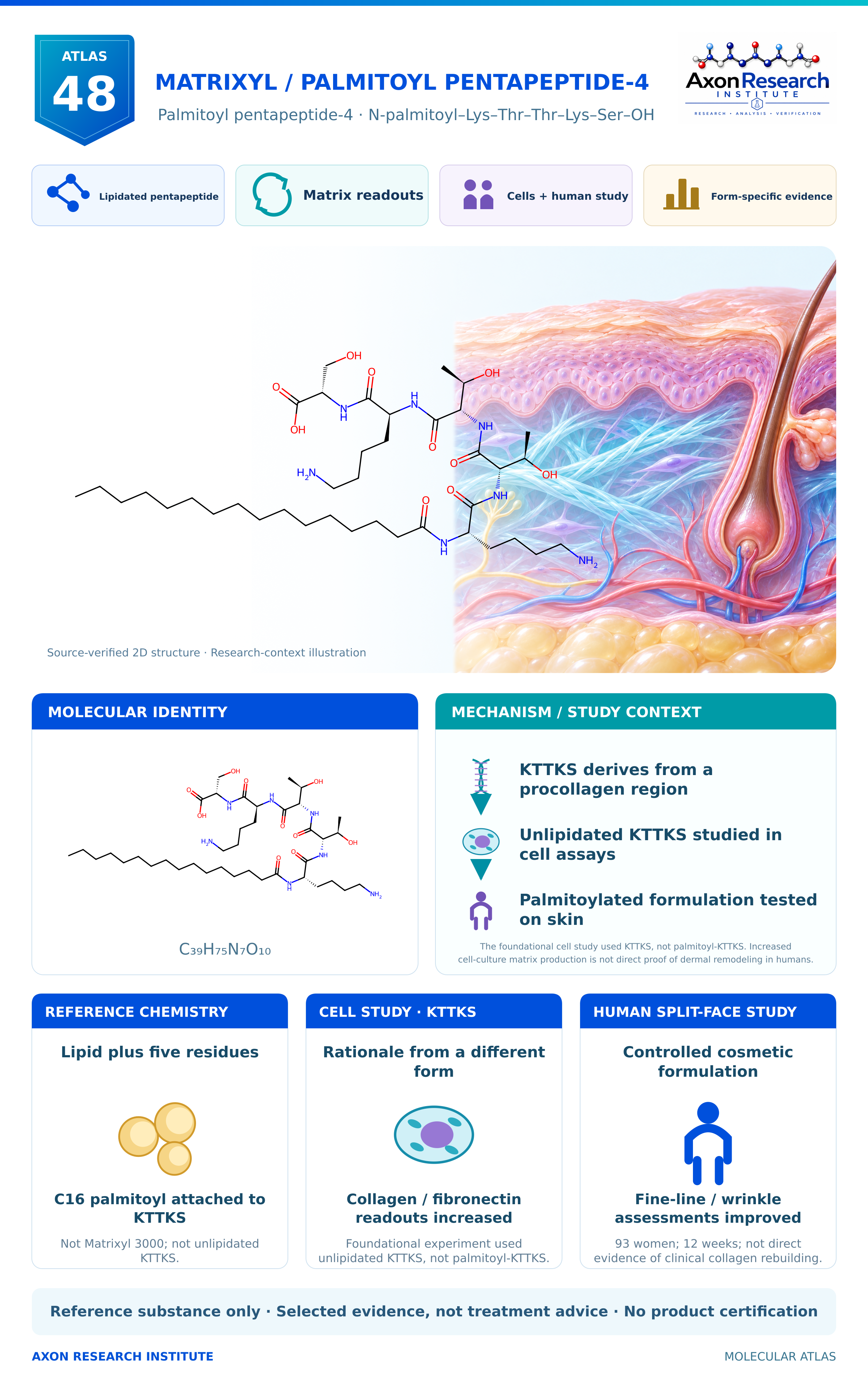
Visual summary only. The research findings, limitations and references accompany the card on this page.
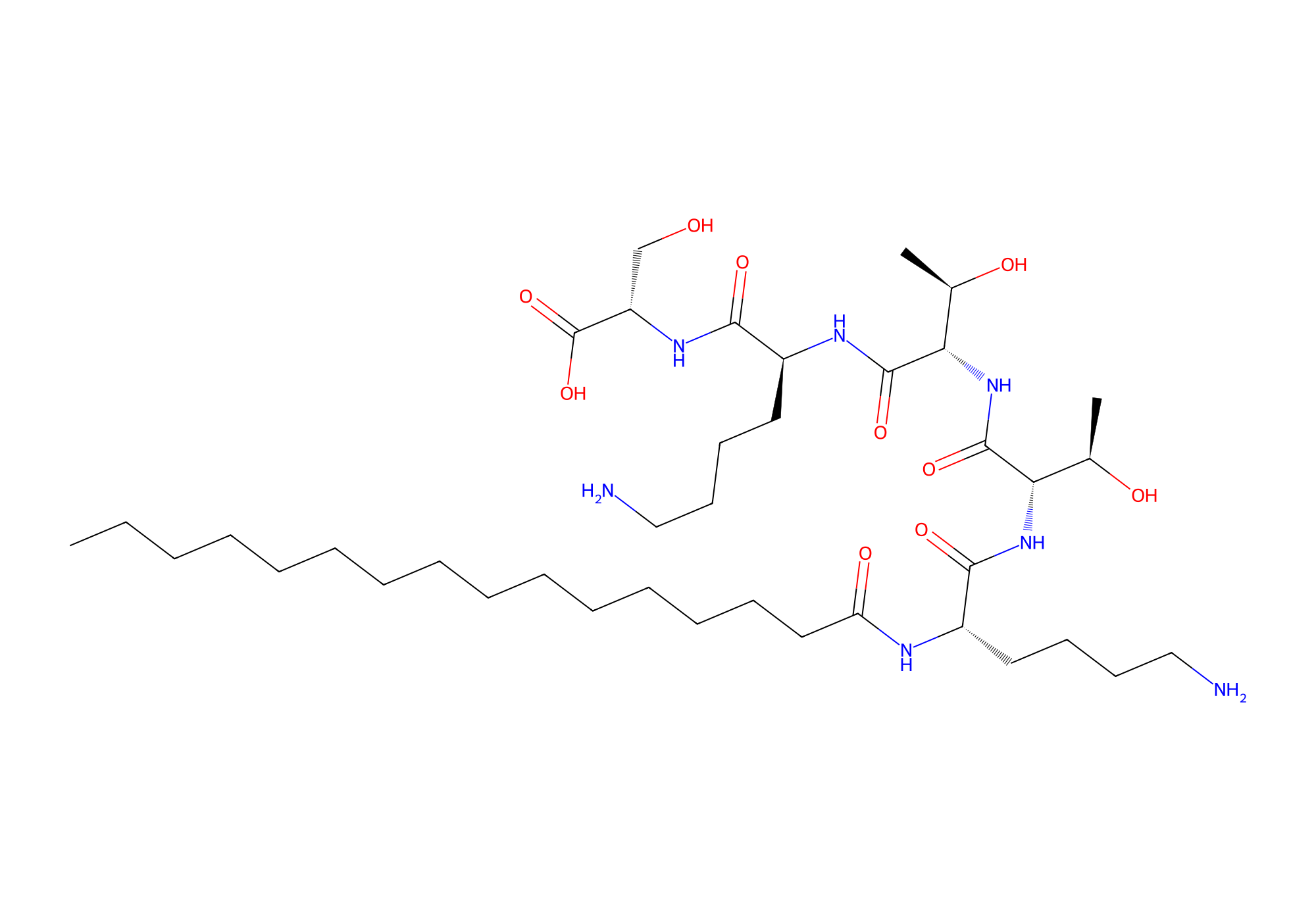
The chemical drawing shows source-verified two-dimensional connectivity and stereochemistry, not an experimental three-dimensional conformation. The biological setting is an illustration. Original study diagrams summarize cited research without reproducing publication artwork or inventing quantitative results.
Matrixyl / palmitoyl pentapeptide-4
Extracellular-matrix research
N-palmitoyl all-L Lys-Thr-Thr-Lys-Ser free-acid parent- Molecular formula
- C39H75N7O10
- Molecular weight
- 802.1 g/mol
- Class
- Lipidated cosmetic pentapeptide
- Identity
- Pal-Lys-Thr-Thr-Lys-Ser-OH
Research snapshot
Palmitoyl pentapeptide-4 joins a C16 lipid chain to KTTKS. Its collagen-fragment rationale comes from cell studies of unlipidated KTTKS; a controlled cosmetic trial tested the palmitoylated ingredient in a moisturizer.
Cells + topical cosmetic trial
Identity & representation
Reference parent, not an AXON formulation or salt.
Educational reference only. Not a dosing guide, treatment recommendation or product endorsement.
Palmitoyl pentapeptide-4 · N-palmitoyl–Lys–Thr–Thr–Lys–Ser–OH[1]
View the chemical structure →Sources checked: 2026-11-06. Identity and evidence limits are stated above. Independent specialist review is pending.
What researchers study
Palmitoyl pentapeptide-4 joins a C16 lipid chain to KTTKS. Its collagen-fragment rationale comes from cell studies of unlipidated KTTKS; a controlled cosmetic trial tested the palmitoylated ingredient in a moisturizer.
Collagen-fragment signaling
Extracellular-matrix production in cells
Photoaged-skin cosmetic measurements
Mechanism in context
- KTTKS derives from a procollagen region
- Cell models show extracellular-matrix responses
- Palmitoylated formulation is evaluated on skin
The foundational cell study used KTTKS, not palmitoyl-KTTKS. Increased cell-culture matrix production is not direct proof of dermal remodeling in humans.
Simplified publication-grounded schematic, not a solved protein structure or proof of clinical benefit.
Selected evidence
Cells + topical cosmetic trial
Topical palmitoyl pentapeptide provides improvement in photoaged human facial skin.[3]
Double-blind placebo-controlled split-face randomized study · 93 women aged 35–55 · 12 weeks
Observed: Peptide-containing moisturizer improved fine-line/wrinkle assessments versus matched moisturizer.
Peptide-containing moisturizer improved fine-line/wrinkle assessments versus matched moisturizer. Single formulation and demographic group; not direct clinical proof of collagen rebuilding.
Limit: Single formulation and demographic group; not direct clinical proof of collagen rebuilding.
Reference identity in detail
Sequences and form distinctions describe the cited reference substance, not a verified supplier preparation.
Research scope
Targeted source verification, not a systematic review. Citation quality and molecule-specific applicability are stated separately.
Safety & evidence limits
The foundational mechanism paper studied unlipidated KTTKS, so its findings require explicit attribution.
The controlled cosmetic trial used a specific moisturizer and a limited demographic sample.
Original Matrixyl, Matrixyl 3000 and other similarly named blends are chemically different.
Practical identity notes
- N-palmitoyl all-L Lys-Thr-Thr-Lys-Ser free-acid parent
- No original PubChem 3D conformer was available for this exact reference in the checked endpoint; use exact 2D structure.
- Reference identity is not confirmation of product contents, purity, sterility or therapeutic equivalence.
- Use verified stereo SMILES; downloaded PubChem 2D SDF has overlapping-neighbor stereo loss on parsing and is not cleared.
The 10-second takeaway
A lipidated KTTKS cosmetic ingredient with formulation-specific human evidence; distinguish it from other Matrixyl-branded blends.
What the visual panels show
Original diagrams summarize the cited research or documented evidence search. They are not copied publication figures or claims of treatment benefit.
MECHANISM / STUDY CONTEXT[2][3]
Publication-grounded mechanism schematic · Original publication-grounded diagram
KTTKS derives from a procollagen region · Unlipidated KTTKS studied in cell assays · Palmitoylated formulation tested on skin
Interpretation: The foundational cell study used KTTKS, not palmitoyl-KTTKS. Increased cell-culture matrix production is not direct proof of dermal remodeling in humans.
Lipid plus five residues[1]
REFERENCE CHEMISTRY · Original publication-grounded diagram
C16 palmitoyl attached to KTTKS
Not Matrixyl 3000; not unlipidated KTTKS.
Interpretation: Not Matrixyl 3000; not unlipidated KTTKS. Original conceptual illustration only; no fabricated data, docking geometry or clinical extrapolation.
Rationale from a different form[2]
CELL STUDY · KTTKS · Original publication-grounded diagram
Collagen / fibronectin readouts increased
Foundational experiment used unlipidated KTTKS, not palmitoyl-KTTKS.
Interpretation: Foundational experiment used unlipidated KTTKS, not palmitoyl-KTTKS. Original conceptual illustration only; no fabricated data, docking geometry or clinical extrapolation.
Controlled cosmetic formulation[3]
HUMAN SPLIT-FACE STUDY · Original publication-grounded diagram
Fine-line / wrinkle assessments improved
93 women; 12 weeks; not direct evidence of clinical collagen rebuilding.
Interpretation: 93 women; 12 weeks; not direct evidence of clinical collagen rebuilding. Original conceptual illustration only; no fabricated data, docking geometry or clinical extrapolation.
Follow the evidence
Sources & what they support
- PubChem CID 9897237: source reference graph
Supports: Exact reference graph, stereochemistry, formula and mass
Original structure record · Download depicted structure SDF
Generated 2D layout from the verified reference graph; not an original 2D source-record download.
- A pentapeptide from type I procollagen promotes extracellular matrix production.
Supports: KTTKS sequence and cell extracellular-matrix study; unlipidated comparator
- Topical palmitoyl pentapeptide provides improvement in photoaged human facial skin.
Supports: Controlled palmitoyl-KTTKS clinical cosmetic trial
← Explore the Molecular Atlas Continue to the research library →