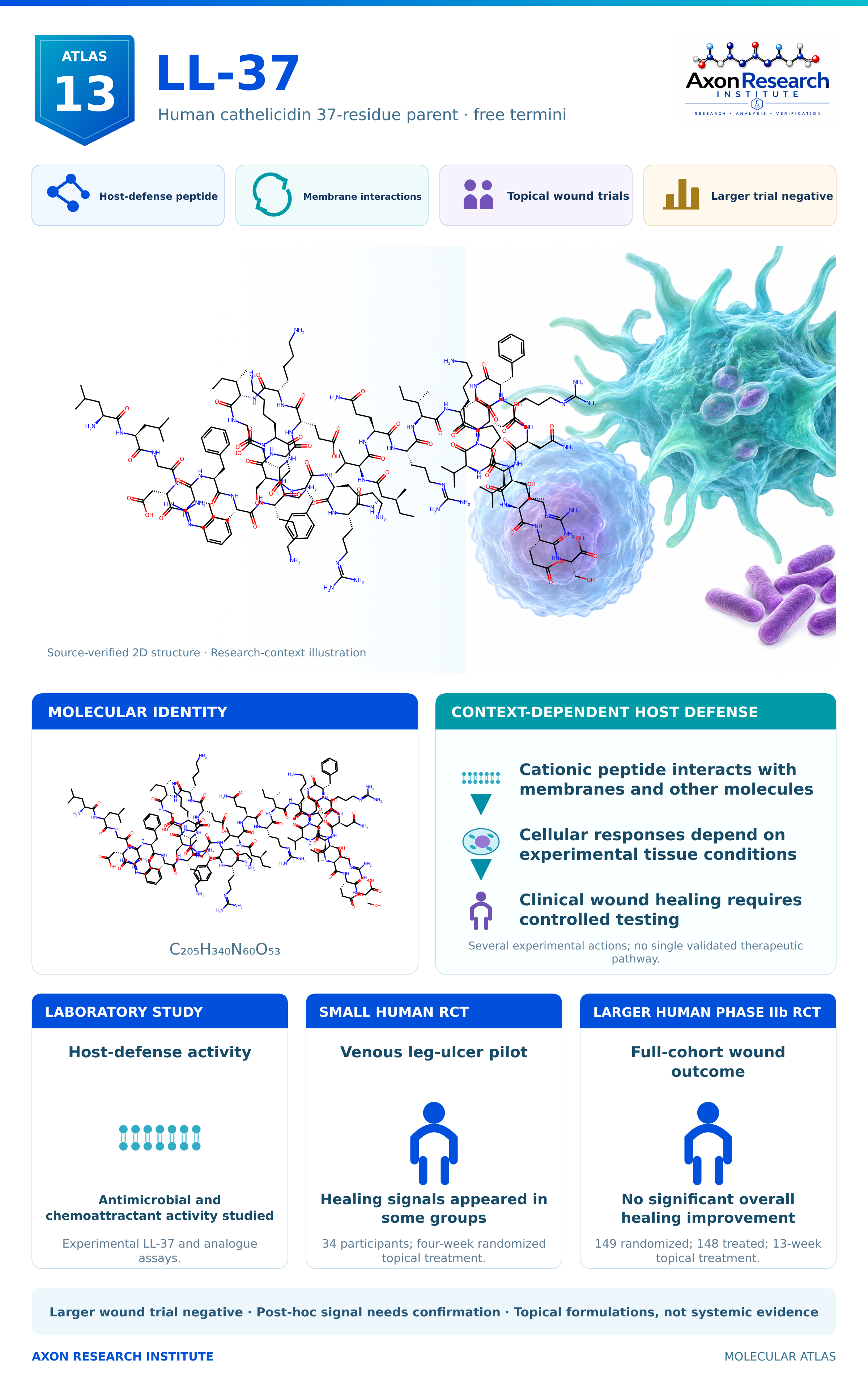
Visual summary only. The research findings, limitations and references accompany the card on this page.
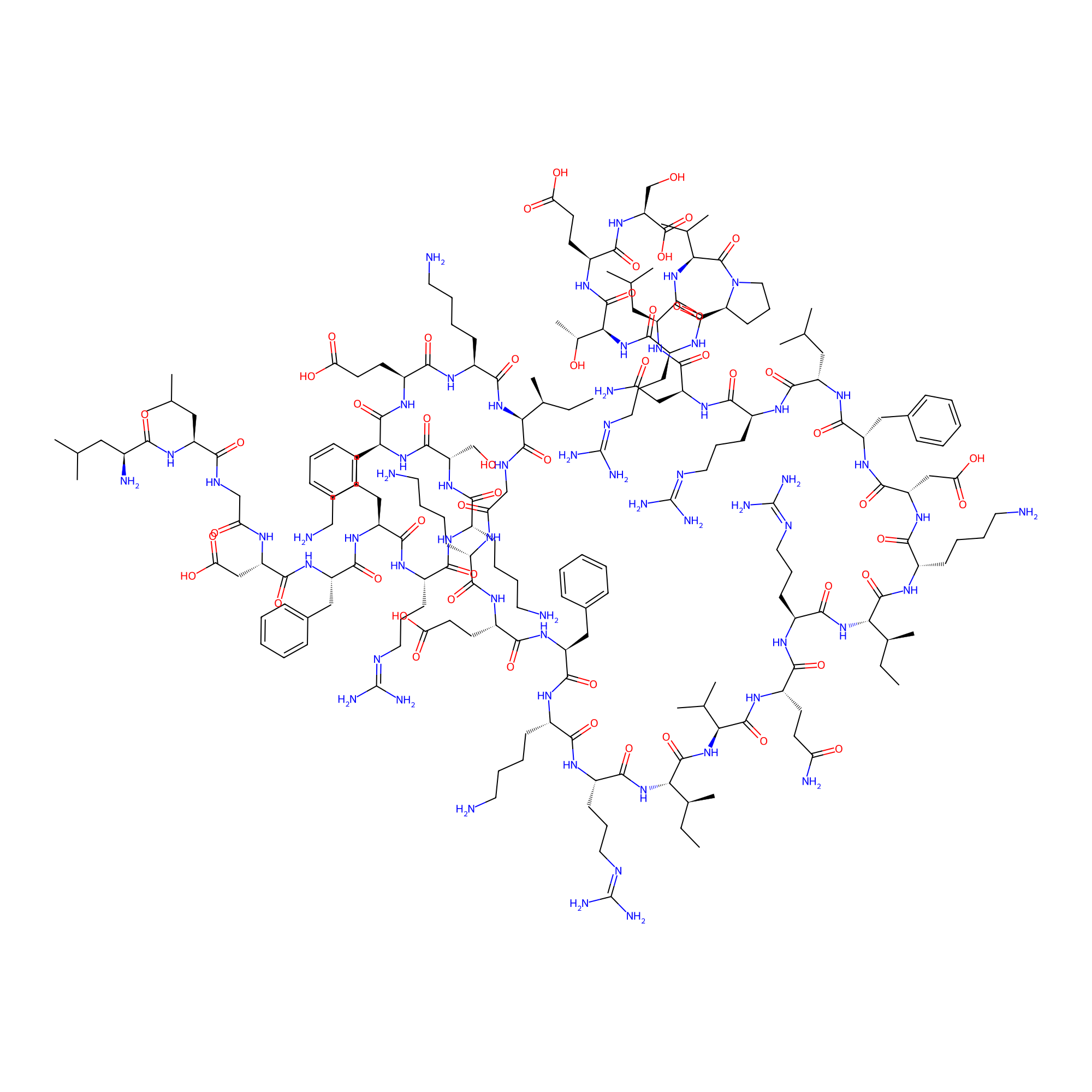
The chemical drawing shows source-verified two-dimensional connectivity and stereochemistry, not an experimental three-dimensional conformation. The biological setting is an illustration. Original study diagrams summarize cited research without reproducing publication artwork or inventing quantitative results.
LL-37
Membrane and immune interactions
Human cathelicidin LL-37; H-LLGDFFRKSKEKIGKEFKRIVQRIKDFLRNLVPRTES-OH- Molecular formula
- C205H340N60O53
- Molecular weight
- 4493 g/mol
- Class
- Host-defense peptide
- Identity
- LLGDFFRKSKEKIGKEFKRIVQRIKDFLRNLVPRTES
Research snapshot
LL-37 is the 37-residue host-defense peptide released from human cathelicidin. It has antimicrobial and context-dependent immune activity, and has been tested in controlled venous-leg-ulcer studies.
Cell studies; topical wound trials
Identity & representation
Literature reference identity only. AXON product composition, salt, purity, sterility and equivalence were not verified. Exact depicted parent/reference form; excludes counterions and excipients unless expressly stated.
Educational reference only. Not a dosing guide, treatment recommendation or product endorsement.
Human cathelicidin 37-residue parent · free termini[1]
View the chemical structure →Sources checked: 2026-11-06. Identity and evidence limits are stated above. Independent specialist review is pending.
What researchers study
LL-37 is the 37-residue host-defense peptide released from human cathelicidin. It has antimicrobial and context-dependent immune activity, and has been tested in controlled venous-leg-ulcer studies.
Antimicrobial membrane interactions and host-cell responses in experimental systems
Topical investigational formulations for hard-to-heal venous leg ulcers
Peptide activity, degradation and immune effects in wound microenvironments
Mechanism in context
- Cationic peptide interacts with membranes and other molecules
- Cell responses depend on local tissue conditions
- Wound-healing effects require controlled clinical assessment
LL-37 has several context-dependent actions rather than one validated therapeutic pathway. The larger wound trial did not show overall efficacy.
Simplified publication-grounded schematic, not a solved protein structure or proof of clinical benefit.
Selected evidence
Cell studies; topical wound trials
Treatment with LL-37 is safe and effective in enhancing healing of hard-to-heal venous leg ulcers: a randomized, placebo-controlled clinical trial.[2]
First-in-human randomized double-blind placebo-controlled phase · 34 participants with venous leg ulcers · 4-week randomized treatment; 4-week follow-up
Observed: Healing signals in two lower-concentration groups; not in the highest group.
An exploratory trial of 34 participants used a four-week randomized treatment phase. Some topical LL-37 groups showed better healing measures, while the highest-concentration group did not. Its small size and multiple comparisons required confirmation, rather than proving general wound-healing benefit.
Limit: Small exploratory trial with several groups; not a definitive efficacy or systemic-safety study.
Evaluation of LL-37 in healing of hard-to-heal venous leg ulcers: A multicentric prospective randomized placebo-controlled clinical trial.[3]
Phase IIb multicentre randomized double-blind placebo-controlled trial · 149 randomized; 148 treated · 13-week treatment; 4-month follow-up
Observed: No significant healing improvement in the full cohort; large-ulcer subgroup signal was post hoc.
The larger phase IIb trial treated 148 participants for 13 weeks with investigational topical formulations plus compression. It did not improve healing significantly across the full cohort. A post-hoc large-ulcer subgroup finding is hypothesis-generating and needs a prospectively designed confirmatory trial.
Limit: Post-hoc subgroup result needs prospective confirmation.
Reference identity in detail
Sequences and form distinctions describe the cited reference substance, not a verified supplier preparation.
Safety & evidence limits
The phase IIb overall result was negative; highlighting only the earlier pilot or post-hoc subgroup would overstate the evidence.
FDA flags uncertain compounded-product safety, immunogenicity concerns and adverse nonclinical signals; limited trial tolerability is not comprehensive safety.
A topical study formulation does not validate systemic administration, other formulations, or unverified research-vial material.
Practical identity notes
- 37 residues with free N- and C-termini in the reference structure.
- PubChem CIDs 134611881 and 16198951 share the same standard InChIKey; CID134611881 explicitly records the full sequence.
- “LL” denotes the initial two leucines; fragments and citrullinated forms are distinct molecules.
The 10-second takeaway
A biologically active host-defense peptide; its larger wound trial found no overall healing benefit.
What the visual panels show
Original diagrams summarize the cited research or documented evidence search. They are not copied publication figures or claims of treatment benefit.
CONTEXT-DEPENDENT HOST DEFENSE[5][3]
Publication-grounded mechanism schematic · Original publication-grounded diagram
Cationic peptide interacts with membranes and other molecules · Cellular responses depend on experimental tissue conditions · Clinical wound healing requires controlled testing
Interpretation: Several experimental actions; no single validated therapeutic pathway.
Host-defense activity[5]
LABORATORY STUDY · Original publication-grounded diagram
Antimicrobial and chemoattractant activity studied
Experimental LL-37 and analogue assays.
Interpretation: Use a symbolic membrane, not proof of eradication of human infection or clinical efficacy.
Venous leg-ulcer pilot[2]
SMALL HUMAN RCT · Original publication-grounded diagram
Healing signals appeared in some groups
34 participants; four-week randomized topical treatment.
Interpretation: Multiple groups and small sample; highest-concentration group lacked the same signal. No generalized healing claim.
Full-cohort wound outcome[3]
LARGER HUMAN PHASE IIb RCT · Original publication-grounded diagram
No significant overall healing improvement
149 randomized; 148 treated; 13-week topical treatment.
Interpretation: Large-ulcer subgroup was post hoc. Do not portray subgroup success as overall efficacy or validate systemic use.
Follow the evidence
Sources & what they support
- PubChem compound record 134611881
Supports: identity; structure; formula; molecular_weight; stereochemistry
Original structure record · Download depicted structure SDF
Generated 2D layout from the verified reference graph; not an original 2D source-record download.
- Treatment with LL-37 is safe and effective in enhancing healing of hard-to-heal venous leg ulcers: a randomized, placebo-controlled clinical trial.
Supports: early human trial
- Evaluation of LL-37 in healing of hard-to-heal venous leg ulcers: A multicentric prospective randomized placebo-controlled clinical trial.
Supports: later human trial; primary limitation
- FDA compounding safety concerns
Supports: safety limitation
- Antimicrobial and chemoattractant activity of human cathelicidin LL-37 analogues
Supports: sequence; experimental antimicrobial context
← Explore the Molecular Atlas Continue to the research library →