Visual summary only. The research findings, limitations and references accompany the card on this page.
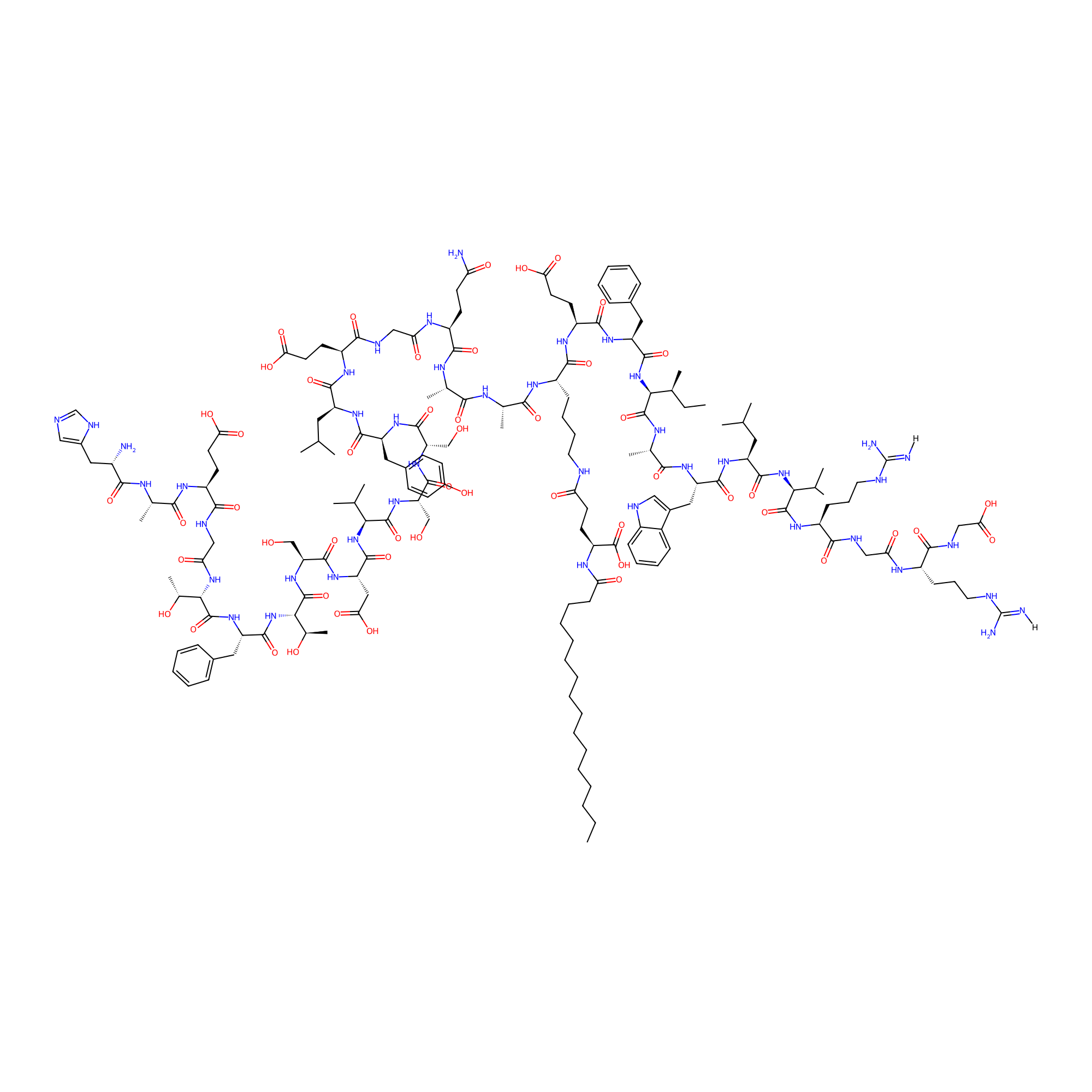
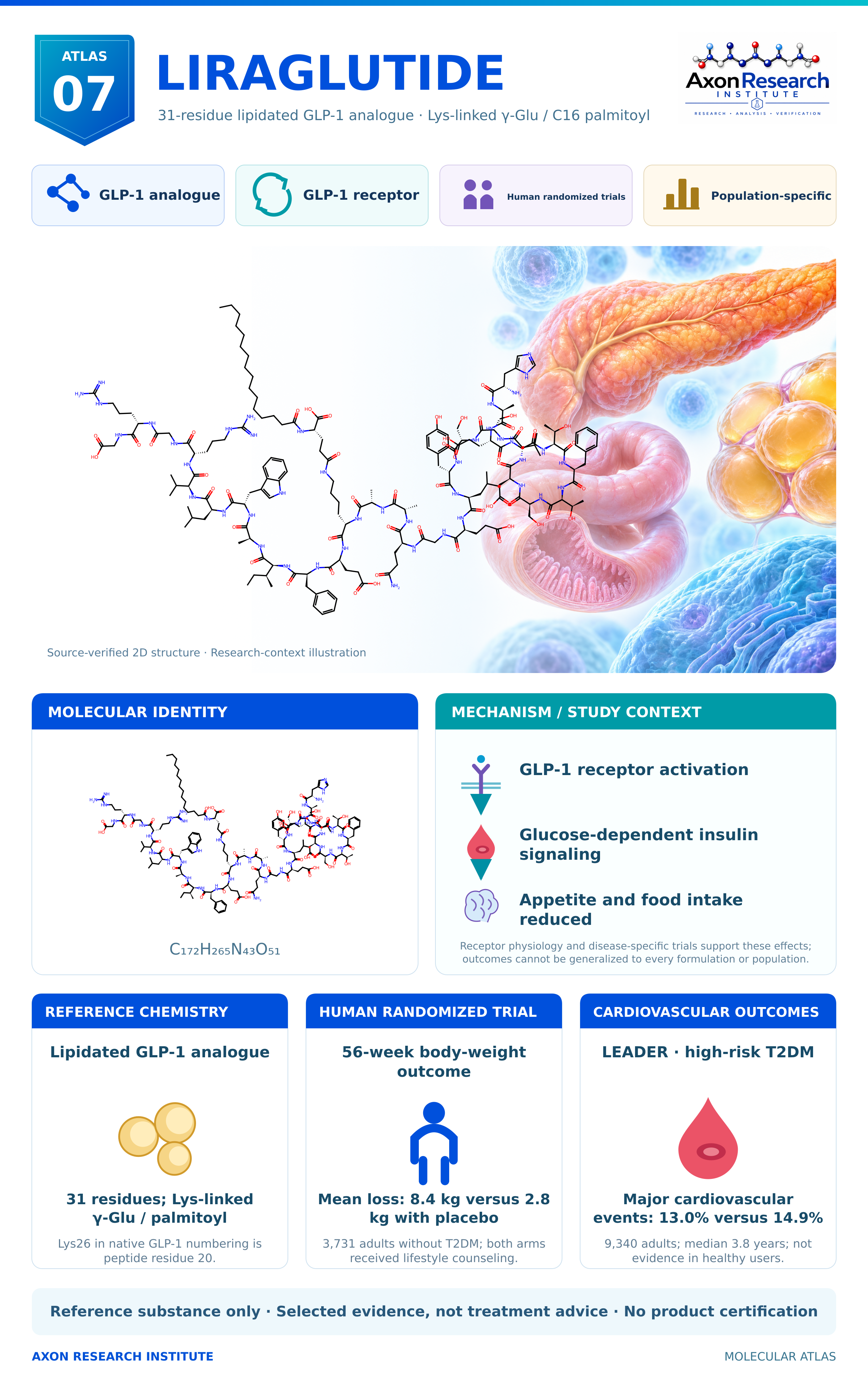
The chemical drawing shows source-verified two-dimensional connectivity and stereochemistry, not an experimental three-dimensional conformation. The biological setting is an illustration. Original study diagrams summarize cited research without reproducing publication artwork or inventing quantitative results.
Liraglutide
GLP-1 receptor
Liraglutide parent, 31-residue lipidated GLP-1 analogue- Molecular formula
- C172H265N43O51
- Molecular weight
- 3751.2 g/mol
- Class
- Lipidated GLP-1 analogue
- Identity
- HAEGTFTSDVSSYLEGQAAK[acyl]EFIAWLVRGRG-OH
Research snapshot
Liraglutide is a lipidated GLP-1 receptor agonist. Clinical formulations have been tested for glycemic control, weight management and cardiovascular outcomes in defined populations; catalog peptides are not thereby validated.
Large human randomized trials
Identity & representation
Literature reference substance only; no equivalence to a catalog product or tested supplier lot is asserted. Arg34 replaces Lys34 in GLP-1 numbering. Peptide Lys20 = GLP-1 Lys26: epsilon-N acylated through L-gamma-Glu to C16 palmitoyl; no Aib and no OEG spacers. Free N and C termini.
Educational reference only. Not a dosing guide, treatment recommendation or product endorsement.
31-residue lipidated GLP-1 analogue · Lys-linked γ-Glu / C16 palmitoyl[4]
View the chemical structure →Sources checked: 2026-11-06. Identity and evidence limits are stated above. Independent specialist review is pending.
What researchers study
Liraglutide is a lipidated GLP-1 receptor agonist. Clinical formulations have been tested for glycemic control, weight management and cardiovascular outcomes in defined populations; catalog peptides are not thereby validated.
Glycemic regulation in type 2 diabetes
Weight-management trials with lifestyle intervention
Cardiovascular outcomes in high-risk type 2 diabetes
Mechanism / evidence map
- GLP-1 receptor activation
- Glucose-dependent insulin signaling
- Reduced appetite and food intake
Receptor physiology and disease-specific trials support these effects; outcomes cannot be generalized to every formulation or population.
Simplified publication-grounded schematic, not a solved protein structure or proof of clinical benefit.
Selected evidence
Extensive human trial evidence exists for specific prescribed formulations and indications; this card is not a use recommendation.
A Randomized, Controlled Trial of 3.0 mg of Liraglutide in Weight Management.[1]
Double-blind randomized placebo-controlled trial · Adults with obesity or overweight and a weight-related condition · 56 weeks · Reported n: 3731
Observed: Mean weight loss was 8.4 kg with liraglutide versus 2.8 kg with placebo; both groups received lifestyle counseling.
Limit: Population excluded type 2 diabetes. Gastrointestinal adverse events were common; outcome depends on the tested clinical formulation.
Liraglutide and Cardiovascular Outcomes in Type 2 Diabetes.[2]
Double-blind cardiovascular outcomes randomized trial · Adults with type 2 diabetes and high cardiovascular risk · Median follow-up 3.8 years · Reported n: 9340
Observed: Major cardiovascular events occurred in 13.0% versus 14.9%; hazard ratio 0.87, 95% CI 0.78–0.97.
Limit: High cardiovascular-risk type 2 diabetes population; not proof of benefit in otherwise healthy users.
Reference identity in detail
Sequences and form distinctions describe the cited reference substance, not a verified supplier preparation.
Safety & evidence limits
Gastrointestinal adverse effects are common. Label warnings include pancreatitis, gallbladder disease and volume-depletion kidney injury.
The label includes a thyroid C-cell tumor warning based on rodent findings; human relevance remains uncertain.
A research catalog label does not establish identity, purity, sterility, bioequivalence or clinical suitability.
Practical identity notes
- 31 residues; C16 palmitoyl branch at GLP-1 Lys26.
- Reference-parent formula C172H265N43O51; FDA-listed molecular mass 3751.2 g/mol.
- Unlike semaglutide, the backbone retains Ala8 and the branch has no OEG spacers.
- Disease-specific clinical evidence • Reference form only
The 10-second takeaway
An established GLP-1 drug molecule with strong indication-specific human evidence, not automatic validation of research-market products.
What the visual panels show
Original diagrams summarize the cited research or documented evidence search. They are not copied publication figures or claims of treatment benefit.
MECHANISM / STUDY CONTEXT[3]
Publication-grounded mechanism schematic · Original publication-grounded diagram
GLP-1 receptor activation · Glucose-dependent insulin signaling · Appetite and food intake reduced
Interpretation: Receptor physiology and disease-specific trials support these effects; outcomes cannot be generalized to every formulation or population.
Lipidated GLP-1 analogue[3]
REFERENCE CHEMISTRY · Original publication-grounded diagram
31 residues; Lys-linked γ-Glu / palmitoyl
Lys26 in native GLP-1 numbering is peptide residue 20.
Interpretation: Lys26 in native GLP-1 numbering is peptide residue 20. Original conceptual illustration only; no fabricated data, docking geometry or clinical extrapolation.
56-week body-weight outcome[1]
HUMAN RANDOMIZED TRIAL · Original publication-grounded diagram
Mean loss: 8.4 kg versus 2.8 kg with placebo
3,731 adults without T2DM; both arms received lifestyle counseling.
Interpretation: 3,731 adults without T2DM; both arms received lifestyle counseling. Original conceptual illustration only; no fabricated data, docking geometry or clinical extrapolation.
LEADER · high-risk T2DM[2]
CARDIOVASCULAR OUTCOMES · Original publication-grounded diagram
Major cardiovascular events: 13.0% versus 14.9%
9,340 adults; median 3.8 years; not evidence in healthy users.
Interpretation: 9,340 adults; median 3.8 years; not evidence in healthy users. Original conceptual illustration only; no fabricated data, docking geometry or clinical extrapolation.
Follow the evidence
Sources & what they support
- A Randomized, Controlled Trial of 3.0 mg of Liraglutide in Weight Management.
Supports: Weight-management trial design/results/adverse events
- Liraglutide and Cardiovascular Outcomes in Type 2 Diabetes.
Supports: LEADER cardiovascular outcomes
- Victoza prescribing information (2025)
Supports: Exact sequence/modification, formula/mass, mechanism and safety
- PubChem CID 16134956
Supports: Reference atom graph cross-checked to peptide chemistry
Original structure record · Download source SDF
Original PubChem 2D source structure record.
← Explore the Molecular Atlas Continue to the research library →