Visual summary only. The research findings, limitations and references accompany the card on this page.
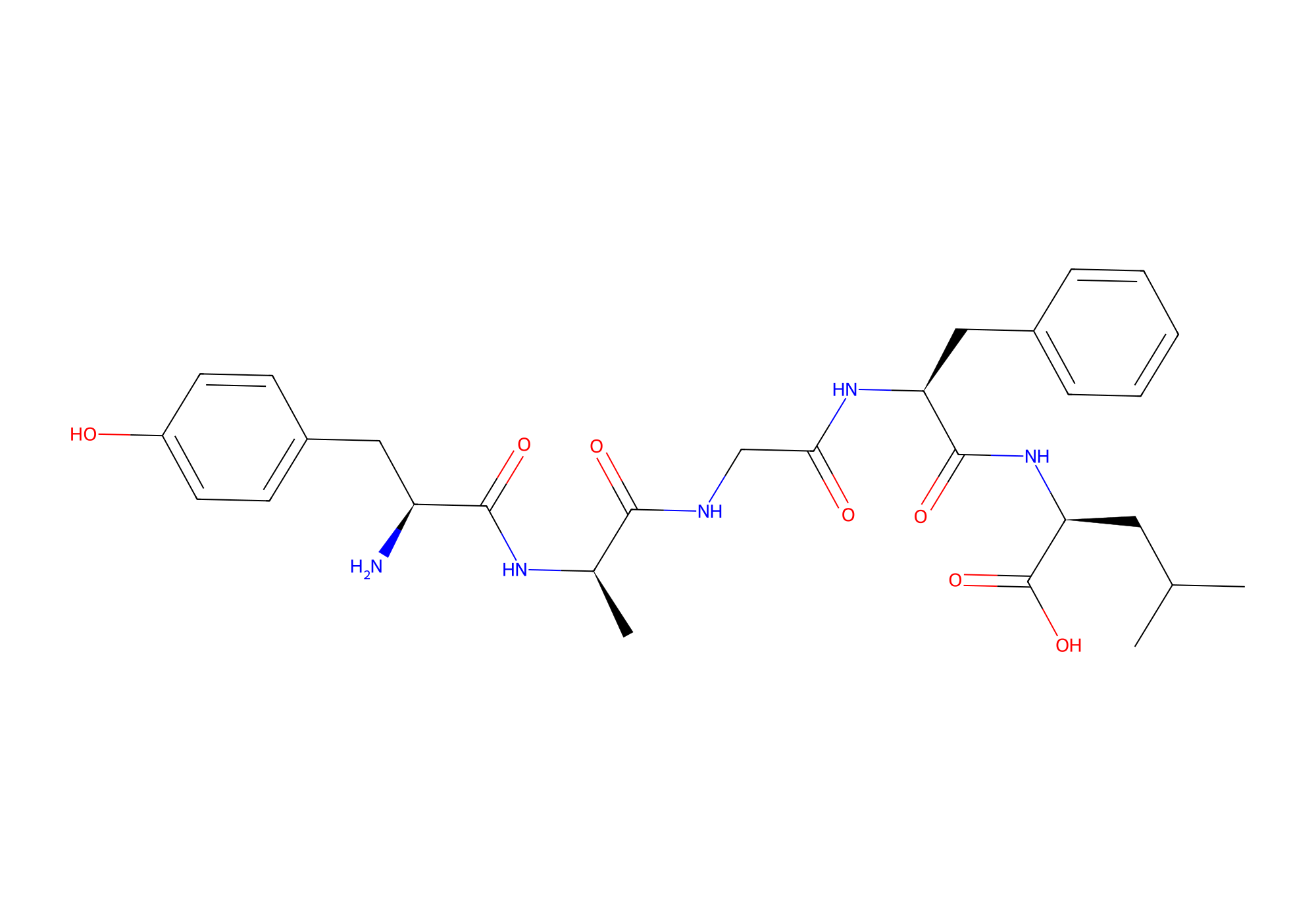
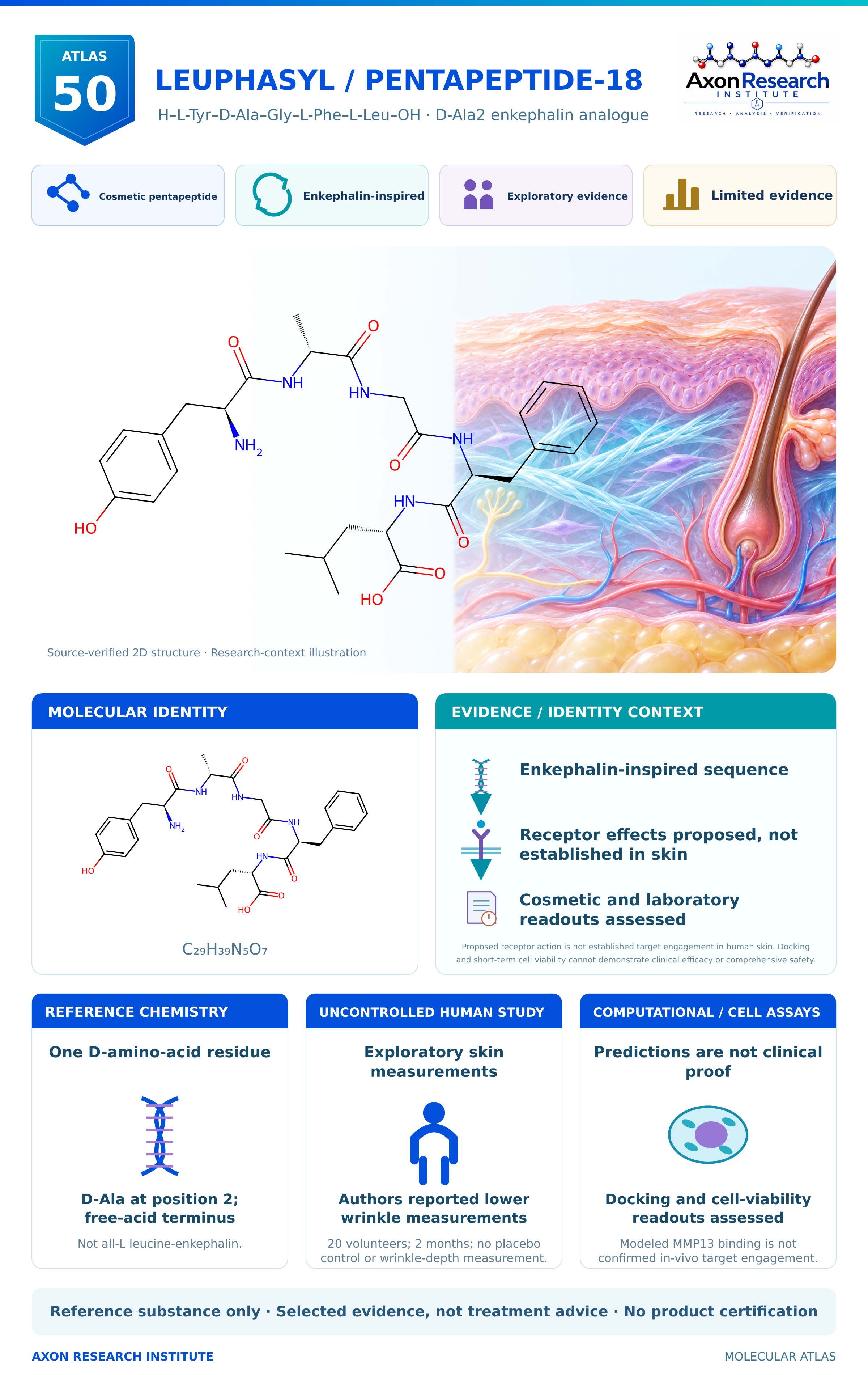
The chemical drawing shows source-verified two-dimensional connectivity and stereochemistry, not an experimental three-dimensional conformation. The biological setting is an illustration. Original study diagrams summarize cited research without reproducing publication artwork or inventing quantitative results.
Leuphasyl / pentapeptide-18
Enkephalin-inspired design
H-L-Tyr-D-Ala-Gly-L-Phe-L-Leu-OH; D-Ala2 leucine-enkephalin analog- Molecular formula
- C29H39N5O7
- Molecular weight
- 569.6 g/mol
- Class
- Cosmetic pentapeptide
- Identity
- H-Tyr-D-Ala-Gly-Phe-Leu-OH
Research snapshot
Leuphasyl is the D-Ala2 analog of a leucine-enkephalin sequence. Exploratory cosmetic studies and newer modeling work investigate it, but these do not establish robust clinical efficacy or a proven skin neuromuscular mechanism.
Exploratory cosmetic + laboratory evidence
Identity & representation
Reference parent, not an AXON formulation or salt.
Educational reference only. Not a dosing guide, treatment recommendation or product endorsement.
H–L-Tyr–D-Ala–Gly–L-Phe–L-Leu–OH · D-Ala2 enkephalin analogue[1]
View the chemical structure →Sources checked: 2026-11-06. Identity and evidence limits are stated above. Independent specialist review is pending.
What researchers study
Leuphasyl is the D-Ala2 analog of a leucine-enkephalin sequence. Exploratory cosmetic studies and newer modeling work investigate it, but these do not establish robust clinical efficacy or a proven skin neuromuscular mechanism.
Cosmetic wrinkle measurement
Molecular interaction modeling
Peptide modification in skin models
Mechanism in context
- Enkephalin-inspired sequence is formulated
- Receptor-related effects are proposed
- Cosmetic and laboratory readouts are assessed
Proposed receptor action is not established target engagement in human skin. Docking and short-term cell viability cannot demonstrate clinical efficacy or comprehensive safety.
Simplified publication-grounded schematic, not a solved protein structure or proof of clinical benefit.
Selected evidence
Exploratory cosmetic + laboratory evidence
The Efficiency and Safety of Leuphasyl—A Botox-Like Peptide[3]
Exploratory uncontrolled cosmetic formulation study · 20 volunteers · 2 months
Observed: Authors reported reduced two-dimensional wrinkle measurements with one tested formulation.
Limit: No placebo, clear randomization or blinding; wrinkle depth not measured; broad safety claims exceed study design.
Reference identity in detail
Sequences and form distinctions describe the cited reference substance, not a verified supplier preparation.
Research scope
Targeted source verification, not a systematic review. Citation quality and molecule-specific applicability are stated separately.
Safety & evidence limits
The published 20-volunteer cosmetic study lacked a placebo arm and reported no clear randomization or blinding.
Computational binding predictions and cultured-cell viability are not clinical safety or efficacy trials.
D-tyrosine-modified derivatives are different molecules; their pigmentation results do not establish effects of parent Leuphasyl.
Practical identity notes
- H-L-Tyr-D-Ala-Gly-L-Phe-L-Leu-OH; D-Ala2 leucine-enkephalin analog
- No original PubChem 3D conformer was available for this exact reference in the checked endpoint; use exact 2D structure.
- Reference identity is not confirmation of product contents, purity, sterility or therapeutic equivalence.
The 10-second takeaway
A defined enkephalin-inspired cosmetic peptide with limited human evidence; modeling and derivative data need clear boundaries.
What the visual panels show
Original diagrams summarize the cited research or documented evidence search. They are not copied publication figures or claims of treatment benefit.
EVIDENCE / IDENTITY CONTEXT[2][3][4]
Publication-grounded mechanism schematic · Original publication-grounded diagram
Enkephalin-inspired sequence · Receptor effects proposed, not established in skin · Cosmetic and laboratory readouts assessed
Interpretation: Proposed receptor action is not established target engagement in human skin. Docking and short-term cell viability cannot demonstrate clinical efficacy or comprehensive safety.
One D-amino-acid residue[1][2]
REFERENCE CHEMISTRY · Original publication-grounded diagram
D-Ala at position 2; free-acid terminus
Not all-L leucine-enkephalin.
Interpretation: Not all-L leucine-enkephalin. Original conceptual illustration only; no fabricated data, docking geometry or clinical extrapolation.
Exploratory skin measurements[3]
UNCONTROLLED HUMAN STUDY · Original publication-grounded diagram
Authors reported lower wrinkle measurements
20 volunteers; 2 months; no placebo control or wrinkle-depth measurement.
Interpretation: 20 volunteers; 2 months; no placebo control or wrinkle-depth measurement. Original conceptual illustration only; no fabricated data, docking geometry or clinical extrapolation.
Predictions are not clinical proof[4]
COMPUTATIONAL / CELL ASSAYS · Original publication-grounded diagram
Docking and cell-viability readouts assessed
Modeled MMP13 binding is not confirmed in-vivo target engagement.
Interpretation: Modeled MMP13 binding is not confirmed in-vivo target engagement. Original conceptual illustration only; no fabricated data, docking geometry or clinical extrapolation.
Follow the evidence
Sources & what they support
- PubChem CID 10099522: source reference graph
Supports: Exact reference graph, stereochemistry, formula and mass
Original structure record · Download source SDF
Original PubChem 2D source structure record.
- D-tyrosine adds an anti-melanogenic effect to cosmetic peptides.
Supports: Parent Y-D-Ala-Gly-Phe-Leu identity; modified derivatives tested, not parent whitening efficacy
- The Efficiency and Safety of Leuphasyl—A Botox-Like Peptide
Supports: Exploratory20-volunteer 60-day topical study; no placebo/randomization reported
- Integrative In Silico and In Vitro Evaluation of Vialox and Leuphasyl Pentapeptides for Antiaging Applications.
Supports: Docking/dynamics and HaCaT cytotoxicity, not human efficacy
- Pentapeptide-18 as an anti-aging candidate: Spectroscopic characterization and molecular interaction analysis.
Supports: Spectroscopy and computational characterization, not clinical trial
← Explore the Molecular Atlas Continue to the research library →