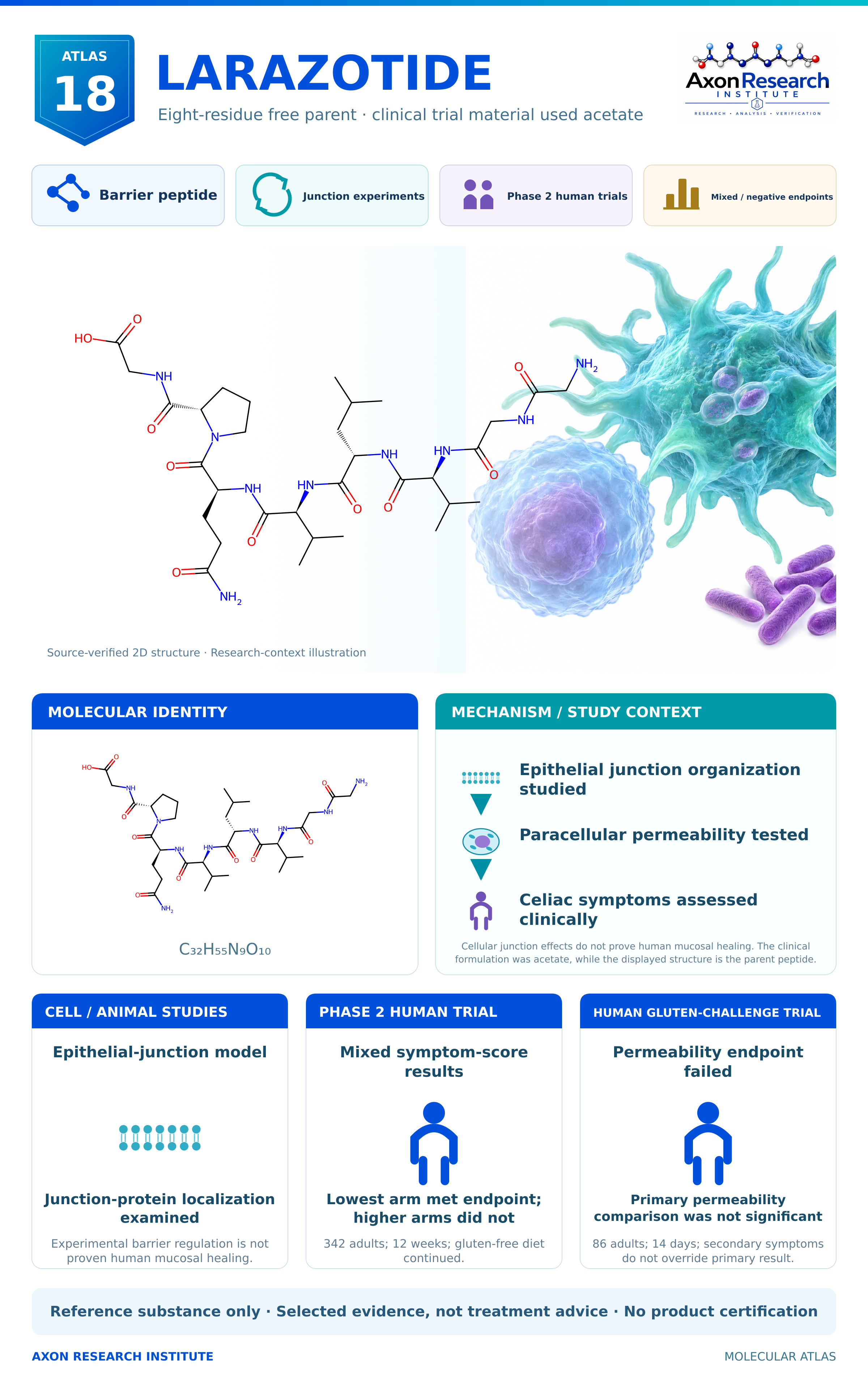
Visual summary only. The research findings, limitations and references accompany the card on this page.
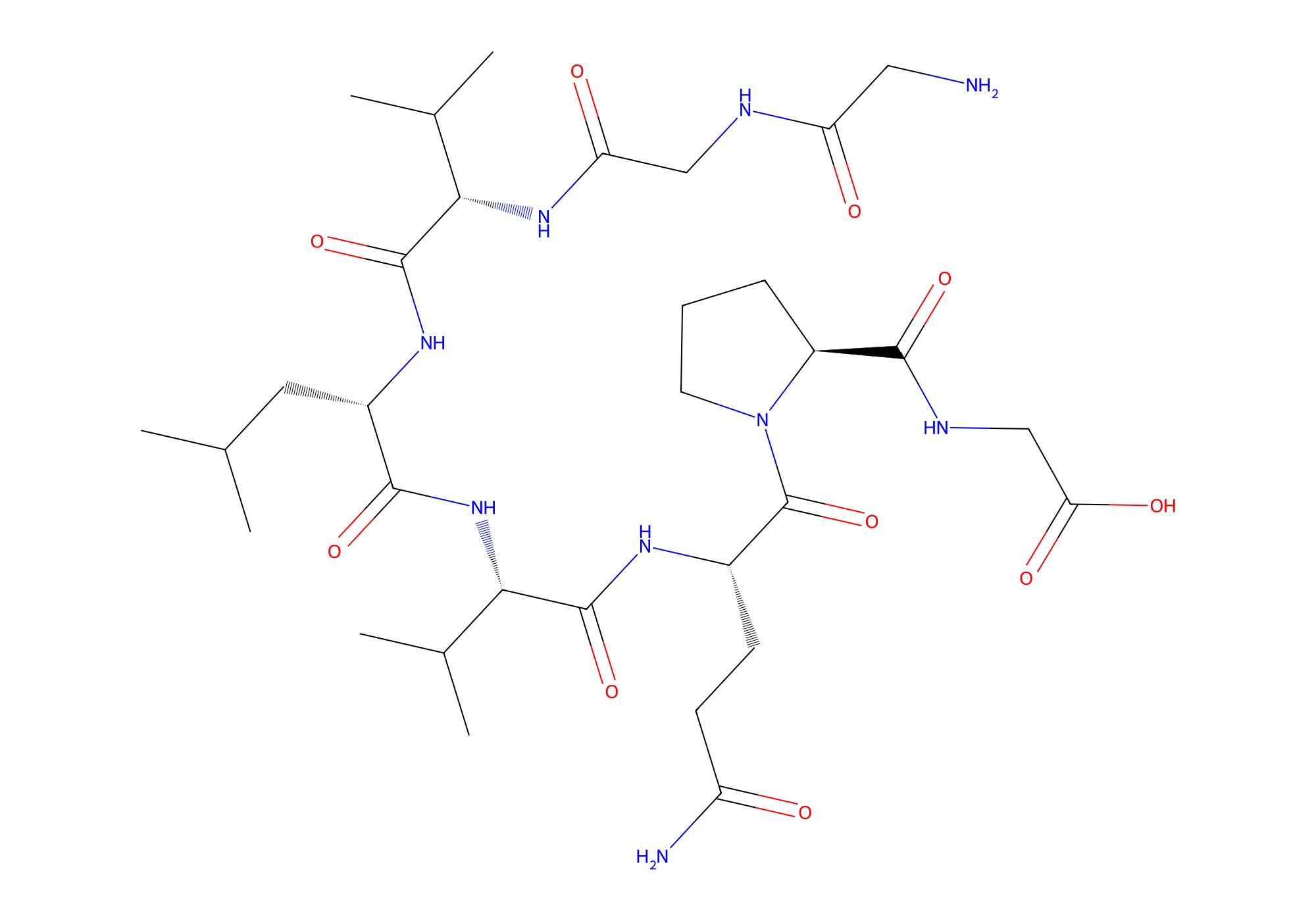
The chemical drawing shows source-verified two-dimensional connectivity and stereochemistry, not an experimental three-dimensional conformation. The biological setting is an illustration. Original study diagrams summarize cited research without reproducing publication artwork or inventing quantitative results.
Larazotide
Epithelial junction organization
Larazotide free peptide parent; clinical studies used acetate material- Molecular formula
- C32H55N9O10
- Molecular weight
- 725.8 g/mol
- Class
- Tight-junction regulator peptide
- Identity
- GGVLVQPG-OH
Research snapshot
Larazotide is an octapeptide studied for epithelial tight-junction regulation. Celiac-disease trials used larazotide acetate alongside a gluten-free diet and produced mixed symptom results, without established general barrier-healing efficacy.
Cell/animal work; mixed human trials
Identity & representation
Literature reference substance only; no equivalence to a catalog product or tested supplier lot is asserted. Eight residues, all-L where chiral, free N and C termini. Counterion is excluded from displayed parent graph/formula.
Educational reference only. Not a dosing guide, treatment recommendation or product endorsement.
Eight-residue free parent · clinical trial material used acetate[5]
View the chemical structure →Sources checked: 2026-11-06. Identity and evidence limits are stated above. Independent specialist review is pending.
What researchers study
Larazotide is an octapeptide studied for epithelial tight-junction regulation. Celiac-disease trials used larazotide acetate alongside a gluten-free diet and produced mixed symptom results, without established general barrier-healing efficacy.
Tight-junction protein localization in epithelial models
Permeability measurements under gluten challenge
Persistent celiac symptoms despite a gluten-free diet
Mechanism / evidence map
- Epithelial junction organization changes
- Paracellular permeability tested
- Celiac symptoms evaluated in trials
Cellular junction effects do not prove human mucosal healing. The clinical formulation was acetate, while the displayed structure is the parent peptide.
Simplified publication-grounded schematic, not a solved protein structure or proof of clinical benefit.
Selected evidence
Phase2 results were mixed. NCT03569007, the subsequent phase 3 study, is registered as terminated by the sponsor; that registry status alone does not specify futility.
Larazotide acetate for persistent symptoms of celiac disease despite a gluten-free diet: a randomized controlled trial.[2]
Multicenter randomized double-blind placebo-controlled phase 2 trial · Adults with celiac disease symptomatic despite gluten-free diet · 12 weeks treatment; 4-week run-in and 4-week run-out · Reported n: 342
Observed: The lowest studied arm met the symptom-score primary endpoint; the two higher arms did not differ from placebo. Safety was comparable in this trial.
Limit: Mixed dose-response pattern; outcomes were symptoms, not proof of histologic healing or unrestricted gluten tolerance.
A randomized, double-blind study of larazotide acetate to prevent the activation of celiac disease during gluten challenge.[3]
Randomized double-blind placebo-controlled gluten-challenge trial · Adults with diet-controlled celiac disease · 14 days · Reported n: 86
Observed: Primary lactulose/mannitol permeability comparison was not significant; some symptom measures favored lower treatment arms.
Limit: Permeability measurements were highly variable; secondary symptom signals must be distinguished from the failed primary endpoint.
Reference identity in detail
Sequences and form distinctions describe the cited reference substance, not a verified supplier preparation.
Safety & evidence limits
Clinical trial findings apply to celiac disease with continued gluten-free diet; they do not justify unrestricted gluten exposure.
The primary permeability endpoint was negative in the 86-person challenge study, despite selected symptom signals.
A later phase 3 study was terminated; do not describe development as successfully completed or human efficacy as established.
Practical identity notes
- Reference sequence GGVLVQPG; eight residues.
- Displayed parent formula excludes acetate counterion.
- Do not substitute a receptor-binding claim for the demonstrated junction assays without additional direct evidence.
- Investigational; trial-specific results • Reference form only
The 10-second takeaway
Junction biology is plausible, but human celiac-trial results were mixed and a later phase 3 study was terminated.
What the visual panels show
Original diagrams summarize the cited research or documented evidence search. They are not copied publication figures or claims of treatment benefit.
MECHANISM / STUDY CONTEXT[1][2][3]
Publication-grounded mechanism schematic · Original publication-grounded diagram
Epithelial junction organization studied · Paracellular permeability tested · Celiac symptoms assessed clinically
Interpretation: Cellular junction effects do not prove human mucosal healing. The clinical formulation was acetate, while the displayed structure is the parent peptide.
Epithelial-junction model[1]
CELL / ANIMAL STUDIES · Original publication-grounded diagram
Junction-protein localization examined
Experimental barrier regulation is not proven human mucosal healing.
Interpretation: Experimental barrier regulation is not proven human mucosal healing. Original conceptual illustration only; no fabricated data, docking geometry or clinical extrapolation.
Mixed symptom-score results[2]
PHASE 2 HUMAN TRIAL · Original publication-grounded diagram
Lowest arm met endpoint; higher arms did not
342 adults; 12 weeks; gluten-free diet continued.
Interpretation: 342 adults; 12 weeks; gluten-free diet continued. Original conceptual illustration only; no fabricated data, docking geometry or clinical extrapolation.
Permeability endpoint failed[3]
HUMAN GLUTEN-CHALLENGE TRIAL · Original publication-grounded diagram
Primary permeability comparison was not significant
86 adults; 14 days; secondary symptoms do not override primary result.
Interpretation: 86 adults; 14 days; secondary symptoms do not override primary result. Original conceptual illustration only; no fabricated data, docking geometry or clinical extrapolation.
Follow the evidence
Sources & what they support
- Larazotide acetate regulates epithelial tight junctions in vitro and in vivo.
Supports: Cell/animal epithelial-junction mechanisms
- Larazotide acetate for persistent symptoms of celiac disease despite a gluten-free diet: a randomized controlled trial.
Supports: 342-person phase 2 symptom trial
- A randomized, double-blind study of larazotide acetate to prevent the activation of celiac disease during gluten challenge.
Supports: Negative primary permeability result
- Larazotide phase 3 trial registry
Supports: Status: terminated by sponsor; checked official API
- PubChem CID9810532
Supports: Free-parent graph verified from sequence
Original structure record · Download source SDF
Original PubChem 2D source structure record.
← Explore the Molecular Atlas Continue to the research library →