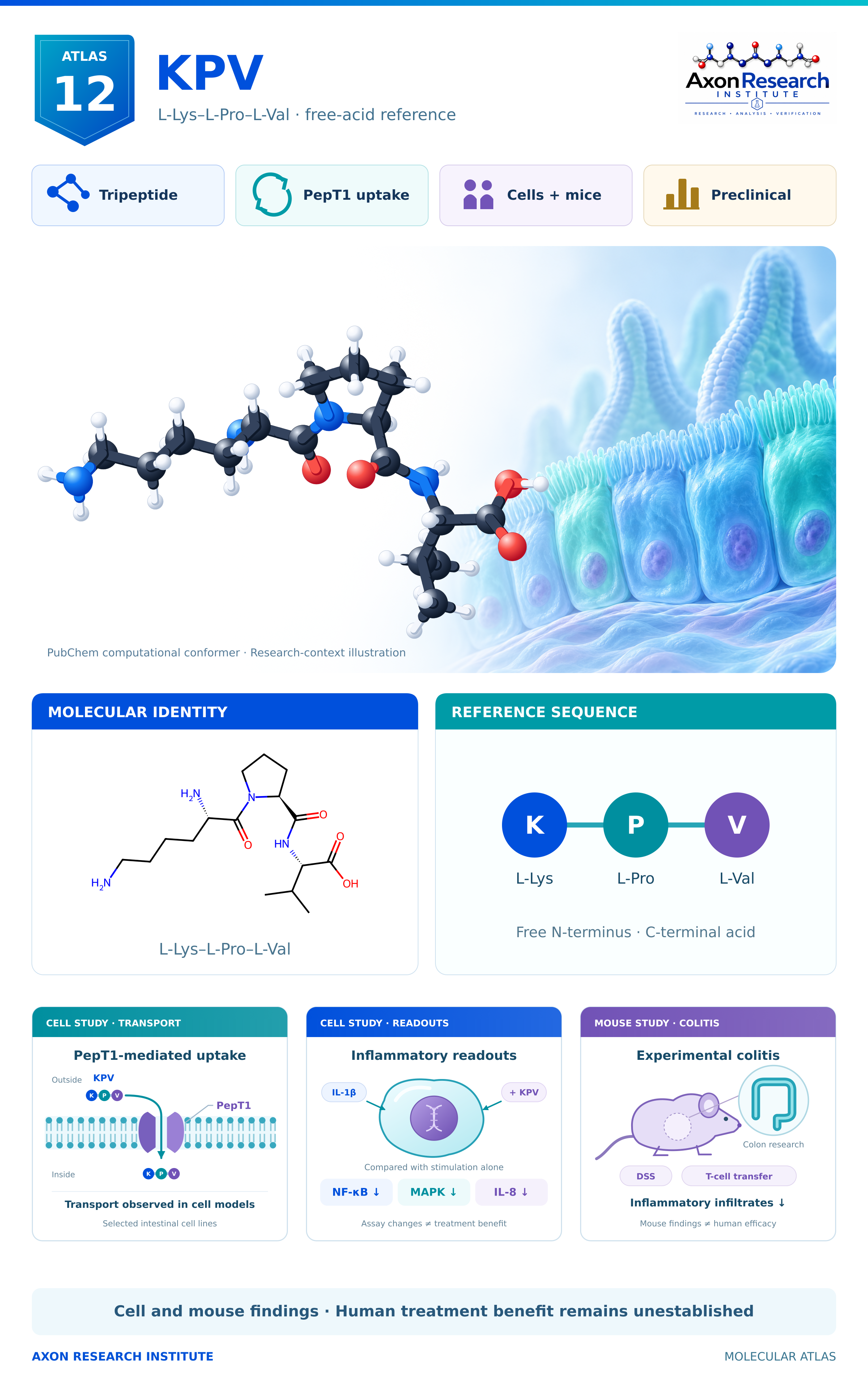
Visual summary only. The research findings, limitations and references accompany the card on this page.
The molecular view uses a source-provided computational conformer, not an experimental or unique bioactive geometry. The biological setting is an illustration. Original study diagrams summarize cited research without reproducing publication artwork or inventing quantitative results.
PubChem computational conformer (3D SDF) · Download visual source SDF
KPV
PepT1; inflammatory signaling
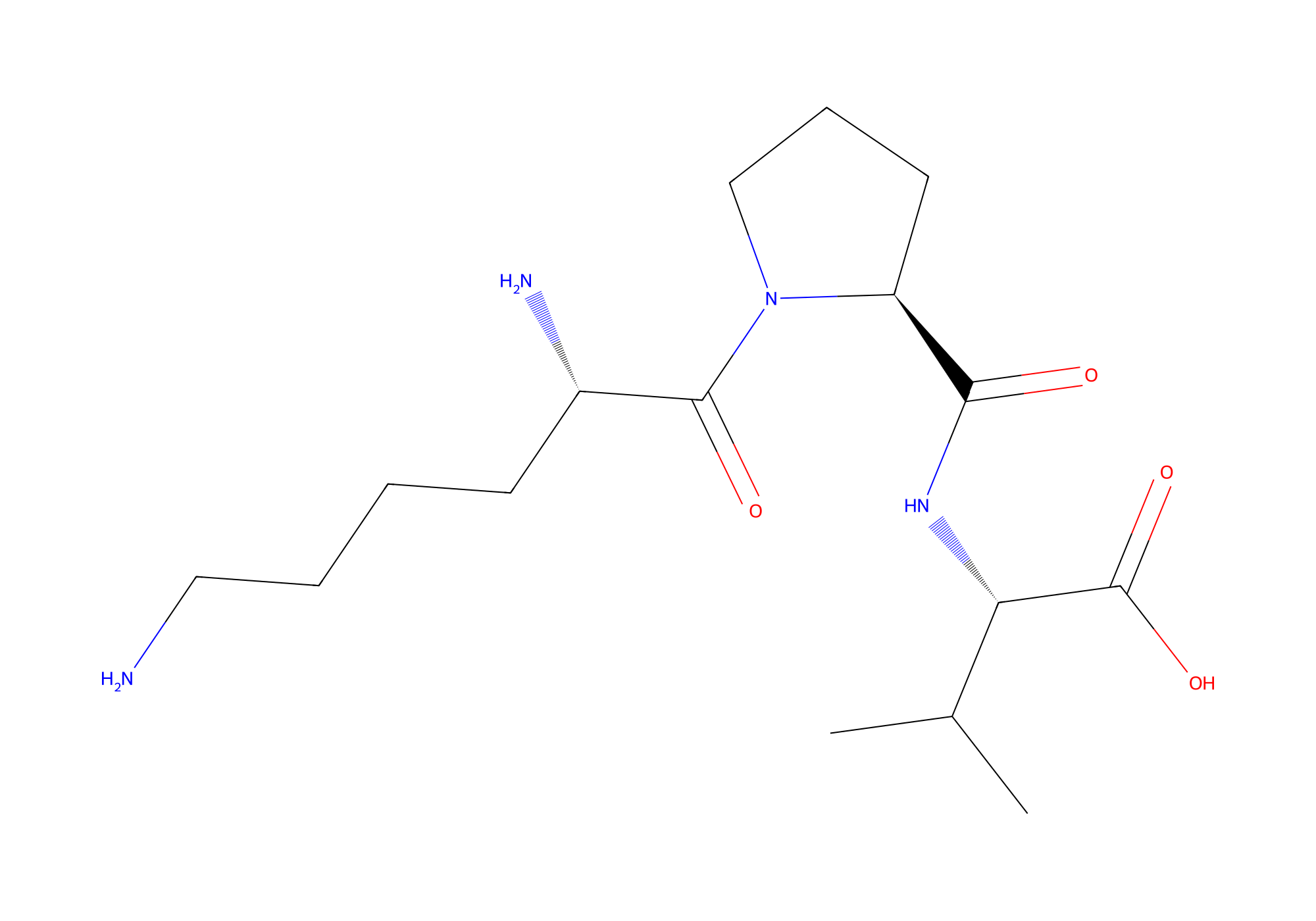
H-L-Lys-L-Pro-L-Val-OH (free-acid reference form)- Molecular formula
- C16H30N4O4
- Molecular weight
- 342.43 g/mol
- Class
- α-MSH-derived tripeptide
- Identity
- KPV
Research snapshot
KPV is the Lys-Pro-Val sequence from the C-terminal region of α-MSH. It is studied for peptide-transporter uptake and inflammatory signaling, particularly in experimental intestinal inflammation.
Cell and mouse studies
Identity & representation
Literature reference identity only. AXON product composition, salt, purity, sterility and equivalence were not verified. Exact depicted parent/reference form; excludes counterions and excipients unless expressly stated.
Educational reference only. Not a dosing guide, treatment recommendation or product endorsement.
L-Lys–L-Pro–L-Val · free-acid reference[1]
View the chemical structure →Sources checked: 2026-11-06. Identity and evidence limits are stated above. Independent specialist review is pending.
What researchers study
KPV is the Lys-Pro-Val sequence from the C-terminal region of α-MSH. It is studied for peptide-transporter uptake and inflammatory signaling, particularly in experimental intestinal inflammation.
Intestinal peptide transport and intracellular inflammatory signaling in cultured cells
Chemically induced and immune-transfer colitis models in mice
Separating melanocortin-derived peptide activity from classical MC1 receptor signaling
Mechanism in context
- PepT1 transports KPV into selected cells
- NF-κB and MAPK activation decrease in models
- Inflammatory cytokines and mouse colitis measures change
Cell and mouse findings do not establish treatment efficacy in people. KPV effects in these models can occur without functional melanocortin-1 receptor signaling.
Simplified publication-grounded schematic, not a solved protein structure or proof of clinical benefit.
Selected evidence
Human therapeutic evidence not established in the selected sources
PepT1-mediated tripeptide KPV uptake reduces intestinal inflammation.[2]
Human cell-line experiments and chemically induced mouse colitis
Observed: KPV entered selected intestinal and immune cell lines through PepT1 and reduced inflammatory signaling readouts. Mouse colitis experiments also showed reduced inflammatory measures. Neither cultured human cells nor mice establish efficacy in patients with inflammatory bowel disease.
Melanocortin-derived tripeptide KPV has anti-inflammatory potential in murine models of inflammatory bowel disease.[3]
Mouse colitis models including nonfunctional MC1 receptor
Observed: KPV changed weight-recovery and inflammatory measures in chemical and immune-transfer colitis models. Activity in MC1R-defective mice suggested at least partial independence from that receptor. This remains preclinical evidence.
Reference identity in detail
Sequences and form distinctions describe the cited reference substance, not a verified supplier preparation.
Safety & evidence limits
No human efficacy trial was identified in the primary studies selected here; mouse colitis outcomes cannot establish clinical benefit.
FDA reports inadequate human exposure and safety information for compounded KPV, leaving clinically important risks unresolved.
The free-acid structure shown is not the same chemical form as an amidated or acetylated KPV derivative.
Practical identity notes
- Three L-amino-acid residues; free amino terminus and carboxy terminus in the depicted reference.
- PubChem search for bare “KPV” can resolve to an unrelated chemical; use verified CID 125672.
- Primary abstracts establish the sequence but do not fully specify every preparation’s terminal chemistry.
- Exact AXON salt/terminal form not supplied. The structure must remain labeled free-acid reference, not confirmed product composition.
The 10-second takeaway
A short peptide with preclinical intestinal-inflammation findings; human benefit and safety remain unestablished.
What the visual panels show
Original diagrams summarize the cited research or documented evidence search. They are not copied publication figures or claims of treatment benefit.
REFERENCE SEQUENCE[1]
Reference identity · Reference sequence schematic
L-Lys · L-Pro · L-Val
Interpretation: Free N-terminus · C-terminal acid
PepT1-mediated uptake[2]
CELL STUDY · TRANSPORT · Original publication-grounded diagram
An abstract membrane gateway indicates observed transporter-mediated uptake, not a solved protein structure.
Interpretation: Selected cultured cells only. Not a human absorption or efficacy claim.
Source context: Figure 4, uptake in Caco2-BBE cells. See the linked references.
Inflammatory readouts[2]
CELL STUDY · READOUTS · Original publication-grounded diagram
Qualitative decreases in NF-κB and MAPK activation and IL-8 readouts compared with stimulation alone.
Interpretation: Down arrows do not encode magnitude. Inputs identify the experiment, not direct binding targets or a clinical effect.
Source context: Figure 1, IL-1β-stimulated Caco2-BBE cells. See the linked references.
Experimental colitis[3]
MOUSE STUDY · COLITIS · Original publication-grounded diagram
Mouse/colon research pictograms and lower inflammatory infiltrates; no histology is fabricated.
Interpretation: No healed human gut or established human treatment benefit.
Source context: PubMed abstract methods and results: DSS and CD45RBhi-transfer models. See the linked references.
Follow the evidence
Sources & what they support
- PubChem compound record 125672
Supports: identity; structure; formula; molecular_weight; stereochemistry
Original structure record · Download depicted structure SDF
Generated 2D layout from the verified reference graph; not an original 2D source-record download.
- PepT1-mediated tripeptide KPV uptake reduces intestinal inflammation.
Supports: overview; mechanism; cell and mouse findings
- Melanocortin-derived tripeptide KPV has anti-inflammatory potential in murine models of inflammatory bowel disease.
Supports: MC1R qualification; mouse colitis
- FDA compounding safety concerns
Supports: safety limitation
← Explore the Molecular Atlas Continue to the research library →