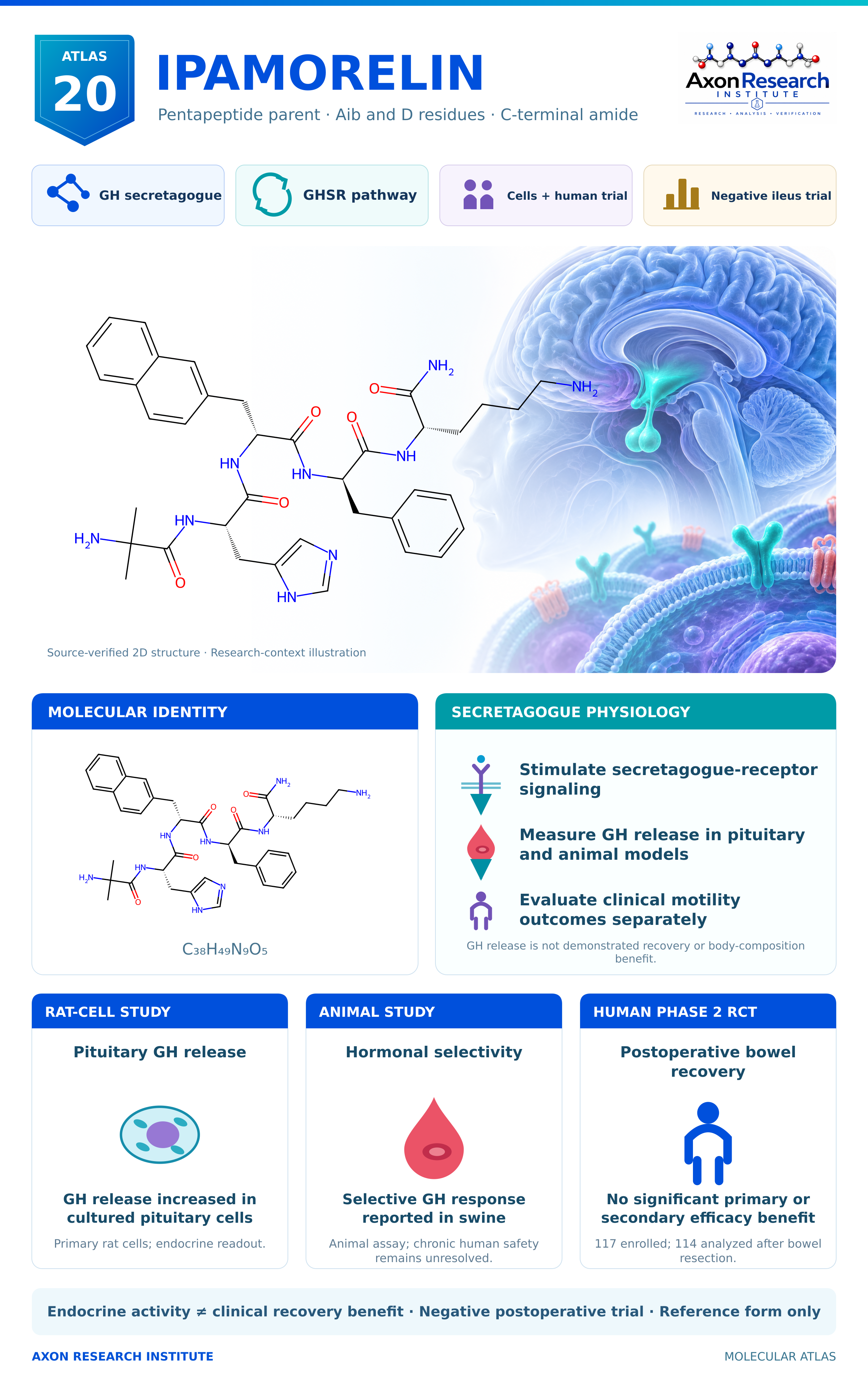
Visual summary only. The research findings, limitations and references accompany the card on this page.
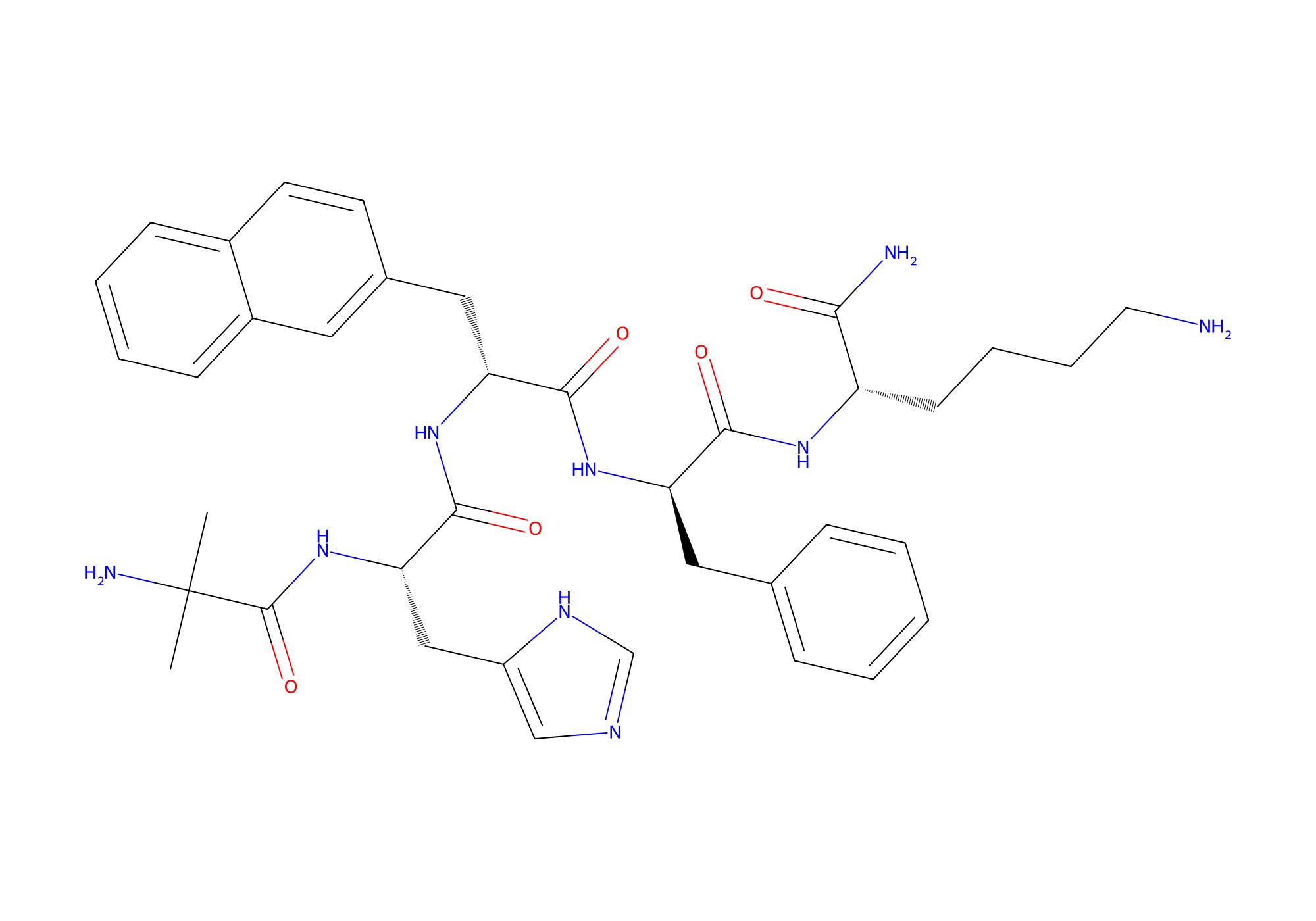
The chemical drawing shows source-verified two-dimensional connectivity and stereochemistry, not an experimental three-dimensional conformation. The biological setting is an illustration. Original study diagrams summarize cited research without reproducing publication artwork or inventing quantitative results.
Ipamorelin
Ghrelin receptor / GHSR
Free peptide parent with C-terminal amide- Molecular formula
- C38H49N9O5
- Molecular weight
- 711.9 g/mol
- Class
- Synthetic pentapeptide
- Identity
- Aib-His-D-2-Nal-D-Phe-Lys-NH2
Research snapshot
Ipamorelin is a synthetic growth-hormone secretagogue and ghrelin-receptor agonist. It has been studied for endocrine signaling and gastrointestinal motility, with findings that depend on the model and endpoint.
Preclinical and short human trials
Identity & representation
Literature reference molecule. Catalog naming is not analytical confirmation of AXON contents, salt, purity or formulation. Aib = α-aminoisobutyric acid; D-2-Nal = D-2-naphthylalanine. Histidine and lysine are L; Aib is achiral.
Educational reference only. Not a dosing guide, treatment recommendation or product endorsement.
Pentapeptide parent · Aib and D residues · C-terminal amide[3]
View the chemical structure →Sources checked: 2026-11-06. Identity and evidence limits are stated above. Independent specialist review is pending.
What researchers study
Ipamorelin is a synthetic growth-hormone secretagogue and ghrelin-receptor agonist. It has been studied for endocrine signaling and gastrointestinal motility, with findings that depend on the model and endpoint.
Ghrelin-receptor signaling and growth-hormone secretion
Hormonal selectivity in cell and animal experiments
Postoperative gastrointestinal motility in controlled clinical research
Mechanism in context
- Activates the ghrelin-receptor pathway
- Stimulates growth-hormone release in experimental systems
- Clinical studies test specific endocrine or motility endpoints
Growth-hormone release is a physiological endpoint, not proof of muscle gain, recovery, fat loss or longevity.
Simplified publication-grounded schematic, not a solved protein structure or proof of clinical benefit.
Selected evidence
Selected human evidence is summarized above; this is not an exhaustive clinical or regulatory review.
Prospective, randomized, controlled, proof-of-concept study of the Ghrelin mimetic ipamorelin for the management of postoperative ileus in bowel resection patients.[2]
Phase 2 randomized double-blind placebo-controlled trial · Patients after bowel resection · Up to 7 postoperative days · Reported n: 117
Observed: The efficacy analysis included 114 patients; key and secondary outcomes did not differ significantly from placebo.
Limit: A small, heterogeneous surgical population and short duration limit generalization.
Reference identity in detail
Sequences and form distinctions describe the cited reference substance, not a verified supplier preparation.
Safety & evidence limits
The postoperative trial did not establish efficacy; do not convert a negative result into a recovery claim.
Selectivity observed in animal hormone assays does not establish absence of endocrine risks in humans.
This short trial cannot establish chronic safety or benefits in healthy adults seeking body-composition changes.
Practical identity notes
- Aib = α-aminoisobutyric acid; D-2-Nal = D-2-naphthylalanine. Histidine and lysine are L; Aib is achiral.
- Formula and mass apply only to the named reference form, excluding unspecified counterions, solvent and water.
- Educational molecular reference • Selected studies, not a systematic review • No dosing guidance
The 10-second takeaway
A ghrelin-receptor research peptide with endocrine activity; the selected postoperative trial did not show significant clinical efficacy.
What the visual panels show
Original diagrams summarize the cited research or documented evidence search. They are not copied publication figures or claims of treatment benefit.
SECRETAGOGUE PHYSIOLOGY[1][2]
Publication-grounded mechanism schematic · Original publication-grounded diagram
Stimulate secretagogue-receptor signaling · Measure GH release in pituitary and animal models · Evaluate clinical motility outcomes separately
Interpretation: GH release is not demonstrated recovery or body-composition benefit.
Pituitary GH release[1]
RAT-CELL STUDY · Original publication-grounded diagram
GH release increased in cultured pituitary cells
Primary rat cells; endocrine readout.
Interpretation: Do not infer human muscle gain or a clinically beneficial endocrine effect.
Hormonal selectivity[1]
ANIMAL STUDY · Original publication-grounded diagram
Selective GH response reported in swine
Animal assay; chronic human safety remains unresolved.
Interpretation: Use blood/assay icon, not a human safety symbol. Animal selectivity does not mean risk-free.
Postoperative bowel recovery[2]
HUMAN PHASE 2 RCT · Original publication-grounded diagram
No significant primary or secondary efficacy benefit
117 enrolled; 114 analyzed after bowel resection.
Interpretation: The negative surgical trial must remain prominent. No accelerated-recovery claim.
Follow the evidence
Sources & what they support
- Ipamorelin, the first selective growth hormone secretagogue.
Supports: Exact sequence and cell/animal secretagogue pharmacology
- Prospective, randomized, controlled, proof-of-concept study of the Ghrelin mimetic ipamorelin for the management of postoperative ileus in bowel resection patients.
Supports: Negative postoperative ileus efficacy results
- PubChem CID 9831659
Supports: Reference chemical graph, formula and molecular mass; not product identity
Original structure record · Download source SDF
Original PubChem 2D source structure record.
← Explore the Molecular Atlas Continue to the research library →