
Visual summary only. The research findings, limitations and references accompany the card on this page.
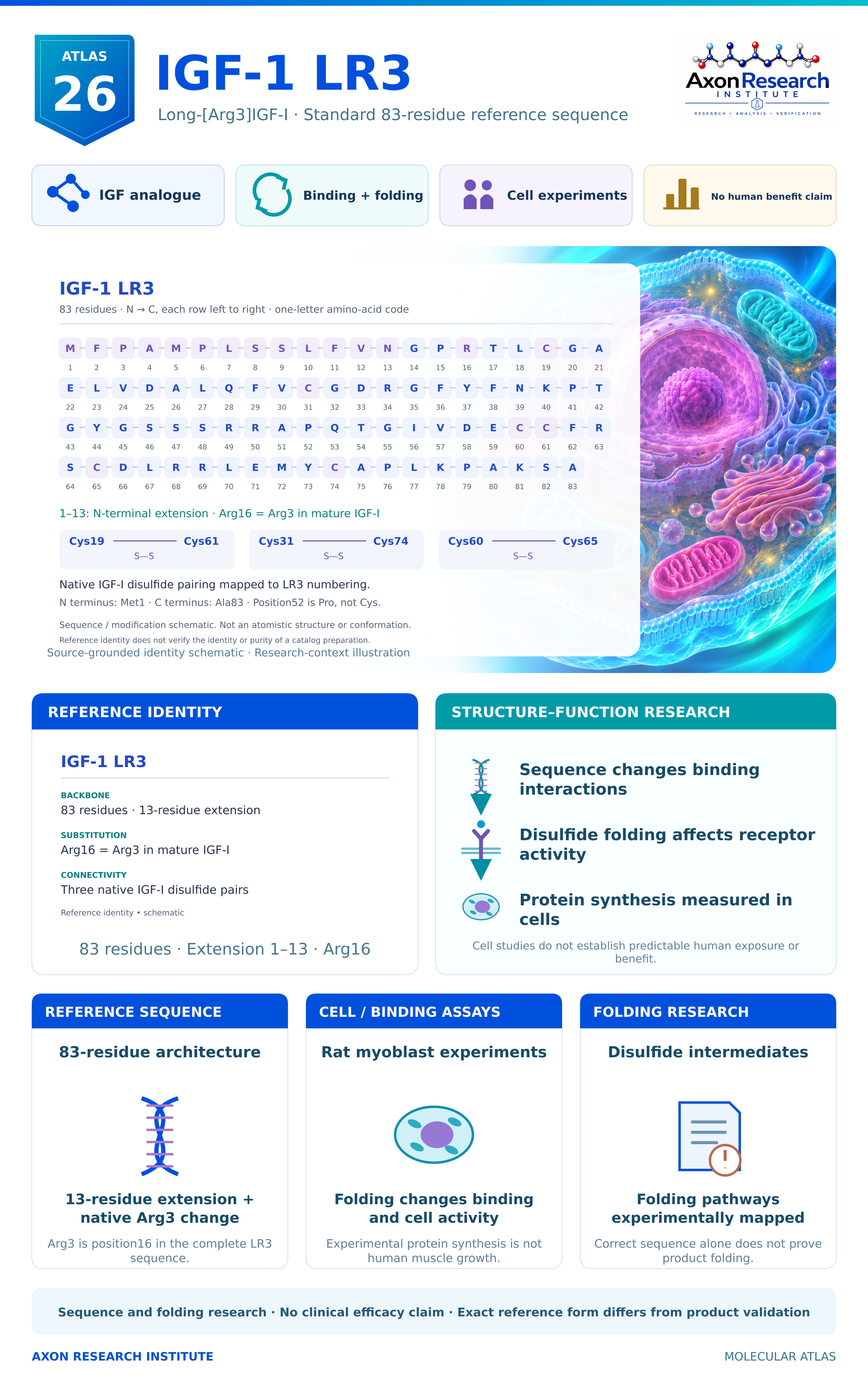
Verified 83-residue sequence. Connector lines show native IGF-I disulfide topology in LR3 numbering; this schematic does not show a protein conformation. Native mature IGF-I disulfide topology, independently verified from UniProt P05019 and mapped by adding 13 for the LR3 extension. These links agree with PDB3LRI SSBOND records, but its atomic coordinates are not used. PDB3LRI current sequence includes an additional annotated Pro 52→Cys difference; it is not cleared as an exact standard-LR3 atomistic structure. Sequence asserted by exact source, not coordinates. Biological settings and research diagrams are illustrations, not measured anatomy or clinical outcomes.
IGF-1 LR3
IGF receptor and binding proteins
Long-[Arg3] human IGF-I; 13-residue N-terminal extension; native three-disulfide form- Backbone
- 83 residues · 13-residue extension
- Substitution
- Arg16 = Arg3 in mature IGF-I
- Connectivity
- Three native IGF-I disulfide pairs
Research snapshot
IGF-1 LR3 is an extended IGF-I analogue engineered with an Arg substitution at native position 3. Research examines altered binding-protein interactions, receptor activity and the consequences of disulfide folding.
Structural and cell studies
Identity & representation
Literature reference identity only. AXON product composition, salt, purity, sterility and equivalence were not verified.
Educational reference only. Not a dosing guide, treatment recommendation or product endorsement.
Verified 83-residue sequence. Connector lines show native IGF-I disulfide topology in LR3 numbering; this schematic does not show a protein conformation.[1][6][2][3]
Sources checked: 2026-11-06. Identity and evidence limits are stated above. Independent specialist review is pending.
What researchers study
IGF-1 LR3 is an extended IGF-I analogue engineered with an Arg substitution at native position 3. Research examines altered binding-protein interactions, receptor activity and the consequences of disulfide folding.
Protein folding and disulfide-isomer effects on growth-factor activity
IGF-binding protein interactions and receptor recognition in cell systems
Protein synthesis responses in cultured rat skeletal-muscle cells
Mechanism in context
- Sequence changes alter binding-protein interactions
- Native folding preserves IGF receptor recognition
- Receptor engagement affects protein synthesis in cell models
These steps summarize structural and cell experiments. Reduced binding-protein affinity does not establish predictable exposure, safety or muscle-building benefit in people.
Simplified publication-grounded schematic, not a solved protein structure or proof of clinical benefit.
Selected evidence
Human therapeutic evidence not established in the selected sources
Mutations in the B-domain of insulin-like growth factor-I influence the oxidative folding to yield products with modified biological properties.[3]
Protein folding, binding and rat myoblast assays
Observed: Native and alternative disulfide forms of IGF-I analogues differed in receptor binding and cell protein-synthesis activity. The N-terminal extension changed folding yields. These experiments support structure–function relationships, not clinical efficacy or safe human exposure.
Reference identity in detail
Sequences and form distinctions describe the cited reference substance, not a verified supplier preparation.
Safety & evidence limits
The selected evidence is structural and cellular, not a controlled human treatment trial of this exact analogue.
Disulfide mispairing changes receptor binding and activity, so amino-acid sequence alone does not prove equivalent material.
Results from native IGF-I or prescription mecasermin cannot be transferred directly to the extended LR3 analogue.
Practical identity notes
- The 13-residue extension is MFPAMPLSSLFVN; native IGF-I Glu3 is changed to Arg.
- Disulfides in full 83-residue numbering: Cys19–Cys61, Cys31–Cys74, Cys60–Cys65.
- BMRB4494 records the standard 83-residue LR3 sequence; PDB3LRI has an extra annotated Pro52→Cys difference and is not used as an exact hero.
- Standard 83-residue sequence verified from BMRB4494. PDB3LRI includes an extra annotated Pro52→Cys sequence difference and must not be used as an exact standard-LR3 hero.
- Formula/mass held pending exact form verification; no generic IGF-I substitution.
The 10-second takeaway
A well-characterized laboratory IGF-I analogue with altered binding behavior, not established evidence for human performance enhancement.
What the visual panels show
Original diagrams summarize the cited research or documented evidence search. They are not copied publication figures or claims of treatment benefit.
STRUCTURE–FUNCTION RESEARCH[2][3]
Publication-grounded mechanism schematic · Original publication-grounded diagram
Sequence changes binding interactions · Disulfide folding affects receptor activity · Protein synthesis measured in cells
Interpretation: Cell studies do not establish predictable human exposure or benefit.
83-residue architecture[1][2]
REFERENCE SEQUENCE · Original publication-grounded diagram
13-residue extension + native Arg3 change
Arg3 is position16 in the complete LR3 sequence.
Interpretation: Not a 3D conformation. Do not use mismatched PDB3LRI atomistic file.
Rat myoblast experiments[3]
CELL / BINDING ASSAYS · Original publication-grounded diagram
Folding changes binding and cell activity
Experimental protein synthesis is not human muscle growth.
Interpretation: Native versus alternative disulfide forms differ; avoid clinical efficacy.
Disulfide intermediates[4]
FOLDING RESEARCH · Original publication-grounded diagram
Folding pathways experimentally mapped
Correct sequence alone does not prove product folding.
Interpretation: No invented protein conformation or supplier quality guarantee.
Follow the evidence
Sources & what they support
- BMRB4494: Human Long-[Arg3]Insulin-Like Growth Factor1
Supports: 83-residue standard LR3 sequence
- Solution structure and backbone dynamics of long-[Arg(3)]insulin-like growth factor-I.
Supports: overview; mechanism; structural evidence
- Mutations in the B-domain of insulin-like growth factor-I influence the oxidative folding to yield products with modified biological properties.
Supports: mechanism; folding limitation; cell research
- Probing the folding pathways of long R(3) insulin-like growth factor-I (LR(3)IGF-I) and IGF-I via capture and identification of disulfide intermediates by cyanylation methodology and mass spectrometry.
Supports: disulfide folding
- PDB3LRI contains an additional annotated Pro→Cys sequence difference
Supports: structure mismatch warning
- UniProt P05019: human insulin-like growth factor I
Supports: Mature native IGF-I sequence and disulfide topology; precursor 54–96,66–109,95–100 maps to mature 6–48,18–61,47–52.
← Explore the Molecular Atlas Continue to the research library →
