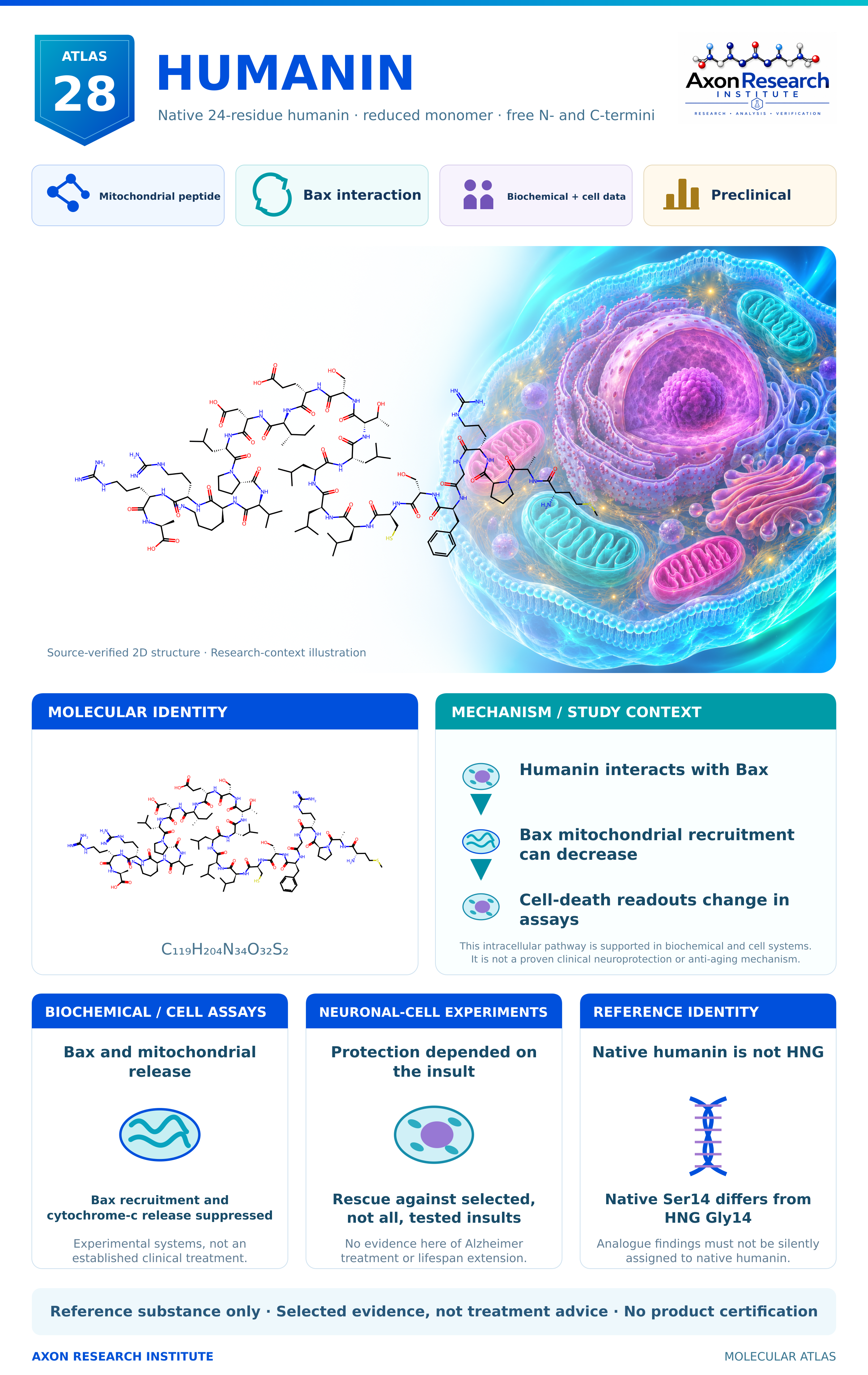
Visual summary only. The research findings, limitations and references accompany the card on this page.
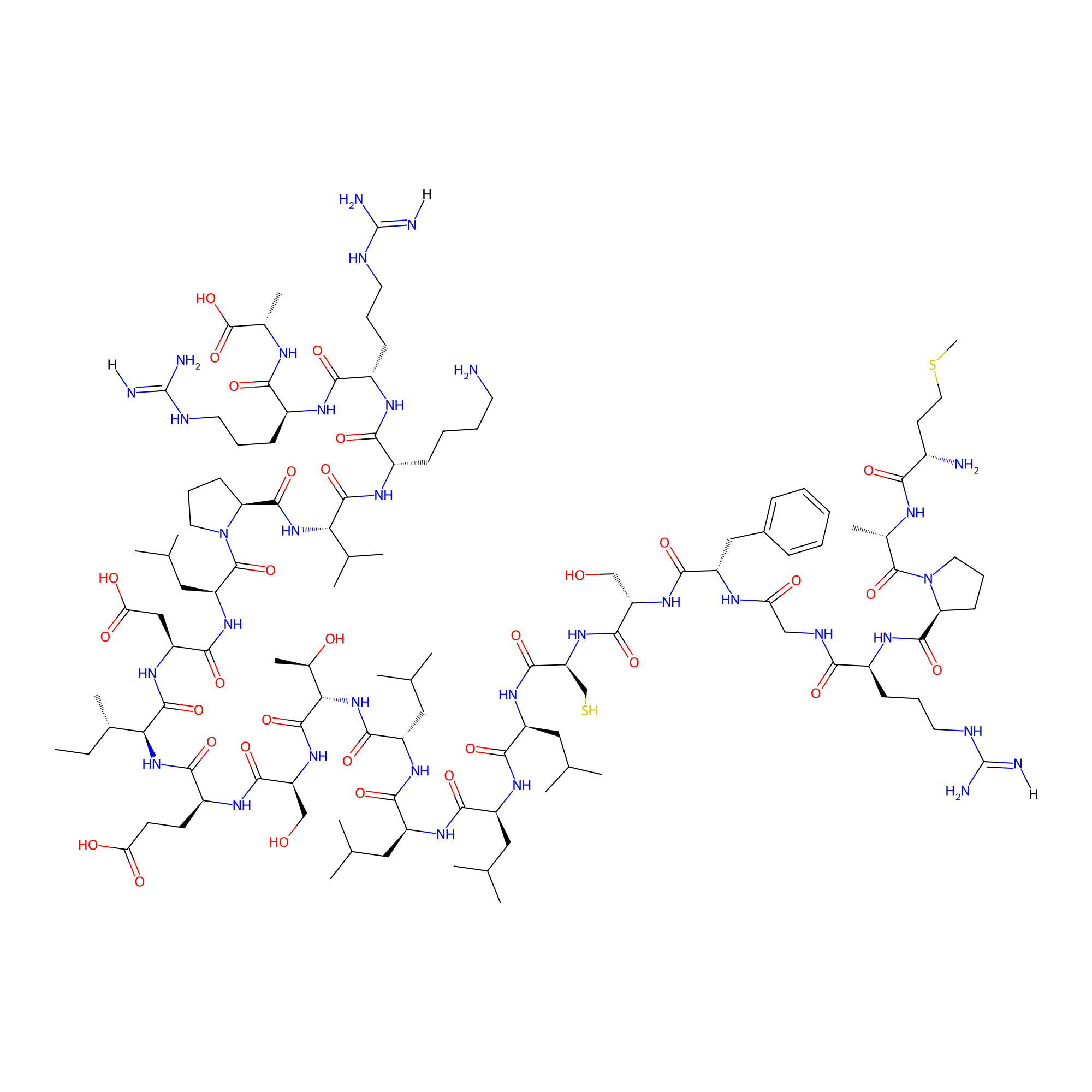
The chemical drawing shows source-verified two-dimensional connectivity and stereochemistry, not an experimental three-dimensional conformation. The biological setting is an illustration. Original study diagrams summarize cited research without reproducing publication artwork or inventing quantitative results.
Humanin
Bax/Bid and context-dependent receptors
Native-sequence24-residue humanin, reduced monomer with free termini- Molecular formula
- C119H204N34O32S2
- Molecular weight
- 2687.2 g/mol
- Class
- Mitochondrial-associated signaling peptide
- Identity
- MAPRGFSCLLLLTSEIDLPVKRRA-OH
Research snapshot
Humanin is a short peptide studied in cell survival and mitochondrial stress models. Native humanin and potent analogues are distinct substances; cell rescue and biomarker associations do not establish human longevity or cognitive benefit.
Cell and biochemical experiments
Identity & representation
Literature reference substance only; no equivalence to a catalog product or tested supplier lot is asserted. All-L backbone. Cys8 is a free thiol, Met1 unoxidized. Not S14G-humanin/HNG, HNGF6A, a21-residue product, dimer or salt.
Educational reference only. Not a dosing guide, treatment recommendation or product endorsement.
Native 24-residue humanin · reduced monomer · free N- and C-termini[4]
View the chemical structure →Sources checked: 2026-11-06. Identity and evidence limits are stated above. Independent specialist review is pending.
What researchers study
Humanin is a short peptide studied in cell survival and mitochondrial stress models. Native humanin and potent analogues are distinct substances; cell rescue and biomarker associations do not establish human longevity or cognitive benefit.
Bax/Bid interactions and mitochondrial membrane permeability
Neuronal-cell responses to Alzheimer-related insults
Context-dependent peptide receptor signaling
Mechanism / evidence map
- Humanin interacts with apoptotic regulators
- Bax mitochondrial recruitment can decrease
- Cell-death readouts change in experimental models
This intracellular pathway is supported in biochemical and cell systems. It is not a proven clinical neuroprotection or anti-aging mechanism.
Simplified publication-grounded schematic, not a solved protein structure or proof of clinical benefit.
Selected evidence
No efficacy trial of this exact native 24-residue reference was verified in the selected evidence set.
Humanin peptide suppresses apoptosis by interfering with Bax activation.[2]
Biochemical and cultured-cell mechanism experiments · Purified/isolated mitochondrial systems and cultured cells · Experimental assay windows
Observed: Humanin bound Bax, reduced mitochondrial translocation and suppressed cytochrome-c release in experimental systems.
Limit: Not a human treatment study; pathway experiments do not establish effective exposure or clinical safety.
A rescue factor abolishing neuronal cell death by a wide spectrum of familial Alzheimer's disease genes and Abeta.[1]
Functional expression screening and neuronal-cell experiments · Cultured neuronal-cell models · Experimental assay windows
Observed: Humanin cDNA and peptide protected against several Alzheimer-associated cell-death insults but not every tested insult.
Limit: Cell models and sequence-specific analog comparisons; not evidence of Alzheimer disease treatment or lifespan extension.
Reference identity in detail
Sequences and form distinctions describe the cited reference substance, not a verified supplier preparation.
Safety & evidence limits
Do not transfer results from S14G-humanin/HNG or other modified analogues to native humanin without identifying the tested molecule.
Cell protection and biomarker correlations do not establish cognitive improvement, disease modification or lifespan extension in humans.
Cys oxidation, oligomerization and sequence variants can change the studied material; no clinical safety assurance follows from endogenous origin.
Practical identity notes
- 24 residues; native sequence MAPRGFSCLLLLTSEIDLPVKRRA.
- Displayed reduced monomer has one free Cys thiol and no disulfide.
- The 21-residue translation product and synthetic analogues are distinct reference forms.
- Preclinical mechanism evidence • Reference form only
The 10-second takeaway
Native humanin has interesting cell-survival biology; human anti-aging or cognitive benefits remain unestablished in this evidence set.
What the visual panels show
Original diagrams summarize the cited research or documented evidence search. They are not copied publication figures or claims of treatment benefit.
MECHANISM / STUDY CONTEXT[2]
Publication-grounded mechanism schematic · Original publication-grounded diagram
Humanin interacts with Bax · Bax mitochondrial recruitment can decrease · Cell-death readouts change in assays
Interpretation: This intracellular pathway is supported in biochemical and cell systems. It is not a proven clinical neuroprotection or anti-aging mechanism.
Bax and mitochondrial release[2]
BIOCHEMICAL / CELL ASSAYS · Original publication-grounded diagram
Bax recruitment and cytochrome-c release suppressed
Experimental systems, not an established clinical treatment.
Interpretation: Experimental systems, not an established clinical treatment. Original conceptual illustration only; no fabricated data, docking geometry or clinical extrapolation.
Protection depended on the insult[1]
NEURONAL-CELL EXPERIMENTS · Original publication-grounded diagram
Rescue against selected, not all, tested insults
No evidence here of Alzheimer treatment or lifespan extension.
Interpretation: No evidence here of Alzheimer treatment or lifespan extension. Original conceptual illustration only; no fabricated data, docking geometry or clinical extrapolation.
Native humanin is not HNG[1][4]
REFERENCE IDENTITY · Original publication-grounded diagram
Native Ser14 differs from HNG Gly14
Analogue findings must not be silently assigned to native humanin.
Interpretation: Analogue findings must not be silently assigned to native humanin. Original conceptual illustration only; no fabricated data, docking geometry or clinical extrapolation.
Follow the evidence
Sources & what they support
- A rescue factor abolishing neuronal cell death by a wide spectrum of familial Alzheimer's disease genes and Abeta.
Supports: Discovery and neuronal-cell rescue models
- Humanin peptide suppresses apoptosis by interfering with Bax activation.
Supports: Bax interaction and mitochondrial mechanism
- Humanin binds and nullifies Bid activity by blocking its activation of Bax and Bak.
Supports: Bid/tBid interaction in biochemical/cellular systems
- PubChem Humanin CID16131438
Supports: 24-residue reduced parent graph verified
Original structure record · Download source SDF
Original PubChem 2D source structure record.
← Explore the Molecular Atlas Continue to the research library →