Visual summary only. The research findings, limitations and references accompany the card on this page.
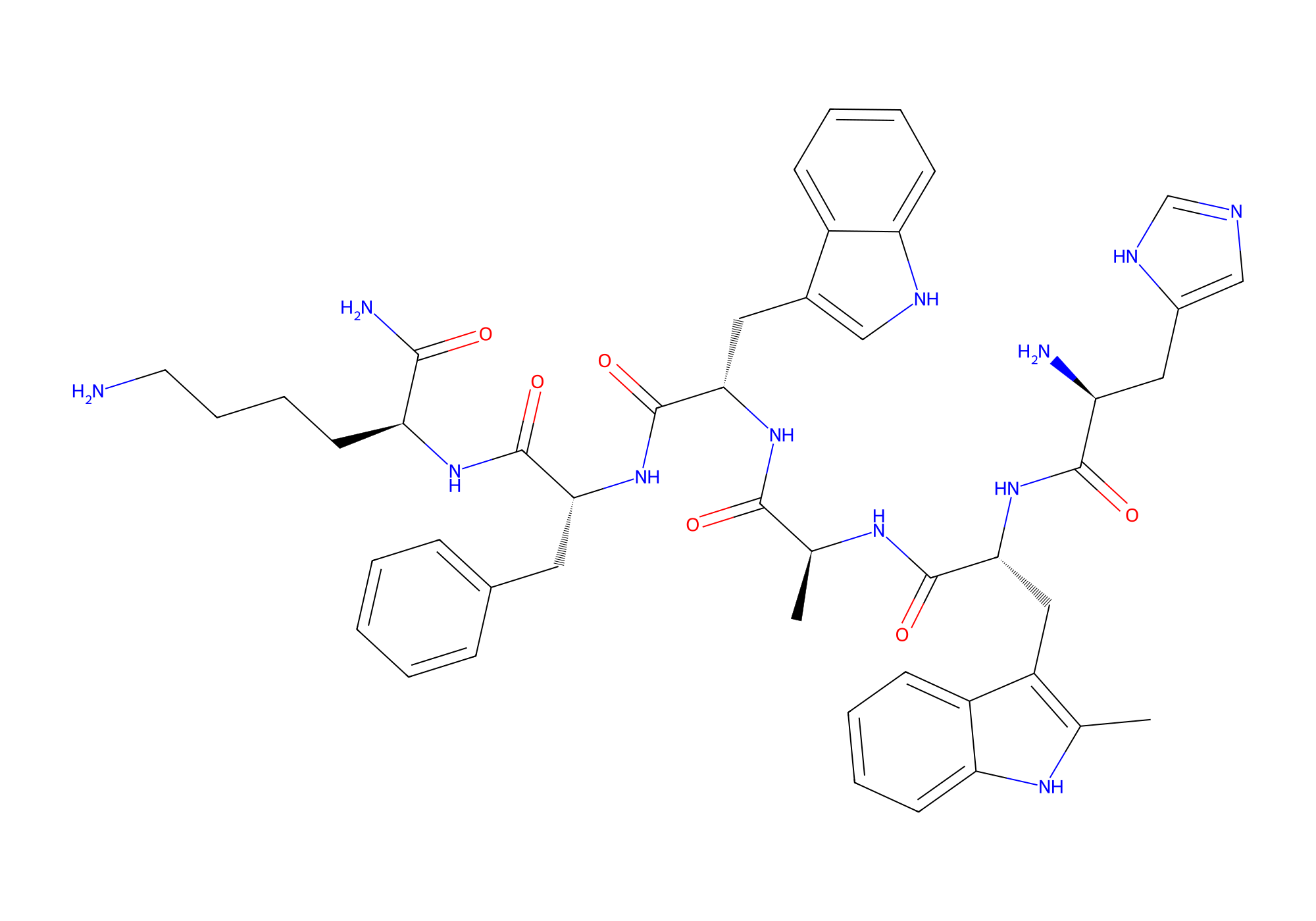
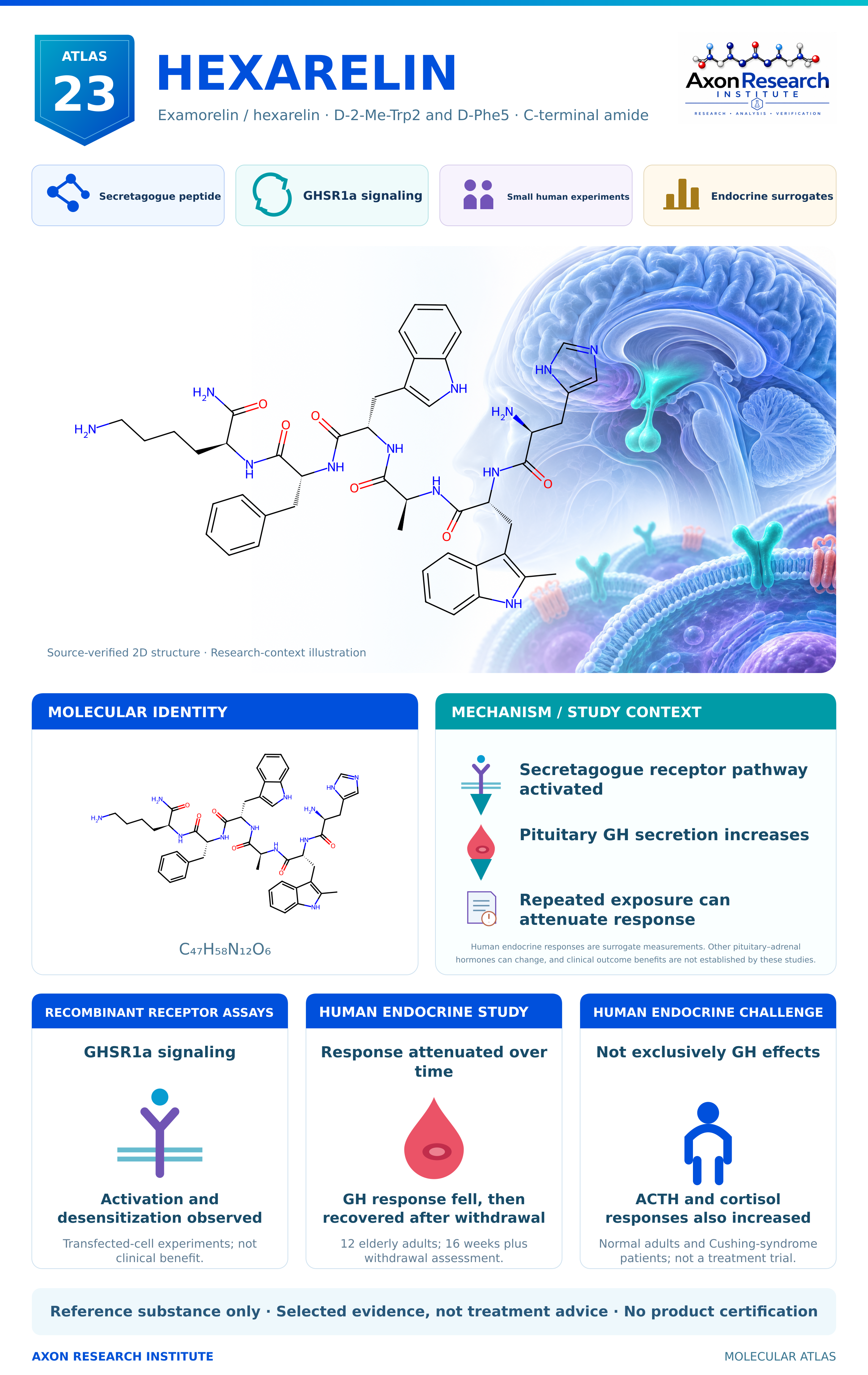
The chemical drawing shows source-verified two-dimensional connectivity and stereochemistry, not an experimental three-dimensional conformation. The biological setting is an illustration. Original study diagrams summarize cited research without reproducing publication artwork or inventing quantitative results.
Hexarelin
Ghrelin/GHS receptor pathway
Examorelin/hexarelin parent, C-terminal amide- Molecular formula
- C47H58N12O6
- Molecular weight
- 887 g/mol
- Class
- Synthetic GH secretagogue
- Identity
- His-D-2-methyl-Trp-Ala-Trp-D-Phe-Lys-NH2
Research snapshot
Hexarelin is a modified hexapeptide that stimulates growth-hormone release. Small human studies also document ACTH/cortisol effects and reduced GH responsiveness during repeated exposure, rather than established long-term health or performance benefits.
Small human endocrine studies
Identity & representation
Literature reference substance only; no equivalence to a catalog product or tested supplier lot is asserted. D configuration at residues 2 and 5; Ala3, Trp4, Lys6 andHis1 are L. Methyl substitution is on indole position 2 of D-Trp2.
Educational reference only. Not a dosing guide, treatment recommendation or product endorsement.
Examorelin / hexarelin · D-2-Me-Trp2 and D-Phe5 · C-terminal amide[4]
View the chemical structure →Sources checked: 2026-11-06. Identity and evidence limits are stated above. Independent specialist review is pending.
What researchers study
Hexarelin is a modified hexapeptide that stimulates growth-hormone release. Small human studies also document ACTH/cortisol effects and reduced GH responsiveness during repeated exposure, rather than established long-term health or performance benefits.
Acute pituitary hormone responses
GH response during repeated exposure
ACTH/cortisol responses in endocrine disorders
Mechanism / evidence map
- Secretagogue receptor pathway activated
- Pituitary GH secretion increases
- Repeated exposure may attenuate response
Human endocrine responses are surrogate measurements. Other pituitary–adrenal hormones can change, and clinical outcome benefits are not established by these studies.
Simplified publication-grounded schematic, not a solved protein structure or proof of clinical benefit.
Selected evidence
Published human data show hormone release and desensitization; they do not establish long-term clinical benefit or routine safety.
Does desensitization to hexarelin occur?[2]
Prospective repeated-exposure endocrine study · Healthy elderly adults · 16 weeks plus4-week withdrawal assessment · Reported n: 12
Observed: Mean GH response area decreased from 19.1 to 10.5 micrograms/L/hour, then recovered to 19.4 after withdrawal.
Limit: Small elderly cohort; endocrine response is not a clinical-benefit endpoint; no durable performance or anti-aging conclusion.
Adrenocorticotropin- and cortisol-releasing effect of hexarelin, a synthetic growth hormone-releasing peptide, in normal subjects and patients with Cushing's syndrome.[3]
Comparative acute endocrine challenge study · 12 normal adults and 17 patients with Cushing syndrome · Acute hormone sampling · Reported n: 29
Observed: ACTH and cortisol rose in 12 normal subjects and were markedly amplified in pituitary Cushing disease among 17 patients with Cushing syndrome.
Limit: Small pathophysiology study, not a treatment trial; shows off-target endocrine consequences.
Reference identity in detail
Sequences and form distinctions describe the cited reference substance, not a verified supplier preparation.
Safety & evidence limits
Hexarelin can increase ACTH and cortisol as well as GH, so it should not be depicted as an isolated GH switch.
The 12-person 16-week study found partial reversible attenuation of GH response during repeated exposure.
Small endocrine studies cannot establish long-term safety, body-composition benefit, athletic performance or healthy-aging effects.
Practical identity notes
- Six-residue amide; D-2-methyl-Trp2 and D-Phe5.
- Not GHRP-6: the indole methyl substituent changes the molecule.
- Salt/counterion excluded from this reference graph.
- Hormonal-response research • Reference form only
The 10-second takeaway
A potent endocrine research tool with hormone spillover and desensitization findings, not proven long-term performance or longevity benefit.
What the visual panels show
Original diagrams summarize the cited research or documented evidence search. They are not copied publication figures or claims of treatment benefit.
MECHANISM / STUDY CONTEXT[5][2]
Publication-grounded mechanism schematic · Original publication-grounded diagram
Secretagogue receptor pathway activated · Pituitary GH secretion increases · Repeated exposure can attenuate response
Interpretation: Human endocrine responses are surrogate measurements. Other pituitary–adrenal hormones can change, and clinical outcome benefits are not established by these studies.
GHSR1a signaling[5]
RECOMBINANT RECEPTOR ASSAYS · Original publication-grounded diagram
Activation and desensitization observed
Transfected-cell experiments; not clinical benefit.
Interpretation: Transfected-cell experiments; not clinical benefit. Original conceptual illustration only; no fabricated data, docking geometry or clinical extrapolation.
Response attenuated over time[2]
HUMAN ENDOCRINE STUDY · Original publication-grounded diagram
GH response fell, then recovered after withdrawal
12 elderly adults; 16 weeks plus withdrawal assessment.
Interpretation: 12 elderly adults; 16 weeks plus withdrawal assessment. Original conceptual illustration only; no fabricated data, docking geometry or clinical extrapolation.
Not exclusively GH effects[3]
HUMAN ENDOCRINE CHALLENGE · Original publication-grounded diagram
ACTH and cortisol responses also increased
Normal adults and Cushing-syndrome patients; not a treatment trial.
Interpretation: Normal adults and Cushing-syndrome patients; not a treatment trial. Original conceptual illustration only; no fabricated data, docking geometry or clinical extrapolation.
Follow the evidence
Sources & what they support
- Desensitization from long-term intranasal treatment with hexarelin does not interfere with the biological effects of this growth hormone-releasing peptide in short children.
Supports: Exact sequence and early repeated-exposure endocrine study
- Does desensitization to hexarelin occur?
Supports: 16-week desensitization and reversibility
- Adrenocorticotropin- and cortisol-releasing effect of hexarelin, a synthetic growth hormone-releasing peptide, in normal subjects and patients with Cushing's syndrome.
Supports: ACTH/cortisol effects
- PubChem examorelin CID6918297
Supports: Exact reference graph and stereochemistry
Original structure record · Download source SDF
Original PubChem 2D source structure record.
- Rapid desensitisation of the GH secretagogue (ghrelin) receptor to hexarelin in vitro.
Supports: Hexarelin activates/desensitizes recombinant human GHSR1a in transfected cells
← Explore the Molecular Atlas Continue to the research library →