Visual summary only. The research findings, limitations and references accompany the card on this page.
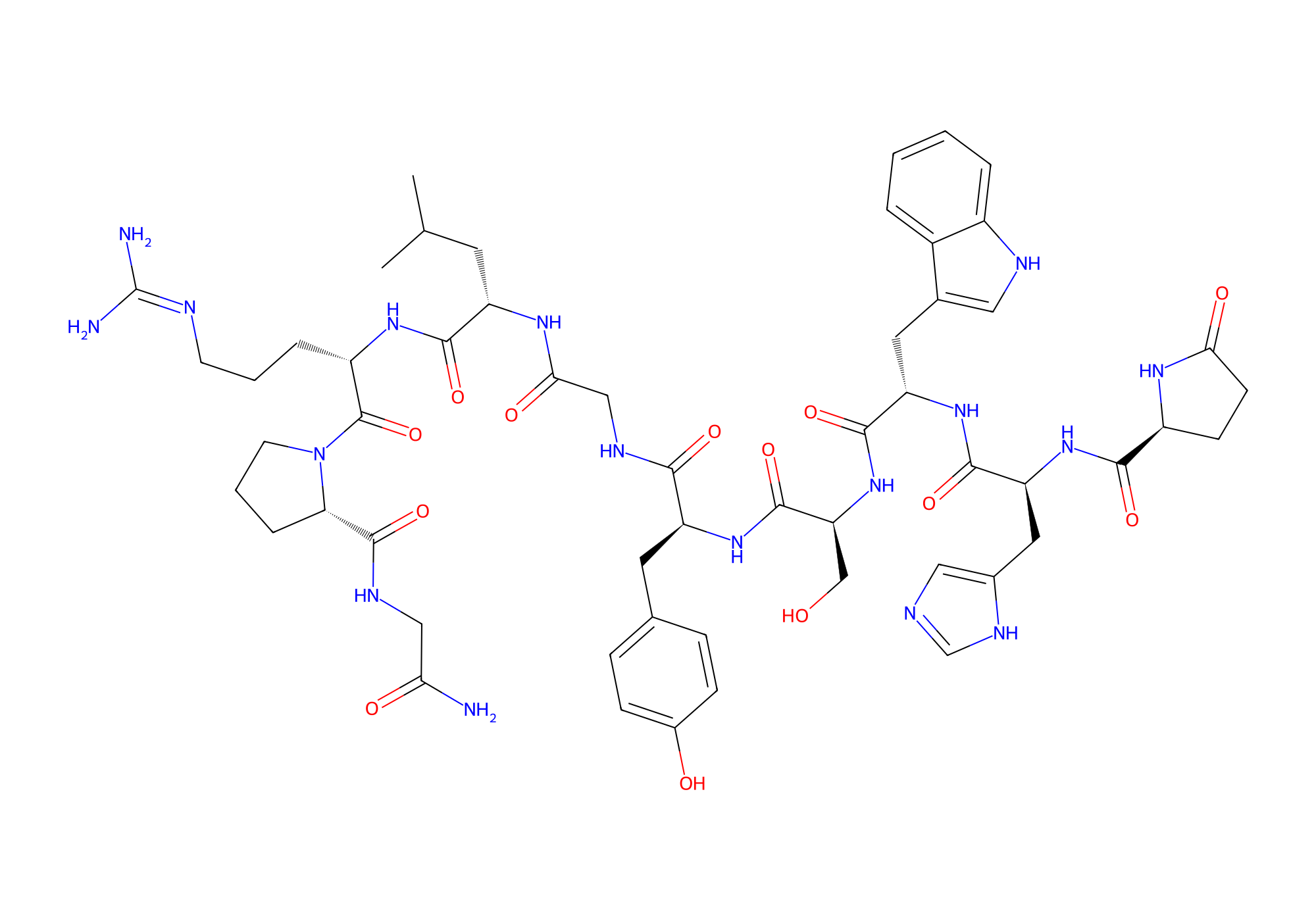
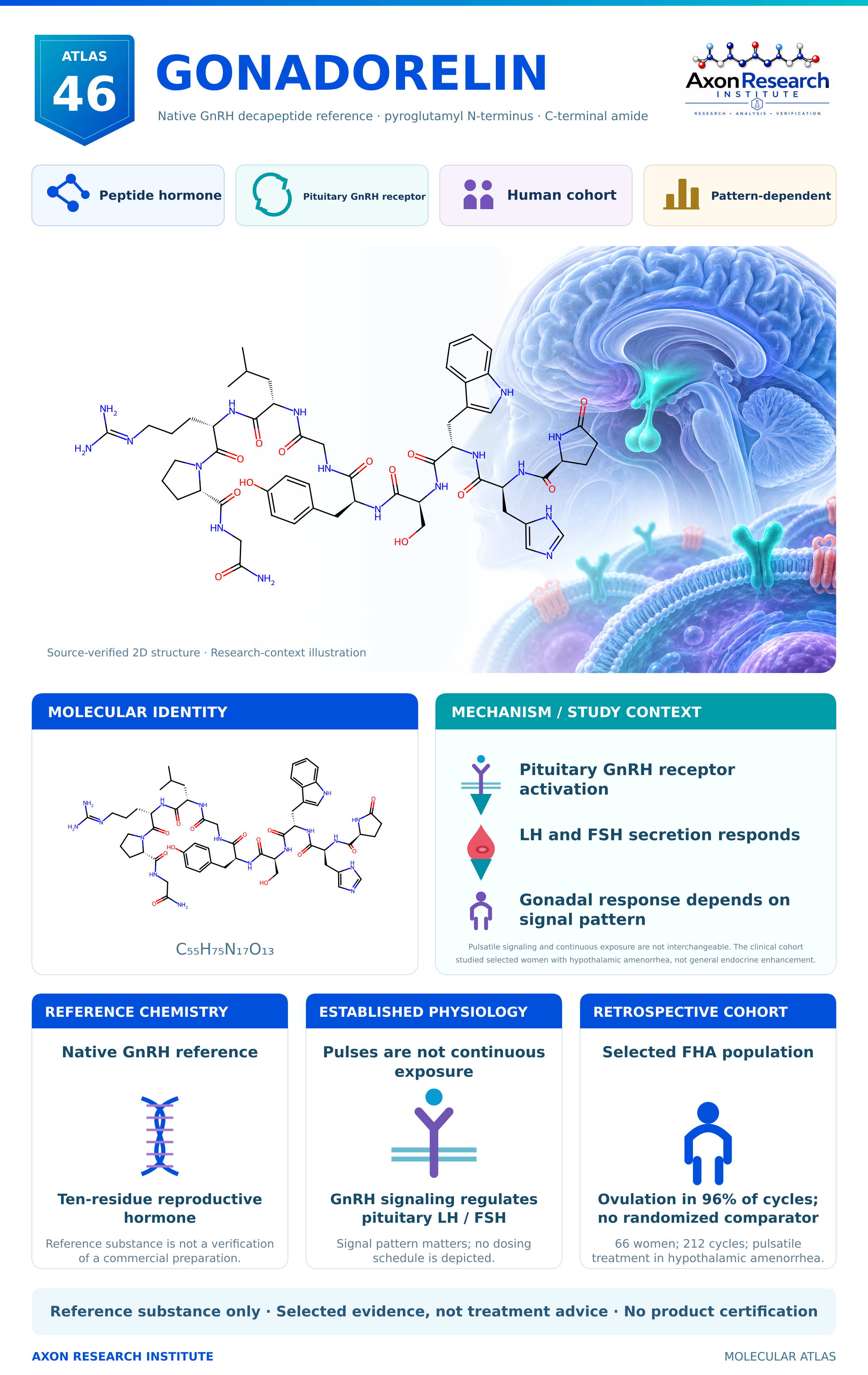
The chemical drawing shows source-verified two-dimensional connectivity and stereochemistry, not an experimental three-dimensional conformation. The biological setting is an illustration. Original study diagrams summarize cited research without reproducing publication artwork or inventing quantitative results.
Gonadorelin
Pituitary GnRH receptor
Synthetic human GnRH-I parent; N-terminal L-pyroglutamyl and C-terminal glycinamide- Molecular formula
- C55H75N17O13
- Molecular weight
- 1182.3 g/mol
- Class
- GnRH decapeptide
- Identity
- pGlu-His-Trp-Ser-Tyr-Gly-Leu-Arg-Pro-Gly-NH2
Research snapshot
Gonadorelin reproduces native GnRH-I signaling to the pituitary. Pulsatile clinical administration has been studied in hypothalamic amenorrhea, where treatment pattern and diagnosis are essential to interpreting fertility outcomes.
Physiology + clinical cohort
Identity & representation
Reference parent, not an AXON formulation or salt.
Educational reference only. Not a dosing guide, treatment recommendation or product endorsement.
Native GnRH decapeptide reference · pyroglutamyl N-terminus · C-terminal amide[1][3]
View the chemical structure →Sources checked: 2026-11-06. Identity and evidence limits are stated above. Independent specialist review is pending.
What researchers study
Gonadorelin reproduces native GnRH-I signaling to the pituitary. Pulsatile clinical administration has been studied in hypothalamic amenorrhea, where treatment pattern and diagnosis are essential to interpreting fertility outcomes.
Pituitary gonadotropin responses
Hypothalamic amenorrhea
Pulsatile reproductive-endocrine signaling
Mechanism in context
- Gonadorelin activates pituitary GnRH receptors
- LH and FSH secretion respond
- Gonadal function depends on signaling pattern
Pulsatile signaling and continuous exposure are not interchangeable. The clinical cohort studied selected women with hypothalamic amenorrhea, not general endocrine enhancement.
Simplified publication-grounded schematic, not a solved protein structure or proof of clinical benefit.
Selected evidence
Physiology + clinical cohort
Use of pulsatile gonadotropin-releasing hormone (GnRH) in patients with functional hypothalamic amenorrhea (FHA) results in monofollicular ovulation and high cumulative live birth rates: a 25-year cohort.[2]
Single-center retrospective cohort · 66 women; 82 treatments; 212 cycles · 1996–2020 cohort
Observed: Live birth per treatment was 65.9%; ovulation occurred in 96% of cycles.
Live birth per treatment was 65.9%; ovulation occurred in 96% of cycles. No randomized comparator for efficacy; results depend on pulsatile delivery and selected FHA population.
Limit: No randomized comparator for efficacy; results depend on pulsatile delivery and selected FHA population.
Reference identity in detail
Sequences and form distinctions describe the cited reference substance, not a verified supplier preparation.
Research scope
Targeted source verification, not a systematic review. Citation quality and molecule-specific applicability are stated separately.
Safety & evidence limits
Hormonal responses do not establish benefit for people without the studied endocrine diagnosis.
The cited fertility evidence is retrospective and uncontrolled for treatment efficacy.
Salt form, formulation and administration pattern affect interpretation; this graph is the parent peptide only.
Practical identity notes
- Synthetic human GnRH-I parent; N-terminal L-pyroglutamyl and C-terminal glycinamide
- No original PubChem 3D conformer was available for this exact reference in the checked endpoint; use exact 2D structure.
- Reference identity is not confirmation of product contents, purity, sterility or therapeutic equivalence.
The 10-second takeaway
Native GnRH signaling is pattern-dependent; clinical reproductive findings apply to selected diagnoses and supervised protocols.
What the visual panels show
Original diagrams summarize the cited research or documented evidence search. They are not copied publication figures or claims of treatment benefit.
MECHANISM / STUDY CONTEXT[3]
Publication-grounded mechanism schematic · Original publication-grounded diagram
Pituitary GnRH receptor activation · LH and FSH secretion responds · Gonadal response depends on signal pattern
Interpretation: Pulsatile signaling and continuous exposure are not interchangeable. The clinical cohort studied selected women with hypothalamic amenorrhea, not general endocrine enhancement.
Native GnRH reference[1]
REFERENCE CHEMISTRY · Original publication-grounded diagram
Ten-residue reproductive hormone
Reference substance is not a verification of a commercial preparation.
Interpretation: Reference substance is not a verification of a commercial preparation. Original conceptual illustration only; no fabricated data, docking geometry or clinical extrapolation.
Pulses are not continuous exposure[3]
ESTABLISHED PHYSIOLOGY · Original publication-grounded diagram
GnRH signaling regulates pituitary LH / FSH
Signal pattern matters; no dosing schedule is depicted.
Interpretation: Signal pattern matters; no dosing schedule is depicted. Original conceptual illustration only; no fabricated data, docking geometry or clinical extrapolation.
Selected FHA population[2]
RETROSPECTIVE COHORT · Original publication-grounded diagram
Ovulation in 96% of cycles; no randomized comparator
66 women; 212 cycles; pulsatile treatment in hypothalamic amenorrhea.
Interpretation: 66 women; 212 cycles; pulsatile treatment in hypothalamic amenorrhea. Original conceptual illustration only; no fabricated data, docking geometry or clinical extrapolation.
Follow the evidence
Sources & what they support
- PubChem CID 638793: source reference graph
Supports: Exact reference graph, stereochemistry, formula and mass
Original structure record · Download source SDF
Original PubChem 2D source structure record.
- Use of pulsatile gonadotropin-releasing hormone (GnRH) in patients with functional hypothalamic amenorrhea (FHA) results in monofollicular ovulation and high cumulative live birth rates: a 25-year cohort.
Supports: Retrospective FHA cohort; pregnancy and ovulation outcomes
- Gonadorelin pharmacology record
Supports: Pituitary GnRH receptor and gonadotropin physiology
Original structure record · Download source SDF
Original PubChem 2D source structure record.
← Explore the Molecular Atlas Continue to the research library →