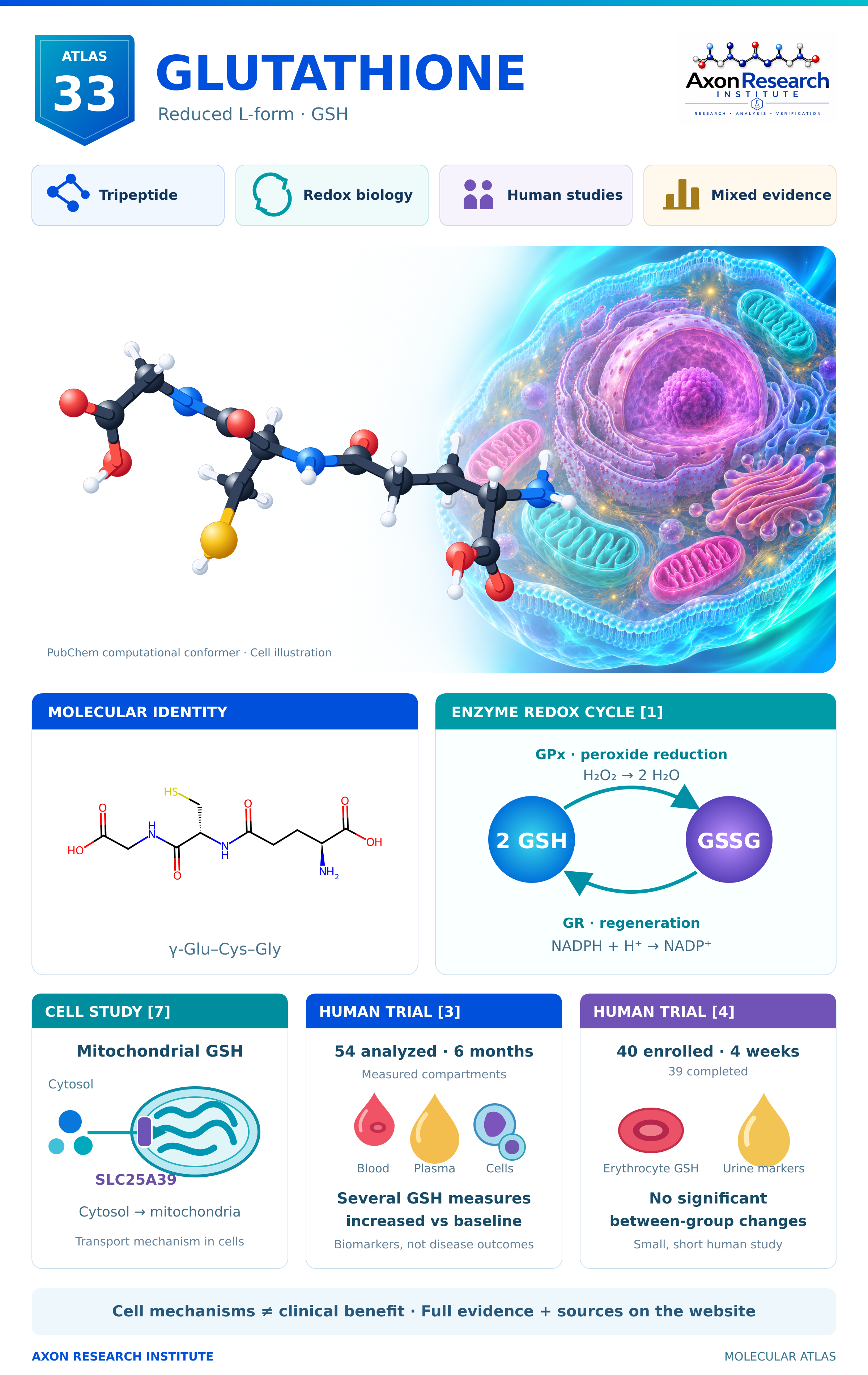
Visual summary only. The research findings, limitations and references accompany the card on this page.
The molecular view uses a source-provided computational conformer, not an experimental or unique bioactive geometry. The biological setting is an illustration. Original study diagrams summarize cited research without reproducing publication artwork or inventing quantitative results.
PubChem computational conformer (3D SDF) · Download visual source SDF
Glutathione
Three amino acids. One redox-active thiol.
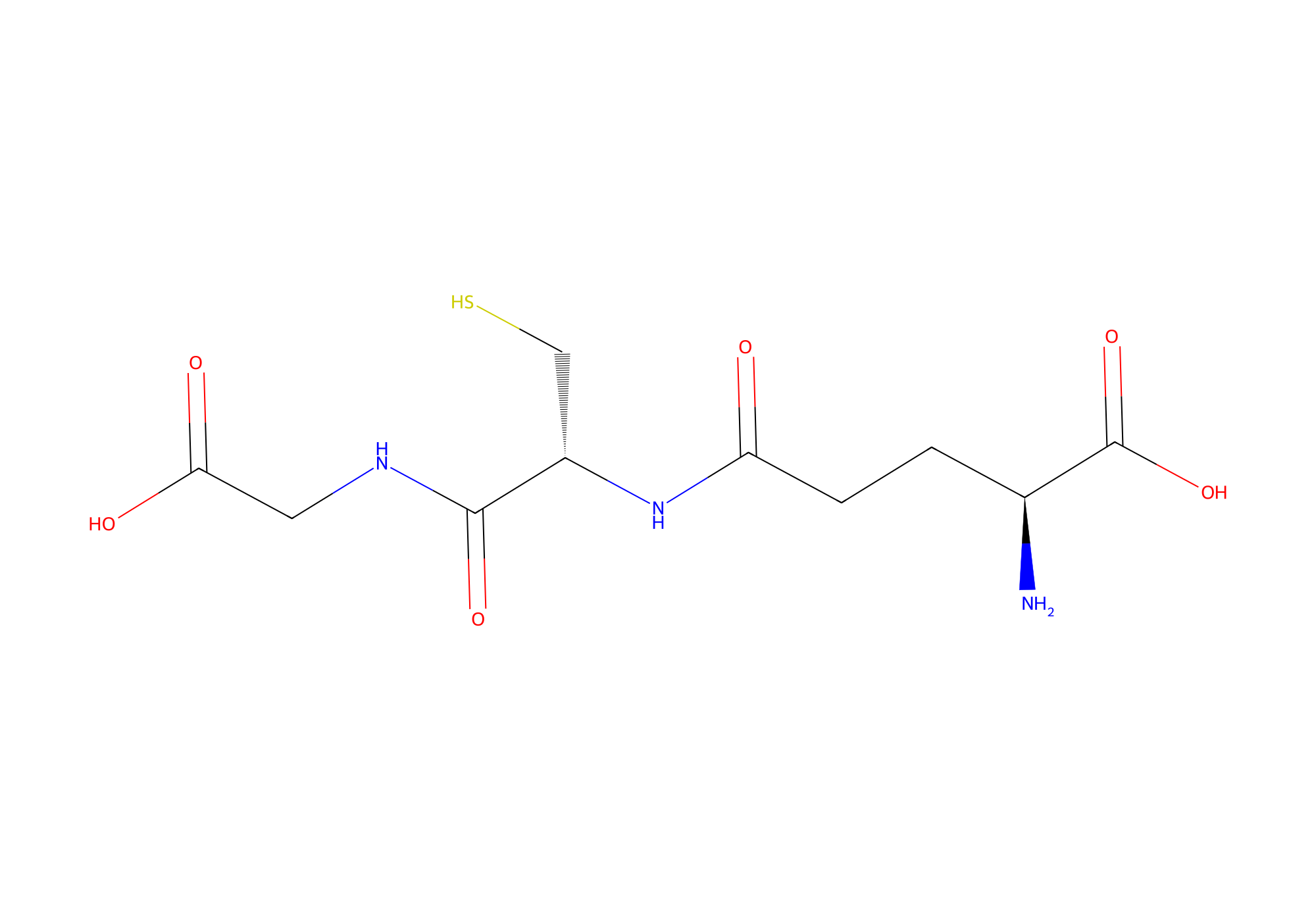
Reduced L-glutathione, neutral parent structure- Molecular formula
- C10H17N3O6S
- Molecular weight
- 307.33 g/mol
- Class
- Tripeptide
- Identity
- γ-L-glutamyl-L-cysteinylglycine
Research snapshot
A naturally occurring tripeptide involved in cellular redox regulation and antioxidant defense.
Established biochemistry; selected placebo-controlled human biomarker trials with mixed results
Identity & representation
The card describes the reduced neutral parent molecule, not a particular salt, formulation, or batch. PubChem depicts glutamate and cysteine stereochemistry.
Educational reference only. Not a dosing guide, treatment recommendation or product endorsement.
Reduced L-form · GSH[2]
View the chemical structure →Sources checked: 2026-11-06. Identity and evidence limits are stated above. Independent specialist review is pending.
3 amino acid residues[2]
Enzyme co-substrate[1]
glutathione products[6]
As of 2026-11-06What researchers study
GSH is made in cells from glutamate, cysteine and glycine. Its sulfur-containing thiol participates in redox reactions and conjugation chemistry.
How the redox cycle works[1][8][9][10]
- 2 GSHReducedGlutathione peroxidases (GPx) ↓
- GSSGOxidizedGlutathione reductase (GR) ↓
- 2 GSHRegenerated
Glutathione peroxidases use GSH to reduce peroxides. Glutathione reductase recycles GSSG to GSH.
Cellular chemistry does not establish that supplementation improves health outcomes.
Original publication-grounded biochemical schematic; enzyme reactions are stoichiometrically balanced.
Human evidence
54 analyzed | 6 months[3]
Richie et al., 2015 · Randomized, double-blind, placebo-controlled trial
Healthy non-smoking adults; 61 enrolled, 60 received intervention, 54 completed at least six months and entered analyses. Oral glutathione supplementation; no dosing guidance provided.
Observed: GSH increased in several measured compartments; the reported increases used in the visual are versus baseline.
Limit: Biomarker findings in healthy adults do not establish disease prevention or treatment. The two selected trials were not a head-to-head comparison.
Endpoint: Biomarker40 enrolled | 39 completed | 4 weeks[4]
Allen and Bradley, 2011 · Randomized, double-blind, placebo-controlled trial
Adults without acute or chronic disease; 40 enrolled and 39 completed per protocol. Oral glutathione supplementation; no dosing guidance provided.
Observed: No significant between-group changes in erythrocyte GSH indices or measured urinary oxidative-stress biomarkers.
Limit: A small, short study; nonsignificance is not proof of zero effect or equivalence. Findings cannot establish treatment benefit or injectable safety.
Endpoint: BiomarkerMeasured endpoints: Erythrocyte glutathione indices; Urinary F2-isoprostanes; Urinary 8-OHdG
Safety & evidence limits
- Biomarkers are not clinical outcomes[3][4]
Small healthy-adult studies cannot establish disease treatment, longevity or broad benefit.
- Preparation and route matter[3][4][5]
Oral trial results do not establish injectable safety or the quality of a different product.
- Contamination can cause serious harm[5]
FDA warns against using dietary supplement-grade glutathione to make injectable drugs.
Practical identity notes
- GSH is the reduced form; GSSG is the disulfide.
- This structure is the neutral parent, not a salt, mixture or formulation.
- Chemical identity does not certify product purity, sterility or suitability for human use.
The 10-second takeaway
Essential endogenous redox chemistry. Mixed supplementation biomarker results. The two trials summarized here do not establish treatment benefit.
Enzyme reactions
- Glutathione peroxidase (GPx)[1][8][10]
2 GSH + H2O2 → GSSG + 2 H2O
- Glutathione reductase (GR)[1][9][10]
GSSG + NADPH + H+ → 2 GSH + NADP+
Biochemical reactions describe cellular chemistry, not treatment outcomes.
What the visual panels show
Original diagrams summarize the cited research or documented evidence search. They are not copied publication figures or claims of treatment benefit.
Enzyme redox cycle[1][8][9][10]
Established biochemistry · Original biochemical cycle schematic
2 GSH · GSSG · GPx · peroxide reduction · H2O2 → 2 H2O · GR · regeneration · NADPH + H+ → NADP+
Interpretation: Cell mechanisms do not establish clinical benefit from supplementation.
Cell study: mitochondrial GSH[7]
Cell and biochemical study · Original cytosol-to-mitochondrion transport diagram
Cytosol · SLC25A39 · Cytosol → mitochondria · Transport mechanism in cells
Interpretation: SLC25A39 is placed at the schematic inner membrane. This is cellular biology, not a treatment-target map or a solved protein structure.
Source context: Figure 2. See the linked references.
Human trial: Richie et al.[3]
Randomized placebo-controlled human biomarker trial · Original blood, plasma and cell specimen icons; no quantitative chart
54 analyzed · 6 months · Measured compartments · Blood · Plasma · Cells · Several GSH measures increased vs baseline
Interpretation: The icon strip depicts measured compartments, not a claim that every compartment improved at every tested dose.
Source context: Figure 2, Figure 3. See the linked references.
Human trial: Allen and Bradley[4]
Randomized placebo-controlled human biomarker trial · Original erythrocyte and urinary-specimen icons; no quantitative chart
40 enrolled · 4 weeks · 39 completed · Erythrocyte GSH · Urine markers · No significant between-group changes
Interpretation: Nonsignificance is not proof of zero effect or equivalence. The selected trials have different designs and are not a head-to-head comparison.
Source context: Figure 1, Figure 2, Figure 3. See the linked references.
Follow the evidence
Sources & what they support
- Glutathione and glutathione-dependent enzymes: From biochemistry to gerontology and successful aging
Supports: Overview; redox homeostasis; peroxidase/reductase mechanism; conjugation; research areas
- Glutathione, PubChem CID 124886
Supports: Chemical identity, connectivity, stereochemistry, molecular formula, molecular weight
Original structure record · Download depicted structure SDF
Generated 2D layout from the verified reference graph; not an original 2D source-record download.
- Randomized controlled trial of oral glutathione supplementation on body stores of glutathione
Supports: Healthy-adult biomarker study: 61 enrolled, 60 received intervention, 54 completed at least six months and entered analyses; increases described in the visual are versus baseline; scope limits
- Effects of oral glutathione supplementation on systemic oxidative stress biomarkers in human volunteers
Supports: Healthy-adult biomarker study: 40 enrolled, 39 completed, four weeks; no significant between-group changes in measured erythrocyte GSH and urinary oxidative-stress biomarkers; scope limits
- FDA reminds compounders not to use dietary supplement grade glutathione for injectables
Supports: Route/formulation-specific contamination safety; supplement-grade ingredients unsuitable for injection
- Adverse Events Linked to Injectable Glutathione Compounded with Dietary Supplement Grade Ingredient: Current Situation
Supports: No FDA-approved glutathione products in the United States as stated by current CDC advisory; safety context
- SLC25A39 is necessary for mitochondrial glutathione import in mammalian cells
Supports: Cytosolic GSH and mitochondrial import with SLC25A39 involvement; source Figure 2. The card uses an original schematic, not copied figure artwork.
- Glutathione peroxidase, EC 1.11.1.9
Supports: 2 GSH + H2O2 → GSSG + 2 H2O.
- Glutathione-disulfide reductase, EC 1.8.1.7
Supports: GSSG + NADPH + H+ → 2 GSH + NADP+.
- Glutathione and mitochondria
Supports: Figure 2 provides publication grounding for GSH/GPx/GR mitochondrial peroxide metabolism. The card uses an original diagram rather than reproducing the figure.
← Explore the Molecular Atlas Continue to the research library →