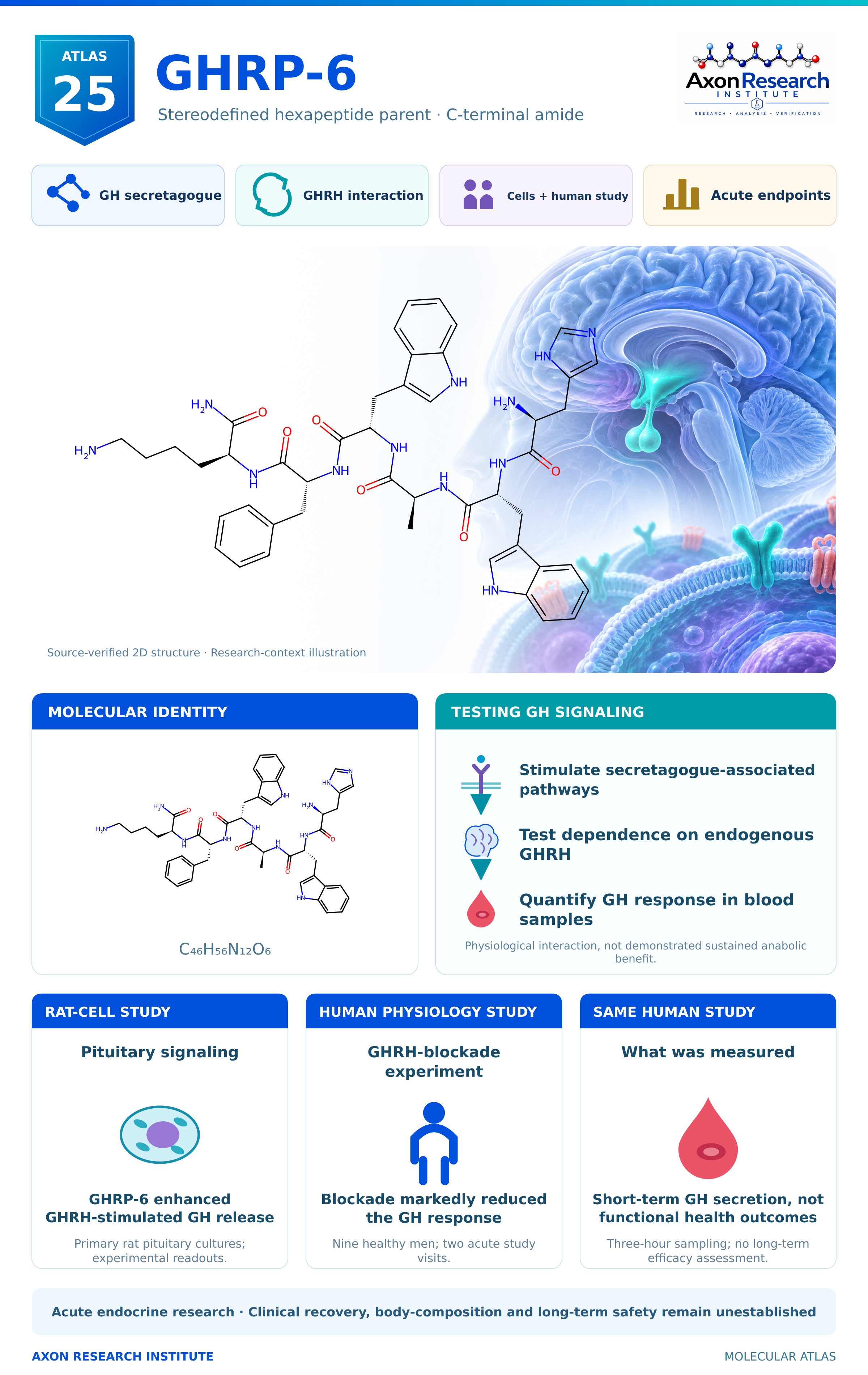
Visual summary only. The research findings, limitations and references accompany the card on this page.
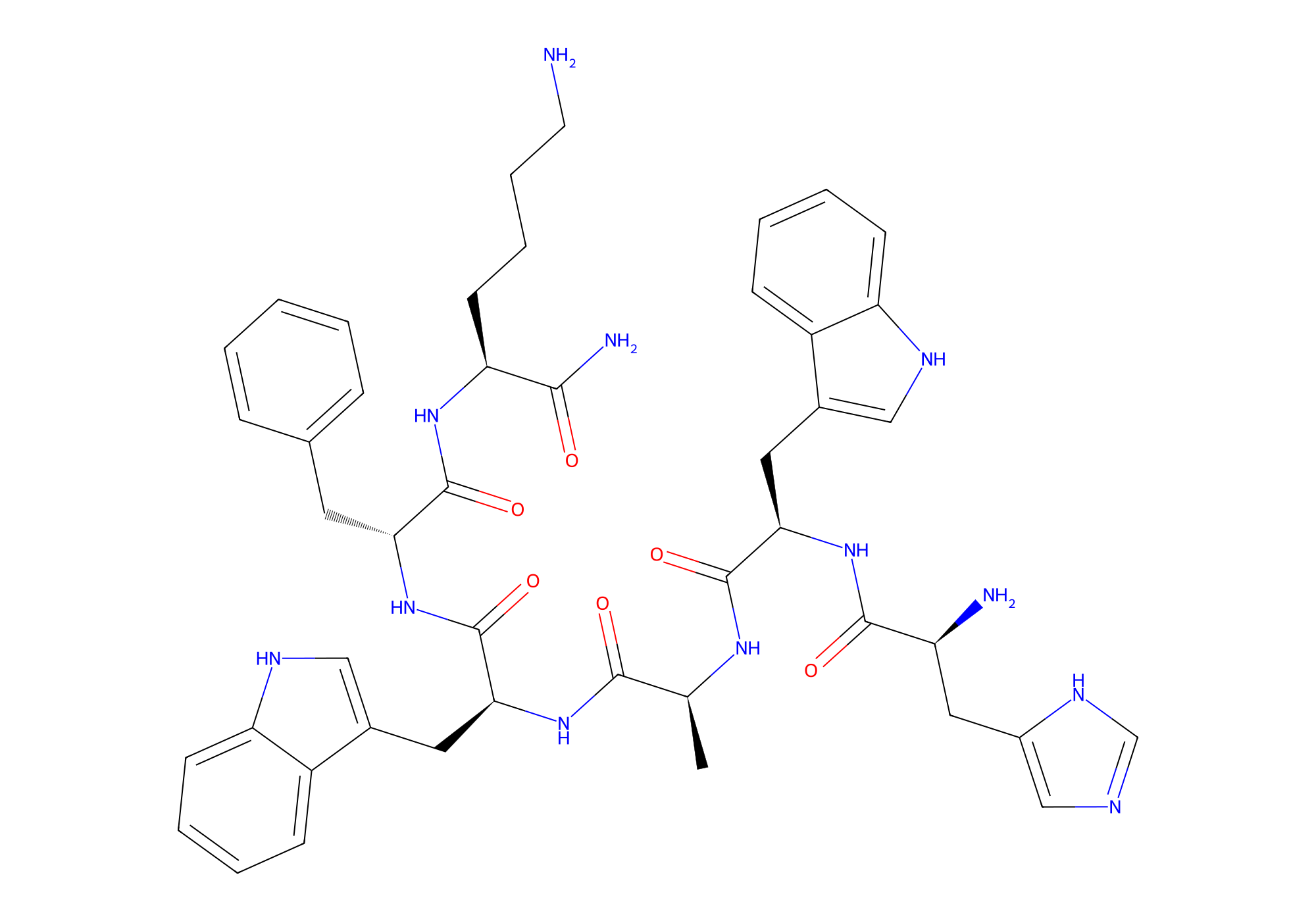
The chemical drawing shows source-verified two-dimensional connectivity and stereochemistry, not an experimental three-dimensional conformation. The biological setting is an illustration. Original study diagrams summarize cited research without reproducing publication artwork or inventing quantitative results.
GHRP-6
Ghrelin / GH secretagogue signaling
Stereodefined GHRP-6 parent with C-terminal amide- Molecular formula
- C46H56N12O6
- Molecular weight
- 873 g/mol
- Class
- Synthetic hexapeptide
- Identity
- His-D-Trp-Ala-Trp-D-Phe-Lys-NH2
Research snapshot
GHRP-6 is a six-residue growth-hormone secretagogue. Research examines its interaction with endogenous endocrine signals, including the requirement for intact GHRH signaling in maximal GH release.
Small human physiology study
Identity & representation
Literature reference molecule. Catalog naming is not analytical confirmation of AXON contents, salt, purity or formulation. His1, Ala3, Trp4 and Lys6 are L; Trp2 and Phe5 are D. Histidine tautomers may differ in drawings without changing peptide sequence.
Educational reference only. Not a dosing guide, treatment recommendation or product endorsement.
Stereodefined hexapeptide parent · C-terminal amide[3]
View the chemical structure →Sources checked: 2026-11-06. Identity and evidence limits are stated above. Independent specialist review is pending.
What researchers study
GHRP-6 is a six-residue growth-hormone secretagogue. Research examines its interaction with endogenous endocrine signals, including the requirement for intact GHRH signaling in maximal GH release.
Interaction between GHRP-6 and endogenous GHRH signaling
Acute growth-hormone responses in controlled physiological studies
Sequence-specific receptor and pharmacokinetic characterization
Mechanism in context
- Stimulates secretagogue-associated endocrine signaling
- Interacts with endogenous GHRH control
- Human studies quantify the acute GH response
The selected experiment supports a physiological interaction, not a claim of sustained anabolic or recovery benefits.
Simplified publication-grounded schematic, not a solved protein structure or proof of clinical benefit.
Selected evidence
Selected human evidence is summarized above; this is not an exhaustive clinical or regulatory review.
Growth hormone (GH)-releasing peptide-6 requires endogenous hypothalamic GH-releasing hormone for maximal GH stimulation.[1]
Controlled within-participant human physiology study · Healthy men aged 20–30 · Two acute study visits; 3-hour sampling per visit · Reported n: 9
Observed: Blocking GHRH markedly reduced the GH response to GHRP-6.
Limit: The outcome was short-term hormone secretion, not strength, body composition, recovery or long-term health.
Reference identity in detail
Sequences and form distinctions describe the cited reference substance, not a verified supplier preparation.
Safety & evidence limits
A large acute hormone response does not demonstrate muscle gain, tissue repair or improved long-term health.
Small, short studies cannot establish long-term endocrine safety or reliable benefit in broader populations.
Use stereodefined CID 9919153; the common CID 4345065 omits stereochemistry and is unsuitable as an exact structure authority.
Practical identity notes
- His1, Ala3, Trp4 and Lys6 are L; Trp2 and Phe5 are D. Histidine tautomers may differ in drawings without changing peptide sequence.
- Formula and mass apply only to the named reference form, excluding unspecified counterions, solvent and water.
- Educational molecular reference • Selected studies, not a systematic review • No dosing guidance
The 10-second takeaway
A sequence-specific secretagogue used to study GH physiology; acute endocrine effects are not proof of long-term clinical benefit.
What the visual panels show
Original diagrams summarize the cited research or documented evidence search. They are not copied publication figures or claims of treatment benefit.
TESTING GH SIGNALING[1][2]
Publication-grounded mechanism schematic · Original publication-grounded diagram
Stimulate secretagogue-associated pathways · Test dependence on endogenous GHRH · Quantify GH response in blood samples
Interpretation: Physiological interaction, not demonstrated sustained anabolic benefit.
Pituitary signaling[2]
RAT-CELL STUDY · Original publication-grounded diagram
GHRP-6 enhanced GHRH-stimulated GH release
Primary rat pituitary cultures; experimental readouts.
Interpretation: Cells are rat-derived. No human therapeutic mechanism or quantitative curve is implied.
GHRH-blockade experiment[1]
HUMAN PHYSIOLOGY STUDY · Original publication-grounded diagram
Blockade markedly reduced the GH response
Nine healthy men; two acute study visits.
Interpretation: Show experiment logic and hormone readout, not strength or recovery outcomes.
What was measured[1]
SAME HUMAN STUDY · Original publication-grounded diagram
Short-term GH secretion, not functional health outcomes
Three-hour sampling; no long-term efficacy assessment.
Interpretation: Do not extrapolate acute GH release into muscle gain, tissue repair or chronic safety.
Follow the evidence
Sources & what they support
- Growth hormone (GH)-releasing peptide-6 requires endogenous hypothalamic GH-releasing hormone for maximal GH stimulation.
Supports: Nine-person GHRH-blockade experiment
- The synergistic effects of His-D-Trp-Ala-Trp-D-Phe-Lys-NH2 on growth hormone (GH)-releasing factor-stimulated GH release and intracellular adenosine 3',5'-monophosphate accumulation in rat primary pituitary cell culture.
Supports: Exact GHRP-6 sequence and primary-cell research
- PubChem CID 9919153
Supports: Reference chemical graph, formula and molecular mass; not product identity
Original structure record · Download source SDF
Original PubChem 2D source structure record.
← Explore the Molecular Atlas Continue to the research library →