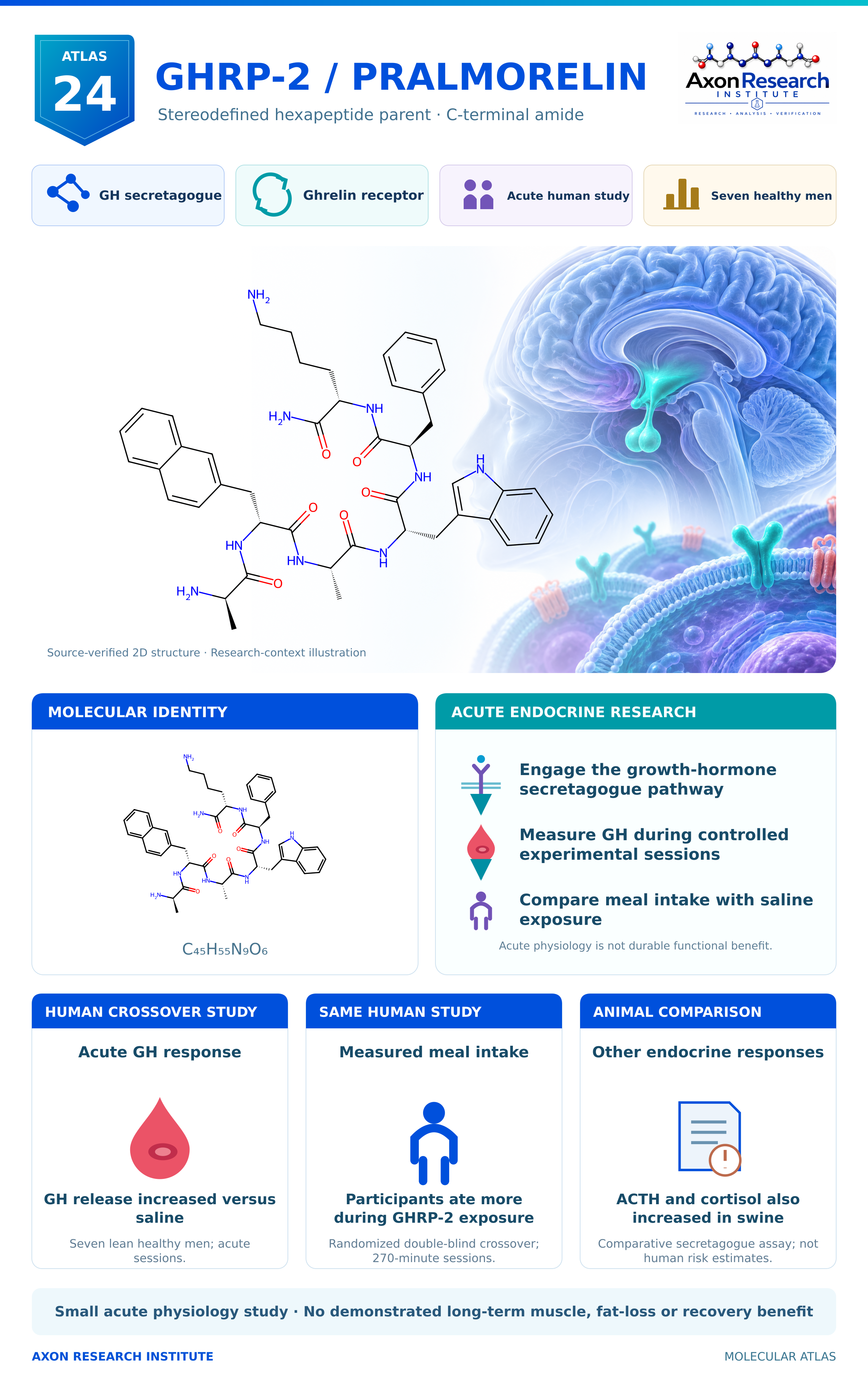
Visual summary only. The research findings, limitations and references accompany the card on this page.
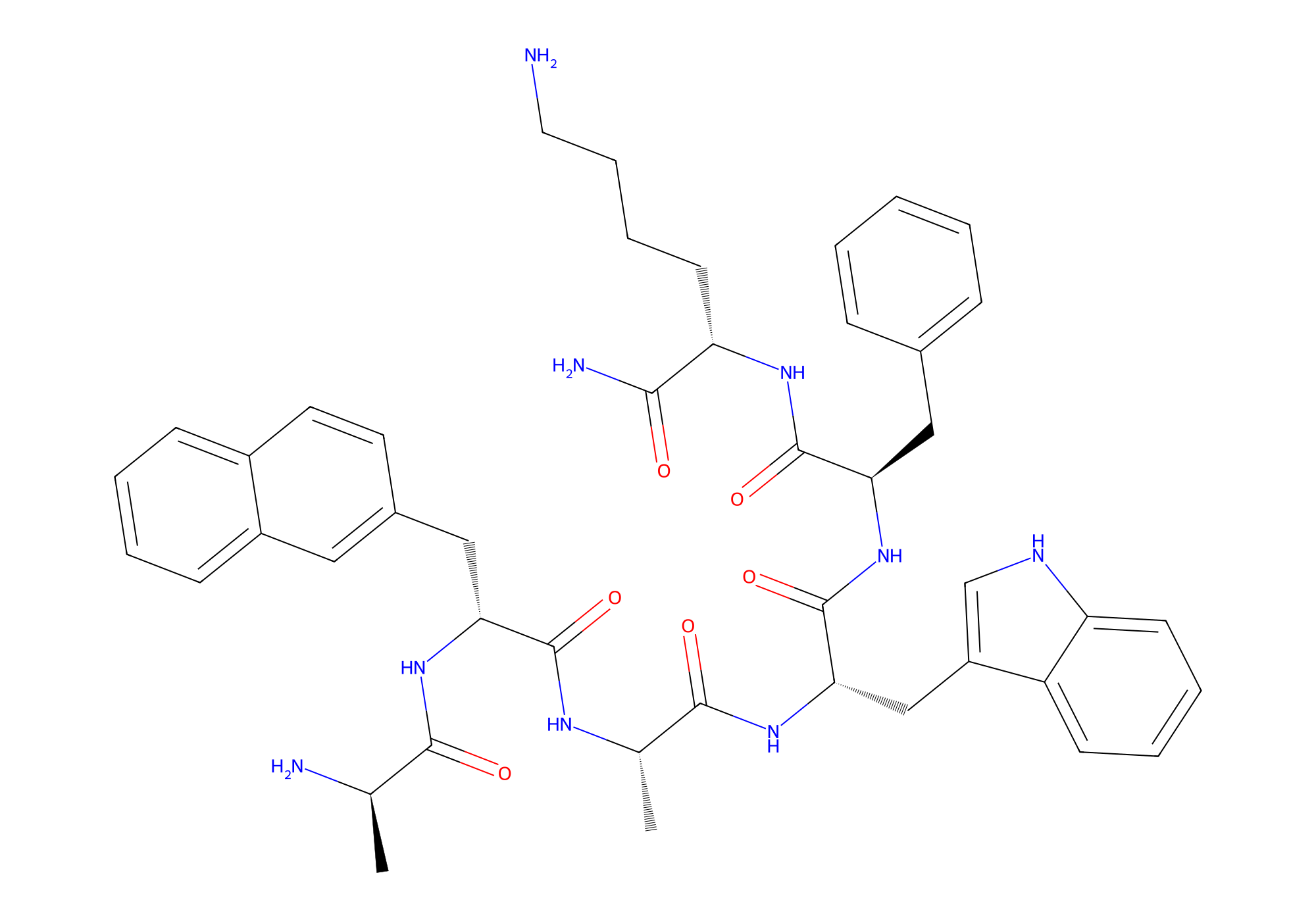
The chemical drawing shows source-verified two-dimensional connectivity and stereochemistry, not an experimental three-dimensional conformation. The biological setting is an illustration. Original study diagrams summarize cited research without reproducing publication artwork or inventing quantitative results.
GHRP-2 / pralmorelin
Ghrelin receptor / GHSR
Pralmorelin peptide parent with C-terminal amide- Molecular formula
- C45H55N9O6
- Molecular weight
- 818 g/mol
- Class
- Synthetic hexapeptide
- Identity
- D-Ala-D-2-Nal-Ala-Trp-D-Phe-Lys-NH2
Research snapshot
GHRP-2, also called pralmorelin, is a synthetic ghrelin-receptor agonist used in endocrine research. Acute human experiments have examined growth-hormone release and food intake.
Small human physiology experiment
Identity & representation
Literature reference molecule. Catalog naming is not analytical confirmation of AXON contents, salt, purity or formulation. D-2-Nal = D-2-naphthylalanine. Ala3, Trp4 and Lys6 are L. Distinct from GHRP-6.
Educational reference only. Not a dosing guide, treatment recommendation or product endorsement.
Stereodefined hexapeptide parent · C-terminal amide[3]
View the chemical structure →Sources checked: 2026-11-06. Identity and evidence limits are stated above. Independent specialist review is pending.
What researchers study
GHRP-2, also called pralmorelin, is a synthetic ghrelin-receptor agonist used in endocrine research. Acute human experiments have examined growth-hormone release and food intake.
Growth-hormone secretagogue receptor pharmacology
Appetite and energy intake in controlled human experiments
Separation of acute endocrine effects from clinical outcomes
Mechanism in context
- Activates the growth-hormone secretagogue receptor
- Produces acute endocrine and appetite-related responses
- Human physiology studies measure GH and meal intake
Acute hormone and meal-intake responses do not establish long-term functional benefit or safety.
Simplified publication-grounded schematic, not a solved protein structure or proof of clinical benefit.
Selected evidence
Selected human evidence is summarized above; this is not an exhaustive clinical or regulatory review.
Growth hormone releasing peptide-2 (GHRP-2), like ghrelin, increases food intake in healthy men.[1]
Small randomized double-blind crossover experiment · Lean healthy men · 270-minute experimental sessions · Reported n: 7
Observed: Participants ate more during GHRP-2 exposure and had increased GH release versus saline.
Limit: A seven-person acute experiment cannot establish sustained body-composition benefit or long-term safety.
Reference identity in detail
Sequences and form distinctions describe the cited reference substance, not a verified supplier preparation.
Safety & evidence limits
The selected study measured food intake and growth hormone, not durable muscle gain, fat loss or improved health.
Results from seven healthy men do not establish responses across sexes, ages, disease states or prolonged exposure.
GHRP-2 and GHRP-6 have different sequences; their properties and findings cannot be treated as identical.
Practical identity notes
- D-2-Nal = D-2-naphthylalanine. Ala3, Trp4 and Lys6 are L. Distinct from GHRP-6.
- Formula and mass apply only to the named reference form, excluding unspecified counterions, solvent and water.
- Educational molecular reference • Selected studies, not a systematic review • No dosing guidance
The 10-second takeaway
A ghrelin-receptor research peptide with acute human endocrine and appetite findings, not established long-term body-composition benefit.
What the visual panels show
Original diagrams summarize the cited research or documented evidence search. They are not copied publication figures or claims of treatment benefit.
ACUTE ENDOCRINE RESEARCH[1]
Publication-grounded mechanism schematic · Original publication-grounded diagram
Engage the growth-hormone secretagogue pathway · Measure GH during controlled experimental sessions · Compare meal intake with saline exposure
Interpretation: Acute physiology is not durable functional benefit.
Acute GH response[1]
HUMAN CROSSOVER STUDY · Original publication-grounded diagram
GH release increased versus saline
Seven lean healthy men; acute sessions.
Interpretation: Hormone-response schematic only; no fabricated time curve or long-term benefit.
Measured meal intake[1]
SAME HUMAN STUDY · Original publication-grounded diagram
Participants ate more during GHRP-2 exposure
Randomized double-blind crossover; 270-minute sessions.
Interpretation: Meal intake is the measured endpoint, not a body-composition or health improvement.
Other endocrine responses[2]
ANIMAL COMPARISON · Original publication-grounded diagram
ACTH and cortisol also increased in swine
Comparative secretagogue assay; not human risk estimates.
Interpretation: Retain species and endocrine caveat. Do not label GHRP-2 selectively GH-only.
Follow the evidence
Sources & what they support
- Growth hormone releasing peptide-2 (GHRP-2), like ghrelin, increases food intake in healthy men.
Supports: Human GH and food-intake physiology
- Ipamorelin, the first selective growth hormone secretagogue.
Supports: Comparative preclinical secretagogue hormone responses
- PubChem CID 6918245
Supports: Reference chemical graph, formula and molecular mass; not product identity
Original structure record · Download source SDF
Original PubChem 2D source structure record.
← Explore the Molecular Atlas Continue to the research library →