
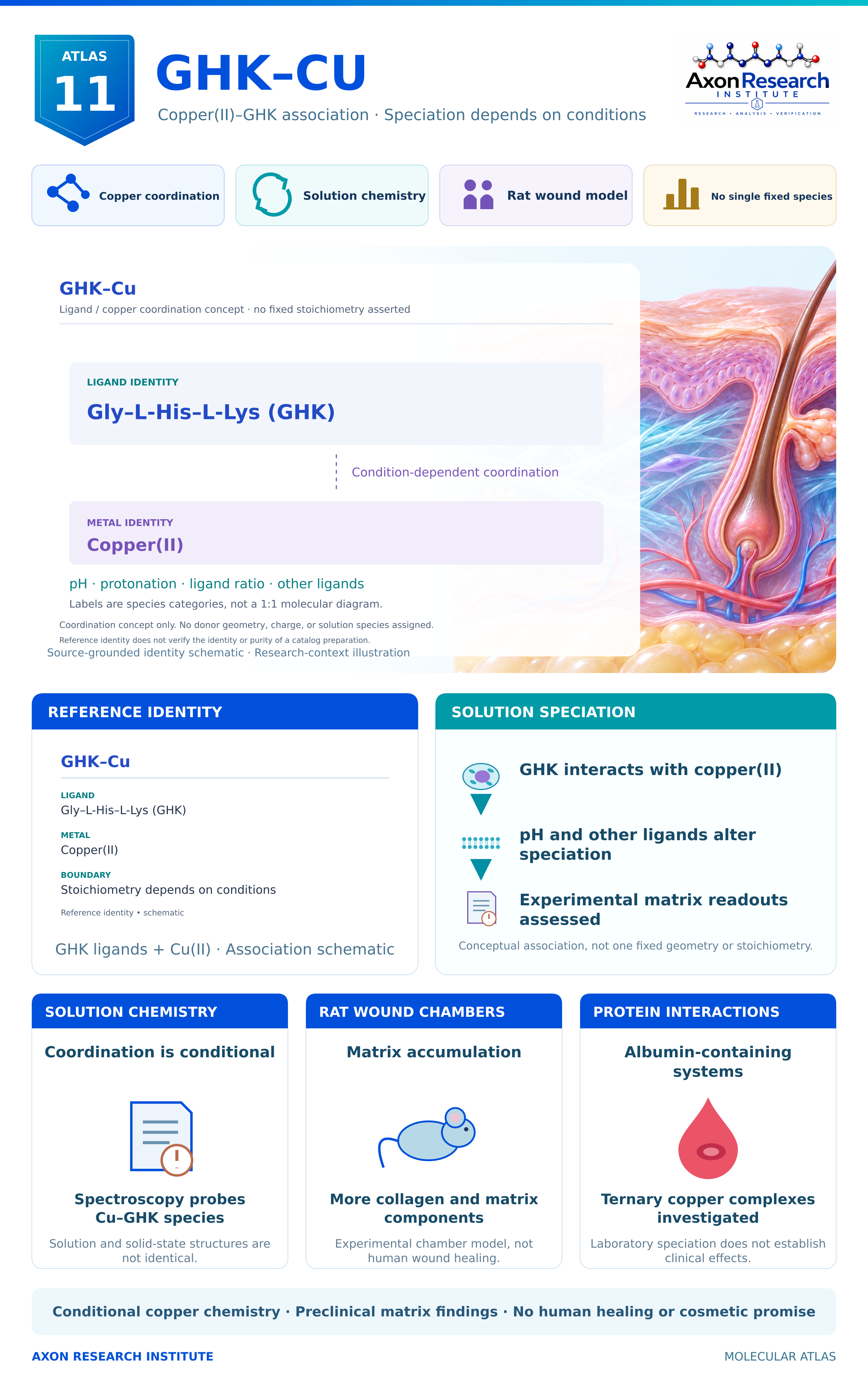
Visual summary only. The research findings, limitations and references accompany the card on this page.
Nonstoichiometric ligand / Cu(II) coordination concept; exact species requires conditions. Dashed association is conceptual, not a covalent bond. No fixed ligand-to-metal ratio, geometry, formula or molecular mass. Biological settings and research diagrams are illustrations, not measured anatomy or clinical outcomes.
GHK–Cu
Copper coordination / matrix biology
GHK ligand coordinated to Cu(II); exact solution species depends on conditions- Ligand
- Gly–L-His–L-Lys (GHK)
- Metal
- Copper(II)
- Boundary
- Stoichiometry depends on conditions
Research snapshot
GHK-Cu describes copper complexes of the tripeptide glycyl-L-histidyl-L-lysine. Research spans solution coordination chemistry and extracellular-matrix responses in experimental wound models.
Solution chemistry and animal wounds
Identity & representation
Literature reference molecule. Catalog naming is not analytical confirmation of AXON contents, salt, purity or formulation. GHK is the ligand, not the full complex. Speciation, protonation, counterions and coordination geometry must be stated.
Educational reference only. Not a dosing guide, treatment recommendation or product endorsement.
Nonstoichiometric ligand / Cu(II) coordination concept; exact species requires conditions.[2][3][4]
Sources checked: 2026-11-06. Identity and evidence limits are stated above. Independent specialist review is pending.
What researchers study
GHK-Cu describes copper complexes of the tripeptide glycyl-L-histidyl-L-lysine. Research spans solution coordination chemistry and extracellular-matrix responses in experimental wound models.
Copper coordination and pH-dependent species in solution
Extracellular-matrix accumulation in experimental wound models
Interactions with albumin and competing biological ligands
Mechanism in context
- GHK coordinates copper(II) in solution
- Speciation changes with pH and available ligands
- Experimental wounds are assessed for matrix accumulation
This simplified research flow is not a unique receptor mechanism. A ligand-only diagram must never be labeled the complete copper complex.
Simplified publication-grounded schematic, not a solved protein structure or proof of clinical benefit.
Selected evidence
Selected evidence is preclinical or laboratory-based; human-derived cells are not a human clinical trial.
In vivo stimulation of connective tissue accumulation by the tripeptide-copper complex glycyl-L-histidyl-L-lysine-Cu2+ in rat experimental wounds.[1]
Controlled animal wound-chamber experiment · Rats with implanted experimental wound chambers · Model-specific wound experiment
Observed: GHK-Cu increased measured collagen and other matrix components in the chambers.
Limit: The model does not establish human wound healing, cosmetic efficacy or systemic treatment benefit.
Reference identity in detail
Sequences and form distinctions describe the cited reference substance, not a verified supplier preparation.
Safety & evidence limits
Different GHK–copper species and salts can have different compositions; one molecular mass cannot represent every preparation.
Rat wound-chamber matrix accumulation is not proof of faster human healing or improved skin appearance.
A coordination schematic is educational, not an analytical identity certificate or demonstration of a formulation’s safety.
Practical identity notes
- GHK is the ligand, not the full complex. Speciation, protonation, counterions and coordination geometry must be stated.
- Formula and mass apply only to the named reference form, excluding unspecified counterions, solvent and water.
- Educational molecular reference • Selected studies, not a systematic review • No dosing guidance
The 10-second takeaway
A copper-binding tripeptide complex with coordination and preclinical matrix research; specify the chemical species before quoting a formula or mass.
What the visual panels show
Original diagrams summarize the cited research or documented evidence search. They are not copied publication figures or claims of treatment benefit.
SOLUTION SPECIATION[2][3][1]
Publication-grounded mechanism schematic · Original publication-grounded diagram
GHK interacts with copper(II) · pH and other ligands alter speciation · Experimental matrix readouts assessed
Interpretation: Conceptual association, not one fixed geometry or stoichiometry.
Coordination is conditional[2][3]
SOLUTION CHEMISTRY · Original publication-grounded diagram
Spectroscopy probes Cu–GHK species
Solution and solid-state structures are not identical.
Interpretation: No fixed species, formula or atomistic graph assigned.
Matrix accumulation[1]
RAT WOUND CHAMBERS · Original publication-grounded diagram
More collagen and matrix components
Experimental chamber model, not human wound healing.
Interpretation: No human cosmetic or systemic efficacy claim.
Albumin-containing systems[4]
PROTEIN INTERACTIONS · Original publication-grounded diagram
Ternary copper complexes investigated
Laboratory speciation does not establish clinical effects.
Interpretation: Do not show clinical transport kinetics or benefit.
Follow the evidence
Sources & what they support
- In vivo stimulation of connective tissue accumulation by the tripeptide-copper complex glycyl-L-histidyl-L-lysine-Cu2+ in rat experimental wounds.
Supports: Rat wound-chamber matrix experiment
- Structure of the Glycyl-L-histidyl-L-lysine--copper(II) complex in solution.
Supports: Neutral-pH mononuclear 1:1 species and distinction from solid-state structure
- N.m.r. and e.p.r. investigation of the interaction of copper(II) and glycyl-L-histidyl-L-lysine, a growth-modulating tripeptide from plasma.
Supports: pH-dependent coordination and spectroscopy limitations
- Ternary Cu2+ Complexes of Human Serum Albumin and Glycyl-l-histidyl-l-lysine.
Supports: Ternary complexes with albumin
← Explore the Molecular Atlas Continue to the research library →
