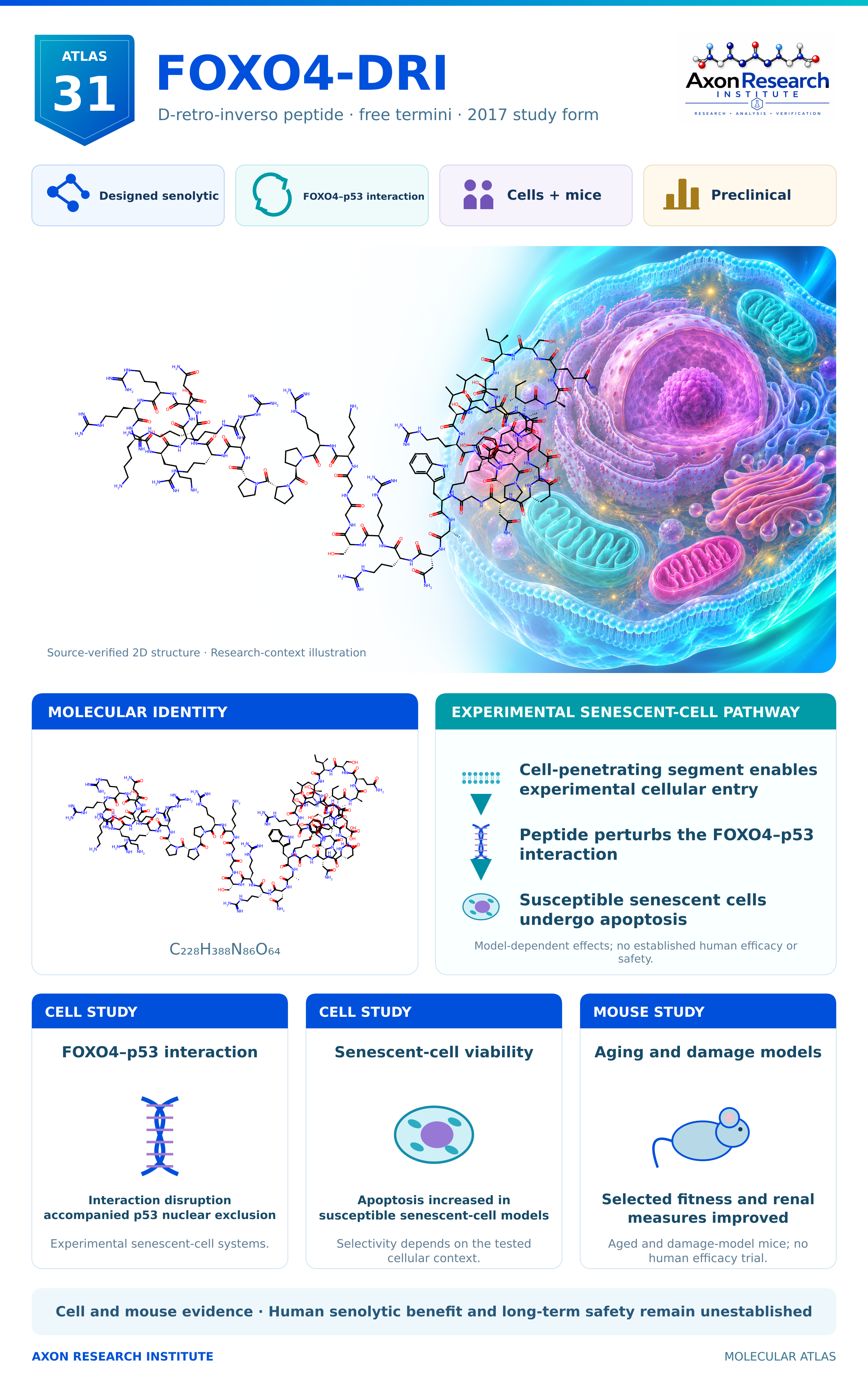
Visual summary only. The research findings, limitations and references accompany the card on this page.
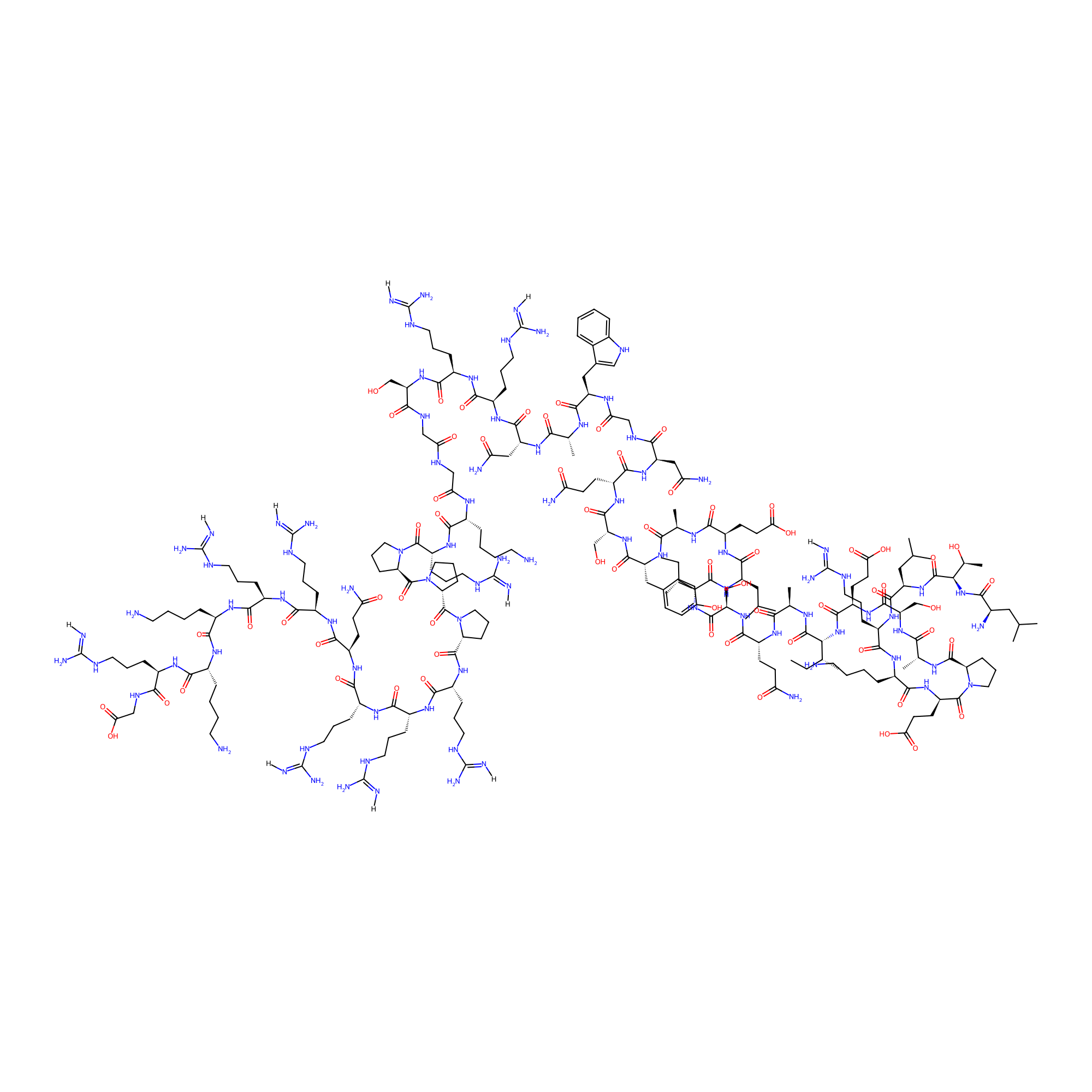
The chemical drawing shows source-verified two-dimensional connectivity and stereochemistry, not an experimental three-dimensional conformation. The biological setting is an illustration. Original study diagrams summarize cited research without reproducing publication artwork or inventing quantitative results.
FOXO4-DRI
FOXO4–p53 interaction
D-isoform peptide with free termini, per 2017 primary Methods- Molecular formula
- C228H388N86O64
- Molecular weight
- 5358.2 g/mol
- Class
- D-retro-inverso 46-residue peptide
- Identity
- H-ltlrkepaseiaqsileaysqngwanrrsggkrppprrrqrrkkrg-OH
Research snapshot
FOXO4-DRI is a designed cell-penetrating peptide investigated for disrupting FOXO4–p53 interactions in senescent cells. The founding study combined molecular experiments with mouse models of damage and aging.
Cell and mouse experiments
Identity & representation
Literature reference molecule. Catalog naming is not analytical confirmation of AXON contents, salt, purity or formulation. Lowercase = D residues; glycine is achiral. Preserve the printed sequence and cell-penetrating segment. Not FOXO4 protein or an all-L fragment.
Educational reference only. Not a dosing guide, treatment recommendation or product endorsement.
D-retro-inverso peptide · free termini · 2017 study form[3]
View the chemical structure →Sources checked: 2026-11-06. Identity and evidence limits are stated above. Independent specialist review is pending.
What researchers study
FOXO4-DRI is a designed cell-penetrating peptide investigated for disrupting FOXO4–p53 interactions in senescent cells. The founding study combined molecular experiments with mouse models of damage and aging.
Protein–protein interaction disruption assessed by NMR and cell assays
Apoptosis responses in senescent versus nonsenescent experimental cells
Tissue-function readouts in chemotoxicity and mouse aging models
Mechanism in context
- Enters experimental cells using a cell-penetrating segment
- Competes with FOXO4 for p53 interaction
- Promotes apoptosis in susceptible senescent-cell models
Selectivity was model-dependent and preclinical; these experiments do not establish human senolytic efficacy or safety.
Simplified publication-grounded schematic, not a solved protein structure or proof of clinical benefit.
Selected evidence
Selected evidence is preclinical or laboratory-based; human-derived cells are not a human clinical trial.
Targeted Apoptosis of Senescent Cells Restores Tissue Homeostasis in Response to Chemotoxicity and Aging.[1]
Molecular, cellular and animal experiments · Senescent cell systems and mouse models · Multiple model-specific experiments
Observed: FOXO4-DRI disrupted FOXO4–p53 interactions and altered senescent-cell viability; selected tissue measures improved in mice.
Limit: No human efficacy trial was reported; benefits and risks cannot be generalized beyond the tested models.
Reference identity in detail
Sequences and form distinctions describe the cited reference substance, not a verified supplier preparation.
Safety & evidence limits
This preclinical study does not establish safe removal of senescent cells, human rejuvenation or extended human lifespan.
The D-retro-inverso sequence is essential; an ordinary FOXO4 protein image or all-L peptide depicts a different molecule.
Senescence and p53 have context-dependent roles; favorable mouse endpoints do not establish the safety of chronic pathway disruption.
Practical identity notes
- Lowercase = D residues; glycine is achiral. Preserve the printed sequence and cell-penetrating segment. Not FOXO4 protein or an all-L fragment.
- Formula and mass apply only to the named reference form, excluding unspecified counterions, solvent and water.
- Educational molecular reference • Selected studies, not a systematic review • No dosing guidance
The 10-second takeaway
A precisely defined experimental senolytic peptide with cell and mouse evidence, not a proven human anti-aging intervention.
What the visual panels show
Original diagrams summarize the cited research or documented evidence search. They are not copied publication figures or claims of treatment benefit.
EXPERIMENTAL SENESCENT-CELL PATHWAY[1]
Publication-grounded mechanism schematic · Original publication-grounded diagram
Cell-penetrating segment enables experimental cellular entry · Peptide perturbs the FOXO4–p53 interaction · Susceptible senescent cells undergo apoptosis
Interpretation: Model-dependent effects; no established human efficacy or safety.
FOXO4–p53 interaction[1]
CELL STUDY · Original publication-grounded diagram
Interaction disruption accompanied p53 nuclear exclusion
Experimental senescent-cell systems.
Interpretation: Abstract interaction schematic, not an experimentally solved complex or universal target selectivity.
Senescent-cell viability[1]
CELL STUDY · Original publication-grounded diagram
Apoptosis increased in susceptible senescent-cell models
Selectivity depends on the tested cellular context.
Interpretation: No blanket claim of safe senescent-cell clearance; no fabricated viability plot.
Aging and damage models[1]
MOUSE STUDY · Original publication-grounded diagram
Selected fitness and renal measures improved
Aged and damage-model mice; no human efficacy trial.
Interpretation: Do not show reverse aging, lifespan extension or a rejuvenated human; endpoints are model-specific.
Follow the evidence
Sources & what they support
- Targeted Apoptosis of Senescent Cells Restores Tissue Homeostasis in Response to Chemotoxicity and Aging.
Supports: Primary mechanism and mouse findings
- FOXO4-DRI primary paper, STAR Methods: FOXO4-DRI peptide
Supports: Exact D-isoform sequence, free termini and reported molecular mass
- PubChem CID 167312269
Supports: Reference chemical graph, formula and molecular mass; not product identity
Original structure record · Download source SDF
Original PubChem 2D source structure record.
← Explore the Molecular Atlas Continue to the research library →