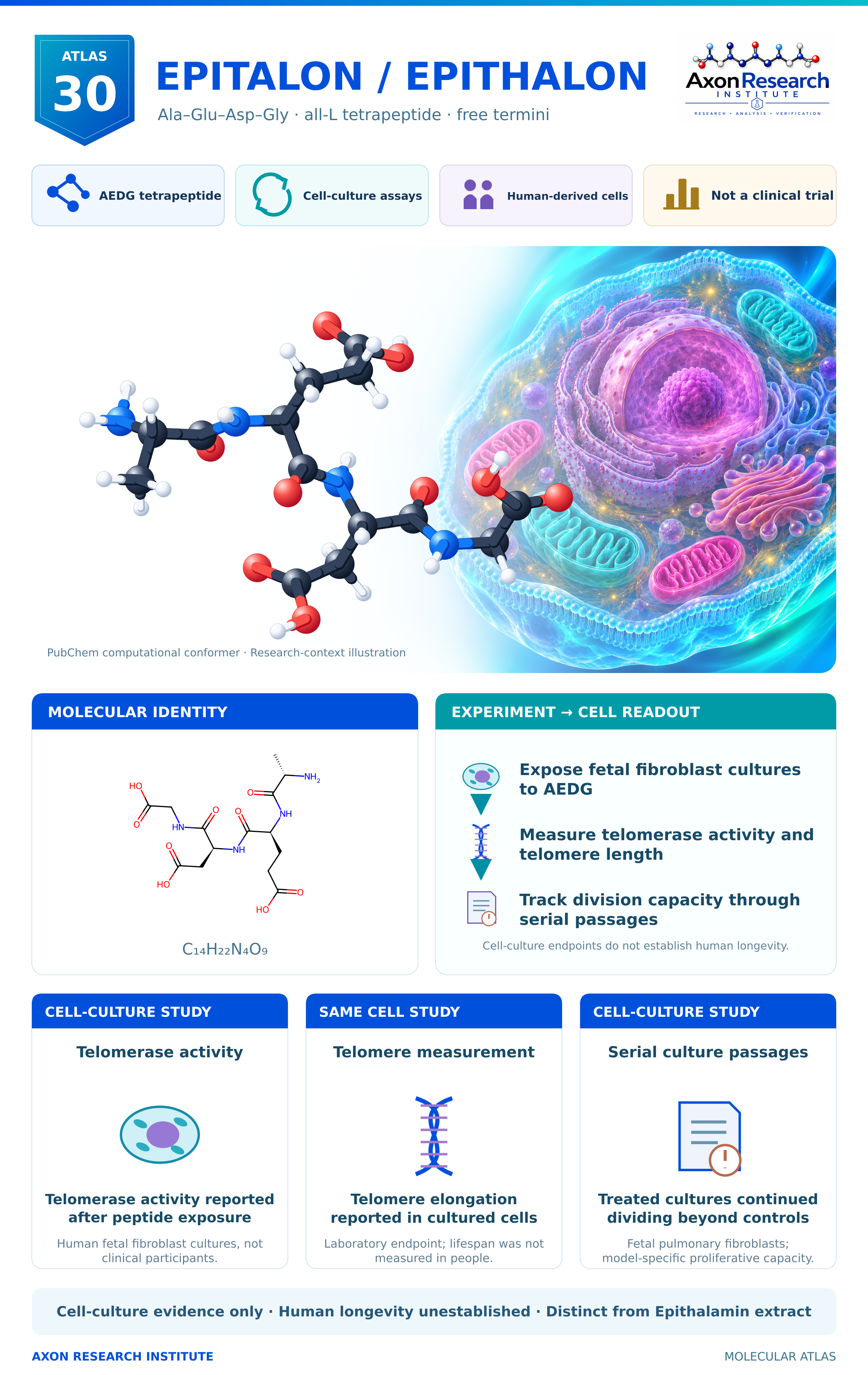
Visual summary only. The research findings, limitations and references accompany the card on this page.
The molecular view uses a source-provided computational conformer, not an experimental or unique bioactive geometry. The biological setting is an illustration. Original study diagrams summarize cited research without reproducing publication artwork or inventing quantitative results.
PubChem computational conformer (3D SDF) · Download visual source SDF
Epitalon / Epithalon
Telomerase / telomere laboratory endpoints
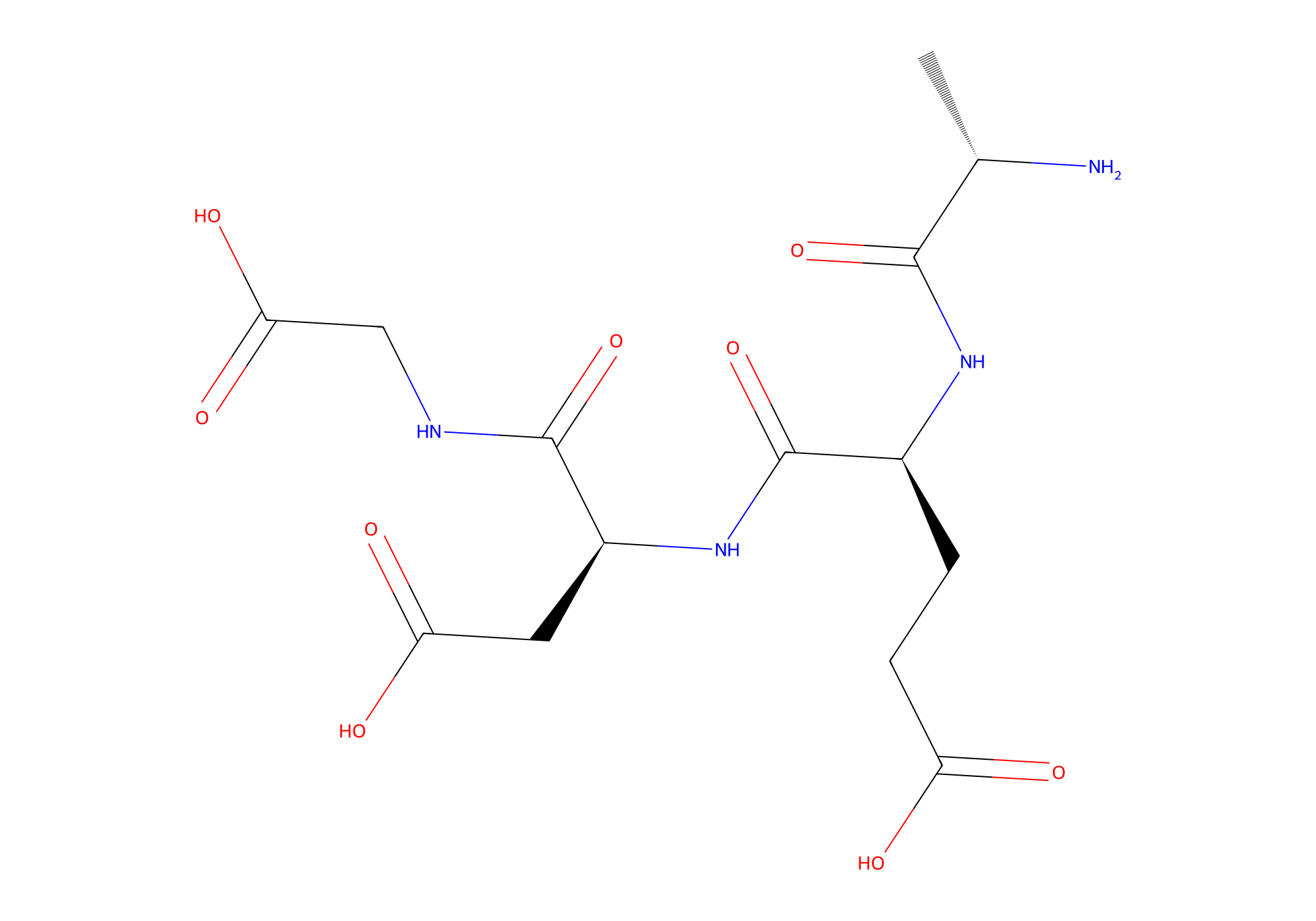
All-L Ala-Glu-Asp-Gly reference peptide, free termini- Molecular formula
- C14H22N4O9
- Molecular weight
- 390.35 g/mol
- Class
- Tetrapeptide
- Identity
- AEDG
Research snapshot
Epithalon is a synthetic tetrapeptide studied in cellular-aging models. Selected experiments reported telomerase-related changes in cultured fetal fibroblasts, which must remain distinct from evidence about human longevity.
Human fibroblast cultures
Identity & representation
Literature reference molecule. Catalog naming is not analytical confirmation of AXON contents, salt, purity or formulation. Ala-Glu-Asp-Gly; also Epitalon. Distinct from Epithalamin, a pineal tissue-extract preparation.
Educational reference only. Not a dosing guide, treatment recommendation or product endorsement.
Ala–Glu–Asp–Gly · all-L tetrapeptide · free termini[3]
View the chemical structure →Sources checked: 2026-11-06. Identity and evidence limits are stated above. Independent specialist review is pending.
What researchers study
Epithalon is a synthetic tetrapeptide studied in cellular-aging models. Selected experiments reported telomerase-related changes in cultured fetal fibroblasts, which must remain distinct from evidence about human longevity.
Telomerase catalytic-subunit expression in cultured fibroblasts
Telomere-length measurements during replicative cell aging
Cell proliferative capacity under controlled culture conditions
Mechanism in context
- Expose cultured fetal fibroblasts to AEDG
- Measure telomerase activity and telomere length
- Track proliferative capacity within the culture model
Telomere-related measurements are laboratory endpoints, not proof of longer life, rejuvenation or improved health in humans.
Simplified publication-grounded schematic, not a solved protein structure or proof of clinical benefit.
Selected evidence
Selected evidence is preclinical or laboratory-based; human-derived cells are not a human clinical trial.
Epithalon peptide induces telomerase activity and telomere elongation in human somatic cells.[1]
In vitro mechanistic experiment · Human fetal fibroblast cultures · Cell-culture study
Observed: Investigators reported telomerase activity and telomere elongation after Epithalon exposure.
Limit: Human-derived cells are not a clinical trial; lifespan and health outcomes in people were not tested.
Peptide promotes overcoming of the division limit in human somatic cell.[2]
In vitro proliferative-capacity experiment · Human fetal pulmonary fibroblasts · Serial culture passages
Observed: Treated cultures continued dividing beyond control cultures under the reported conditions.
Limit: Culture-passage extension is not demonstrated organismal longevity or safe telomerase manipulation.
Reference identity in detail
Sequences and form distinctions describe the cited reference substance, not a verified supplier preparation.
Safety & evidence limits
Do not describe telomerase activation in cultured cells as proven human lifespan extension or clinical rejuvenation.
Epithalamin extract and Epithalon tetrapeptide are different materials; evidence cannot be transferred without verification.
These laboratory studies do not establish long-term human safety or the consequences of sustained telomerase-related changes.
Practical identity notes
- Ala-Glu-Asp-Gly; also Epitalon. Distinct from Epithalamin, a pineal tissue-extract preparation.
- Formula and mass apply only to the named reference form, excluding unspecified counterions, solvent and water.
- Educational molecular reference • Selected studies, not a systematic review • No dosing guidance
The 10-second takeaway
A four-residue peptide with telomere-related cell-culture findings; human longevity and rejuvenation benefits are not established by those experiments.
What the visual panels show
Original diagrams summarize the cited research or documented evidence search. They are not copied publication figures or claims of treatment benefit.
EXPERIMENT → CELL READOUT[1][2]
Publication-grounded mechanism schematic · Original publication-grounded diagram
Expose fetal fibroblast cultures to AEDG · Measure telomerase activity and telomere length · Track division capacity through serial passages
Interpretation: Cell-culture endpoints do not establish human longevity.
Telomerase activity[1]
CELL-CULTURE STUDY · Original publication-grounded diagram
Telomerase activity reported after peptide exposure
Human fetal fibroblast cultures, not clinical participants.
Interpretation: No receptor target is established; no human rejuvenation icon or efficacy inference.
Telomere measurement[1]
SAME CELL STUDY · Original publication-grounded diagram
Telomere elongation reported in cultured cells
Laboratory endpoint; lifespan was not measured in people.
Interpretation: Use a schematic chromosome end only. Do not fabricate microscopy, lengths or trends.
Serial culture passages[2]
CELL-CULTURE STUDY · Original publication-grounded diagram
Treated cultures continued dividing beyond controls
Fetal pulmonary fibroblasts; model-specific proliferative capacity.
Interpretation: Culture-passage extension is not organismal lifespan extension or evidence of safe telomerase activation.
Follow the evidence
Sources & what they support
- Epithalon peptide induces telomerase activity and telomere elongation in human somatic cells.
Supports: Telomerase and telomere cell-culture findings
- Peptide promotes overcoming of the division limit in human somatic cell.
Supports: Sequence and proliferative-capacity experiment
- PubChem CID 219042
Supports: Reference chemical graph, formula and molecular mass; not product identity
Original structure record · Download source SDF
Original PubChem 2D source structure record.
← Explore the Molecular Atlas Continue to the research library →