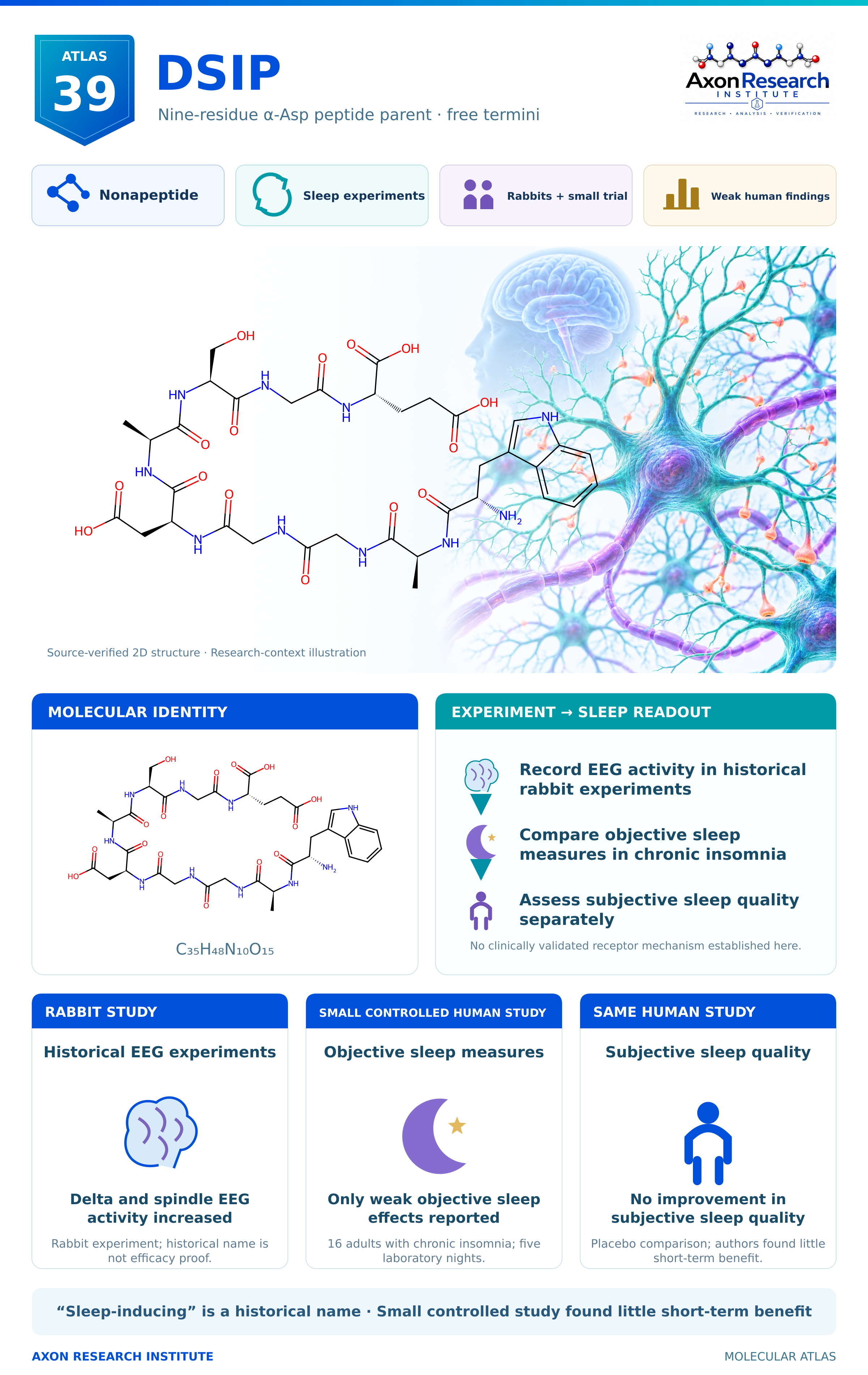
Visual summary only. The research findings, limitations and references accompany the card on this page.
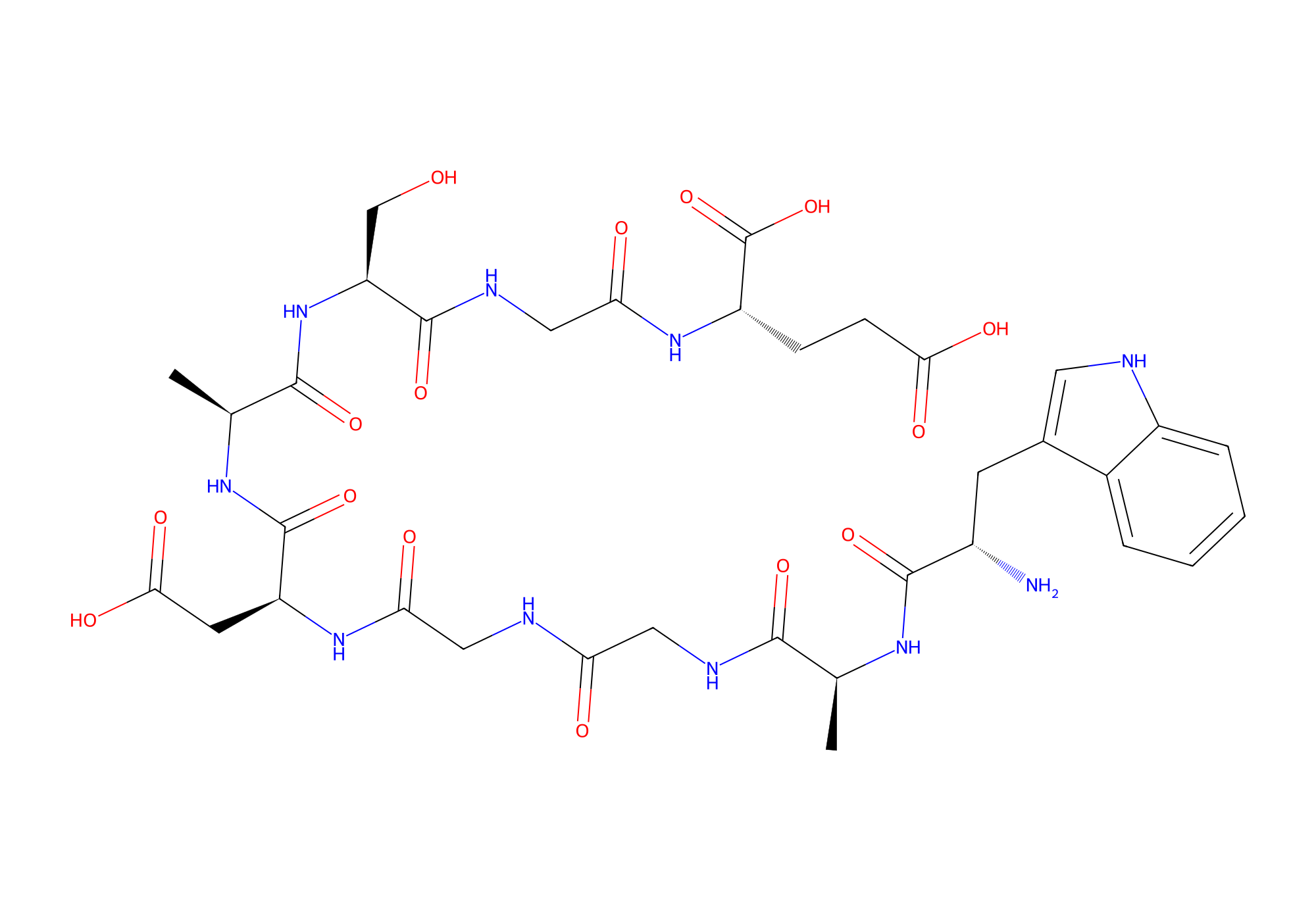
The chemical drawing shows source-verified two-dimensional connectivity and stereochemistry, not an experimental three-dimensional conformation. The biological setting is an illustration. Original study diagrams summarize cited research without reproducing publication artwork or inventing quantitative results.
DSIP
Sleep-related physiology; target unresolved
Delta sleep-inducing peptide, all-L α-peptide parent- Molecular formula
- C35H48N10O15
- Molecular weight
- 848.8 g/mol
- Class
- Nonapeptide
- Identity
- WAGGDASGE
Research snapshot
DSIP is a nine-residue peptide originally identified through sleep-related animal experiments. Its historical name should not be treated as proof of a reliable sleep treatment.
Small placebo-controlled human study
Identity & representation
Literature reference molecule. Catalog naming is not analytical confirmation of AXON contents, salt, purity or formulation. Trp-Ala-Gly-Gly-Asp-Ala-Ser-Gly-Glu; free termini. The α-aspartyl linkage is distinct from a β-Asp isomer.
Educational reference only. Not a dosing guide, treatment recommendation or product endorsement.
Nine-residue α-Asp peptide parent · free termini[3]
View the chemical structure →Sources checked: 2026-11-06. Identity and evidence limits are stated above. Independent specialist review is pending.
What researchers study
DSIP is a nine-residue peptide originally identified through sleep-related animal experiments. Its historical name should not be treated as proof of a reliable sleep treatment.
EEG slow-wave measures in original rabbit experiments
Polysomnographic sleep latency and efficiency in small clinical studies
Comparison of subjective sleep quality with objective recordings
Research pathway
- Early experiments tracked EEG slow-wave activity
- Human studies measured objective and subjective sleep
- Results require endpoint-by-endpoint interpretation
A clinically validated receptor mechanism is not established here; the selected human findings were weak and inconsistent.
Simplified publication-grounded schematic, not a solved protein structure or proof of clinical benefit.
Selected evidence
Selected human evidence is summarized above; this is not an exhaustive clinical or regulatory review.
Effects of delta sleep-inducing peptide on sleep of chronic insomniac patients. A double-blind study.[2]
Double-blind matched-pairs placebo-controlled study · Adults with chronic insomnia · 5 laboratory nights; treatment before 3 nights · Reported n: 16
Observed: Some objective sleep measures improved weakly, but subjective sleep quality did not. Authors found little support for major short-term benefit.
Limit: Small sample, brief exposure and possible incidental placebo changes constrain interpretation.
Reference identity in detail
Sequences and form distinctions describe the cited reference substance, not a verified supplier preparation.
Safety & evidence limits
The name “sleep-inducing” is historical and does not establish effective insomnia treatment or consistent sleep improvement.
The selected trial’s weak objective signals were not accompanied by improved subjective sleep quality.
Brief, small studies cannot determine chronic safety, dependable efficacy or effects in wider populations.
Practical identity notes
- Trp-Ala-Gly-Gly-Asp-Ala-Ser-Gly-Glu; free termini. The α-aspartyl linkage is distinct from a β-Asp isomer.
- Formula and mass apply only to the named reference form, excluding unspecified counterions, solvent and water.
- Educational molecular reference • Selected studies, not a systematic review • No dosing guidance
The 10-second takeaway
A historically named sleep-research peptide; a small controlled study found weak effects and no improvement in subjective sleep quality.
What the visual panels show
Original diagrams summarize the cited research or documented evidence search. They are not copied publication figures or claims of treatment benefit.
EXPERIMENT → SLEEP READOUT[1][2]
Publication-grounded mechanism schematic · Original publication-grounded diagram
Record EEG activity in historical rabbit experiments · Compare objective sleep measures in chronic insomnia · Assess subjective sleep quality separately
Interpretation: No clinically validated receptor mechanism established here.
Historical EEG experiments[1]
RABBIT STUDY · Original publication-grounded diagram
Delta and spindle EEG activity increased
Rabbit experiment; historical name is not efficacy proof.
Interpretation: Use an EEG/brain symbol without fabricated traces. Do not substitute mouse or human subjects.
Objective sleep measures[2]
SMALL CONTROLLED HUMAN STUDY · Original publication-grounded diagram
Only weak objective sleep effects reported
16 adults with chronic insomnia; five laboratory nights.
Interpretation: Small double-blind matched-pairs study, not a major confirmed sleep benefit.
Subjective sleep quality[2]
SAME HUMAN STUDY · Original publication-grounded diagram
No improvement in subjective sleep quality
Placebo comparison; authors found little short-term benefit.
Interpretation: Keep the subjective null result visible. No sleeping-person success image.
Follow the evidence
Sources & what they support
- The delta EEG (sleep)-inducing peptide (DSIP). XI. Amino-acid analysis, sequence, synthesis and activity of the nonapeptide.
Supports: Original sequence and α-Asp linkage distinction
- Effects of delta sleep-inducing peptide on sleep of chronic insomniac patients. A double-blind study.
Supports: Small insomnia trial and limited benefit
- PubChem CID 68816
Supports: Reference chemical graph, formula and molecular mass; not product identity
Original structure record · Download source SDF
Original PubChem 2D source structure record.
← Explore the Molecular Atlas Continue to the research library →