Visual summary only. The research findings, limitations and references accompany the card on this page.
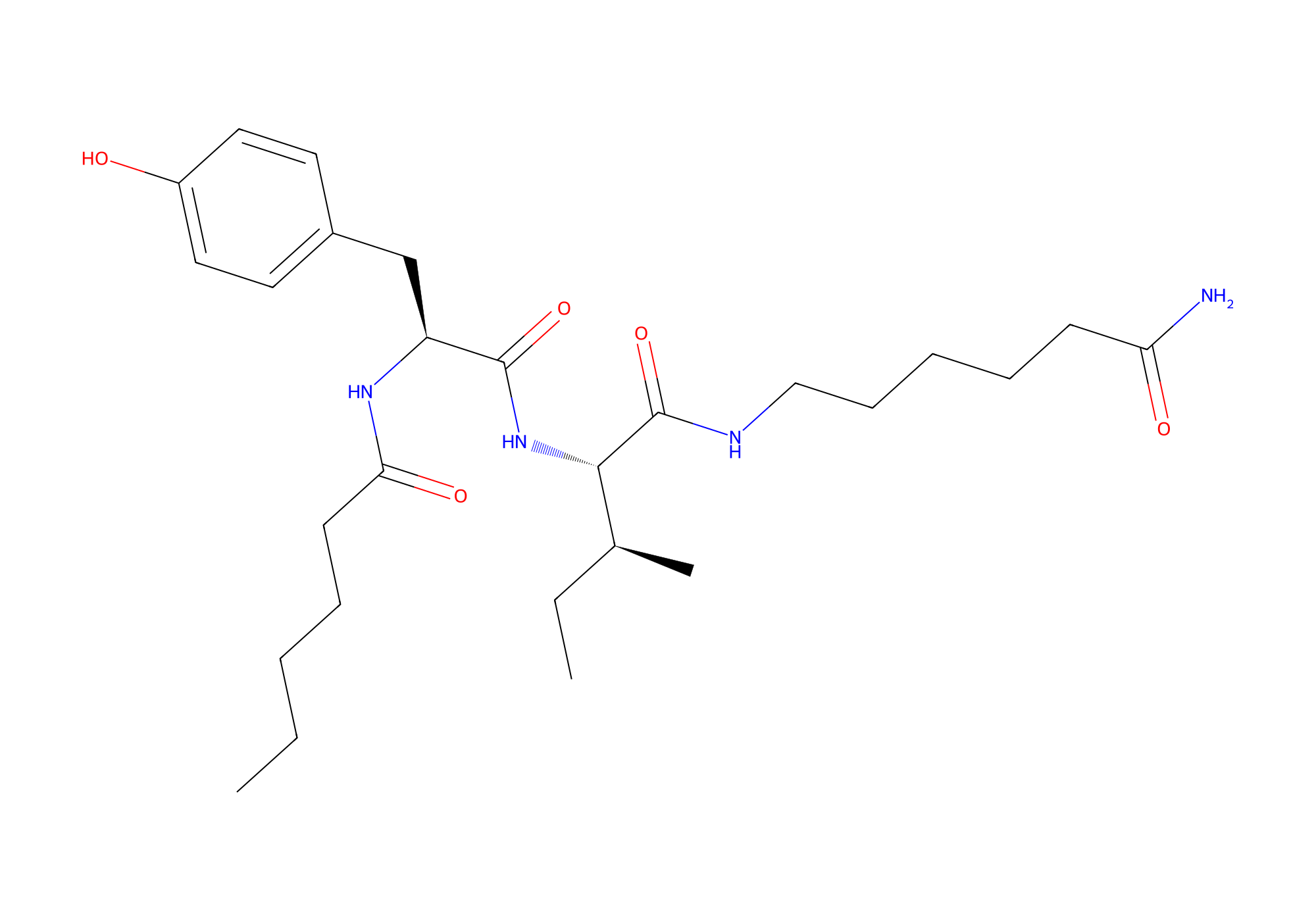
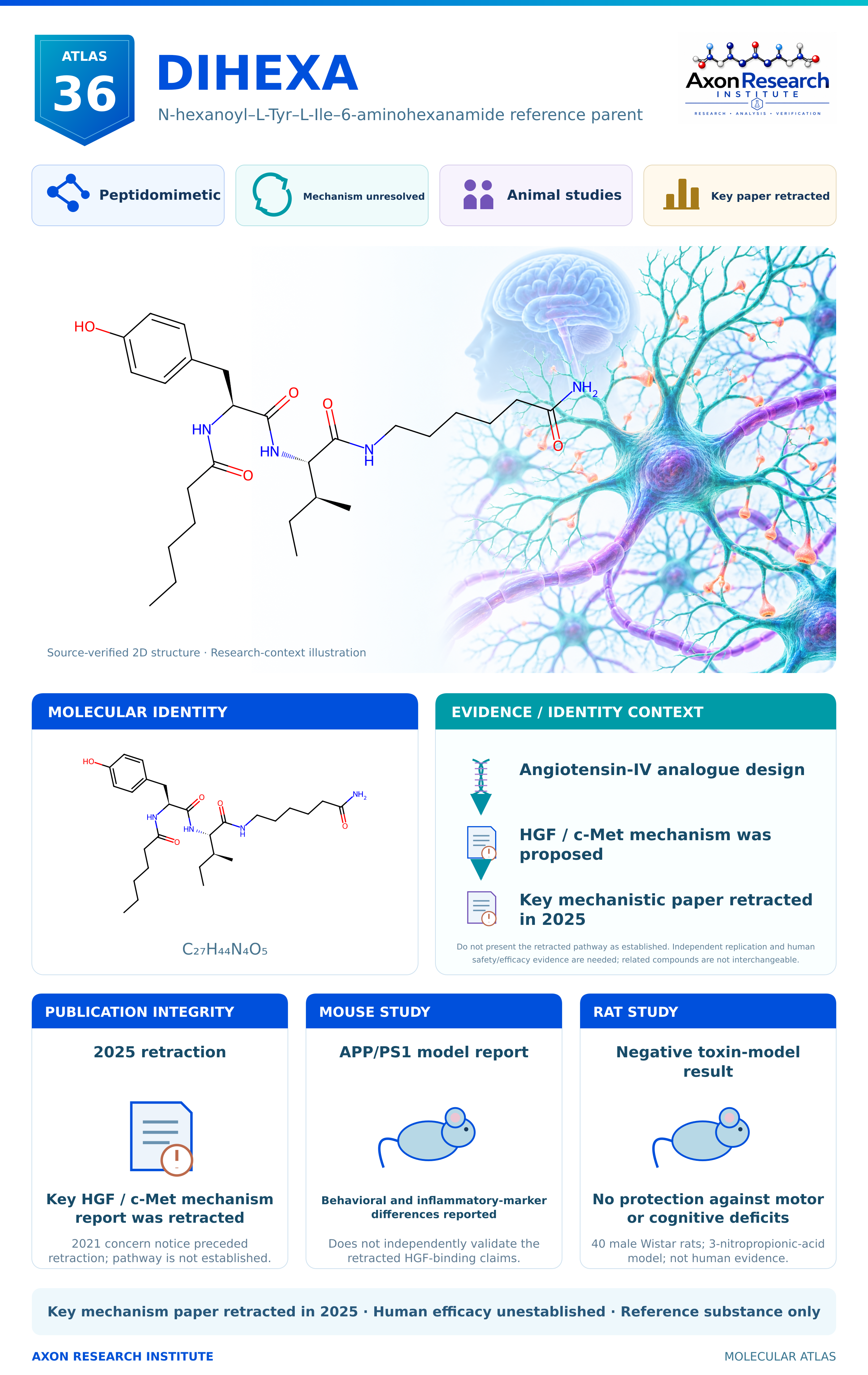
The chemical drawing shows source-verified two-dimensional connectivity and stereochemistry, not an experimental three-dimensional conformation. The biological setting is an illustration. Original study diagrams summarize cited research without reproducing publication artwork or inventing quantitative results.
Dihexa
Mechanism disputed
N-hexanoyl-L-Tyr-L-Ile-6-aminohexanamide parent- Molecular formula
- C27H44N4O5
- Molecular weight
- 504.7 g/mol
- Class
- Peptidomimetic
- Identity
- Hexanoyl-L-Tyr-L-Ile-NH-(CH2)5-CONH2
Research snapshot
Dihexa is an angiotensin-IV-derived peptidomimetic studied in animal models. A central HGF/c-Met mechanism paper was retracted, an earlier development paper carries a concern notice, and later animal findings are mixed.
Preclinical; key papers compromised
Identity & representation
Reference parent, not an AXON formulation or salt.
Educational reference only. Not a dosing guide, treatment recommendation or product endorsement.
N-hexanoyl–L-Tyr–L-Ile–6-aminohexanamide reference parent[1]
View the chemical structure →Sources checked: 2026-11-06. Identity and evidence limits are stated above. Independent specialist review is pending.
What researchers study
Dihexa is an angiotensin-IV-derived peptidomimetic studied in animal models. A central HGF/c-Met mechanism paper was retracted, an earlier development paper carries a concern notice, and later animal findings are mixed.
Animal learning and memory assays
Synaptic-marker studies
Independent replication and evidence integrity
Mechanism in context
- Angiotensin-IV analog design produced Dihexa
- HGF/c-Met mechanism was proposed
- Key mechanistic report was retracted
Do not present the retracted pathway as established. Independent replication and human safety/efficacy evidence are needed; related compounds are not interchangeable.
Simplified publication-grounded schematic, not a solved protein structure or proof of clinical benefit.
Selected evidence
Preclinical; key papers compromised
AngIV-Analog Dihexa Rescues Cognitive Impairment and Recovers Memory in the APP/PS1 Mouse via the PI3K/AKT Signaling Pathway.[4]
APP/PS1 transgenic mouse experiment · APP/PS1 and comparator mice · Animal study
Observed: Reported behavioral and inflammatory-marker differences and PI3K/AKT-associated findings.
Reported behavioral and inflammatory-marker differences and PI3K/AKT-associated findings. Mouse evidence; does not independently validate every retracted HGF-binding claim.
Limit: Mouse evidence; does not independently validate every retracted HGF-binding claim.
Effects of an Angiotensin IV Analog on 3-Nitropropionic Acid-Induced Huntington's Disease-Like Symptoms in Rats.[5]
Randomized animal experiment · 40 male Wistar rats · 5 weeks
Observed: Dihexa did not protect against motor or cognitive deficits induced by 3-nitropropionic acid.
Dihexa did not protect against motor or cognitive deficits induced by 3-nitropropionic acid. Toxin-induced Huntington-like model; not a human clinical trial.
Limit: Toxin-induced Huntington-like model; not a human clinical trial.
Reference identity in detail
Sequences and form distinctions describe the cited reference substance, not a verified supplier preparation.
Research scope
Targeted source verification, not a systematic review. Citation quality and molecule-specific applicability are stated separately.
Safety & evidence limits
The 2014 HGF/c-Met paper was retracted in 2025; the 2013 development paper has an expression of concern.
No human efficacy or long-term safety is established in the reviewed record.
A 40-rat Huntington-like model found no protection; positive findings in other models do not guarantee translation.
Practical identity notes
- N-hexanoyl-L-Tyr-L-Ile-6-aminohexanamide parent
- No original PubChem 3D conformer was available for this exact reference in the checked endpoint; use exact 2D structure.
- Reference identity is not confirmation of product contents, purity, sterility or therapeutic equivalence.
- Do not cite retracted PMID25187433 as valid mechanistic proof. Do not equate Dihexa with fosgonimeton or other development compounds.
The 10-second takeaway
Preclinical Dihexa research includes major integrity warnings and negative findings; its mechanism and human benefit remain unestablished.
What the visual panels show
Original diagrams summarize the cited research or documented evidence search. They are not copied publication figures or claims of treatment benefit.
EVIDENCE / IDENTITY CONTEXT[2]
Publication-grounded mechanism schematic · Original publication-grounded diagram
Angiotensin-IV analogue design · HGF / c-Met mechanism was proposed · Key mechanistic paper retracted in 2025
Interpretation: Do not present the retracted pathway as established. Independent replication and human safety/efficacy evidence are needed; related compounds are not interchangeable.
2025 retraction[3][2]
PUBLICATION INTEGRITY · Original publication-grounded diagram
Key HGF / c-Met mechanism report was retracted
2021 concern notice preceded retraction; pathway is not established.
Interpretation: 2021 concern notice preceded retraction; pathway is not established. Original conceptual illustration only; no fabricated data, docking geometry or clinical extrapolation.
APP/PS1 model report[4]
MOUSE STUDY · Original publication-grounded diagram
Behavioral and inflammatory-marker differences reported
Does not independently validate the retracted HGF-binding claims.
Interpretation: Does not independently validate the retracted HGF-binding claims. Original conceptual illustration only; no fabricated data, docking geometry or clinical extrapolation.
Negative toxin-model result[5]
RAT STUDY · Original publication-grounded diagram
No protection against motor or cognitive deficits
40 male Wistar rats; 3-nitropropionic-acid model; not human evidence.
Interpretation: 40 male Wistar rats; 3-nitropropionic-acid model; not human evidence. Original conceptual illustration only; no fabricated data, docking geometry or clinical extrapolation.
Follow the evidence
Sources & what they support
- PubChem CID 129010512: source reference graph
Supports: Exact reference graph, stereochemistry, formula and mass
Original structure record · Download source SDF
Original PubChem 2D source structure record.
- Retraction notice to "The Procognitive and Synaptogenic Effects of Angiotensin IV-Derived Peptides Are Dependent on Activation of the Hepatocyte Growth Factor/c-Met System" [J Pharmacol Exp Ther 351 (2014) 390-402].
Supports: Formal 2025 retraction of PMID25187433
- Notice of Concern: McCoy AT, Benoist CC, Wright JW, Kawas LH, Bule-Ghogare JM, Zhu M, Appleyard SM, Wayman GA, and Harding JW (2013) Evaluation of Metabolically Stabilized Angiotensin IV Analogs as Procognitive/Antidementia Agents, J Pharmacol Exp Ther, 344: 141-154; DOI: https://doi.org/10.1124/jpet.112.199497.
Supports: Concern notice for PMID23055539
- AngIV-Analog Dihexa Rescues Cognitive Impairment and Recovers Memory in the APP/PS1 Mouse via the PI3K/AKT Signaling Pathway.
Supports: APP/PS1 mouse study
- Effects of an Angiotensin IV Analog on 3-Nitropropionic Acid-Induced Huntington's Disease-Like Symptoms in Rats.
Supports: Negative40-rat model study
← Explore the Molecular Atlas Continue to the research library →