
Visual summary only. The research findings, limitations and references accompany the card on this page.
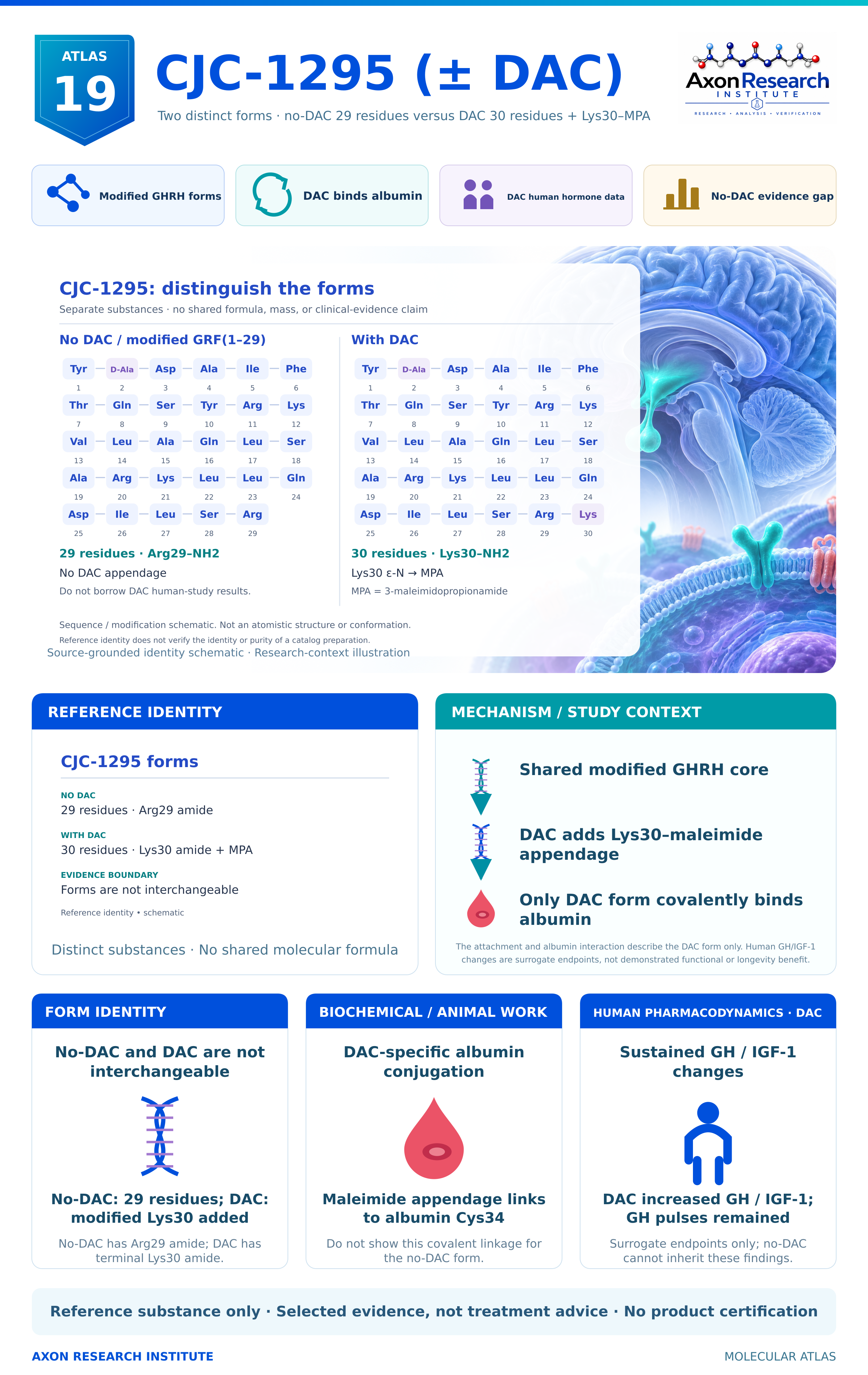
Complete side-by-side sequence schematics of no-DAC and DAC forms. D-Ala2 retained in each form. DAC appendage on Lys30 epsilon amino group, not N terminus. Human DAC evidence must not be assigned to no-DAC. Biological settings and research diagrams are illustrations, not measured anatomy or clinical outcomes.
CJC-1295 (± DAC)
GHRH receptor; DAC adds albumin conjugation
CJC-1295 two-form comparison: no-DAC and with-DAC are distinct substances- No DAC
- 29 residues · Arg29 amide
- With DAC
- 30 residues · Lys30 amide + MPA
- Evidence boundary
- Forms are not interchangeable
Research snapshot
“CJC-1295” is used ambiguously. The 29-residue no-DAC analogue and 30-residue maleimide-bearing DAC molecule are distinct; albumin binding and long-acting human hormone findings belong to the DAC form.
Human hormone studies concern DAC
Identity & representation
Literature reference substance only; no equivalence to a catalog product or tested supplier lot is asserted. One card compares two separately defined forms. Do not assign one molecular formula, mass or generic atom graph to both.
Educational reference only. Not a dosing guide, treatment recommendation or product endorsement.
Complete side-by-side sequence schematics of no-DAC and DAC forms.[1][4][5]
Sources checked: 2026-11-06. Identity and evidence limits are stated above. Independent specialist review is pending.
What researchers study
“CJC-1295” is used ambiguously. The 29-residue no-DAC analogue and 30-residue maleimide-bearing DAC molecule are distinct; albumin binding and long-acting human hormone findings belong to the DAC form.
GHRH analogue identity and nomenclature
Albumin bioconjugation of the DAC form
GH/IGF-1 pharmacodynamics and pulsatility
Mechanism / evidence map
- Shared modified GHRH core
- DAC adds Lys30–maleimide appendage
- DAC form conjugates to albumin
The attachment and albumin interaction describe the DAC form only. Human GH/IGF-1 changes are surrogate endpoints, not demonstrated functional or longevity benefit.
Simplified publication-grounded schematic, not a solved protein structure or proof of clinical benefit.
Selected evidence
The retrieved 2006 human studies concern long-acting albumin-binding DAC. FDA 2024 review found no relevant clinical data for no-DAC; related variants must remain separate.
Prolonged stimulation of growth hormone (GH) and insulin-like growth factor I secretion by CJC-1295, a long-acting analog of GH-releasing hormone, in healthy adults.[2]
Two randomized placebo-controlled double-blind ascending-exposure trials · Healthy adults aged 21–61 years; long-acting DAC form · 28 and 49 days
Observed: The DAC form caused sustained GH/IGF-1 increases; reported elimination half-life was 5.8–8.1 days.
Limit: Sample size not stated in retrieved abstract. Healthy-adult surrogate endpoints; findings cannot be assigned to no-DAC.
Pulsatile secretion of growth hormone (GH) persists during continuous stimulation by CJC-1295, a long-acting GH-releasing hormone analog.[3]
Before/after overnight endocrine sampling experiment · Healthy men aged 20–40 years; albumin-binding DAC form · Before and 1 week after exposure
Observed: DAC-form CJC-1295 preserved GH pulses while increasing trough/mean GH and IGF-1.
Limit: Small mechanistic human study; not proof of restored health, muscle growth, fat loss or long-term safety.
Reference identity in detail
Sequences and form distinctions describe the cited reference substance, not a verified supplier preparation.
Safety & evidence limits
Form ambiguity is a safety issue: the 29-residue no-DAC molecule and 30-residue DAC molecule differ in chemistry and persistence.
Limited early human studies measured hormones, not durable clinical benefits; a small study reporting no serious reactions is not broad safety assurance.
FDA review notes immunogenicity/impurity concerns and limited evidence; do not apply DAC pharmacokinetics or efficacy claims to no-DAC.
Practical identity notes
- No-DAC: 29 residues with D-Ala2, Gln8, Ala15, Leu27 and C-terminal amide.
- With-DAC: additional Lys30 bearing epsilon-N-3-maleimidopropionamide; albumin-reactive group.
- No single formula or mass for the two-form card; see separately labeled identities.
- Two forms, separate evidence • Reference form only
The 10-second takeaway
DAC and no-DAC are different molecules. Long-acting human hormone data belong to DAC and do not establish clinical benefits for either form.
What the visual panels show
Original diagrams summarize the cited research or documented evidence search. They are not copied publication figures or claims of treatment benefit.
MECHANISM / STUDY CONTEXT[1][4]
Publication-grounded mechanism schematic · Original publication-grounded diagram
Shared modified GHRH core · DAC adds Lys30–maleimide appendage · Only DAC form covalently binds albumin
Interpretation: The attachment and albumin interaction describe the DAC form only. Human GH/IGF-1 changes are surrogate endpoints, not demonstrated functional or longevity benefit.
No-DAC and DAC are not interchangeable[1][4]
FORM IDENTITY · Original publication-grounded diagram
No-DAC: 29 residues; DAC: modified Lys30 added
No-DAC has Arg29 amide; DAC has terminal Lys30 amide.
Interpretation: No-DAC has Arg29 amide; DAC has terminal Lys30 amide. Original conceptual illustration only; no fabricated data, docking geometry or clinical extrapolation.
DAC-specific albumin conjugation[1]
BIOCHEMICAL / ANIMAL WORK · Original publication-grounded diagram
Maleimide appendage links to albumin Cys34
Do not show this covalent linkage for the no-DAC form.
Interpretation: Do not show this covalent linkage for the no-DAC form. Original conceptual illustration only; no fabricated data, docking geometry or clinical extrapolation.
Sustained GH / IGF-1 changes[2][3][4]
HUMAN PHARMACODYNAMICS · DAC · Original publication-grounded diagram
DAC increased GH / IGF-1; GH pulses remained
Surrogate endpoints only; no-DAC cannot inherit these findings.
Interpretation: Surrogate endpoints only; no-DAC cannot inherit these findings. Original conceptual illustration only; no fabricated data, docking geometry or clinical extrapolation.
Follow the evidence
Sources & what they support
- Human growth hormone-releasing factor (hGRF)1-29-albumin bioconjugates activate the GRF receptor on the anterior pituitary in rats: identification of CJC-1295 as a long-lasting GRF analog.
Supports: Primary DAC chemistry: C-terminal modified Lys30 and albumin Cys34 conjugation
- Prolonged stimulation of growth hormone (GH) and insulin-like growth factor I secretion by CJC-1295, a long-acting analog of GH-releasing hormone, in healthy adults.
Supports: DAC-form randomized human pharmacodynamics
- Pulsatile secretion of growth hormone (GH) persists during continuous stimulation by CJC-1295, a long-acting GH-releasing hormone analog.
Supports: DAC-form GH pulsatility study
- FDA CJC-1295-related substance review (2024)
Supports: Two active-moiety distinction, identity pitfalls, no-DAC evidence gaps and safety
- PubChem CID56841945
Supports: Verified 29-residue no-DAC graph only; misleading synonyms are excluded
← Explore the Molecular Atlas Continue to the research library →
