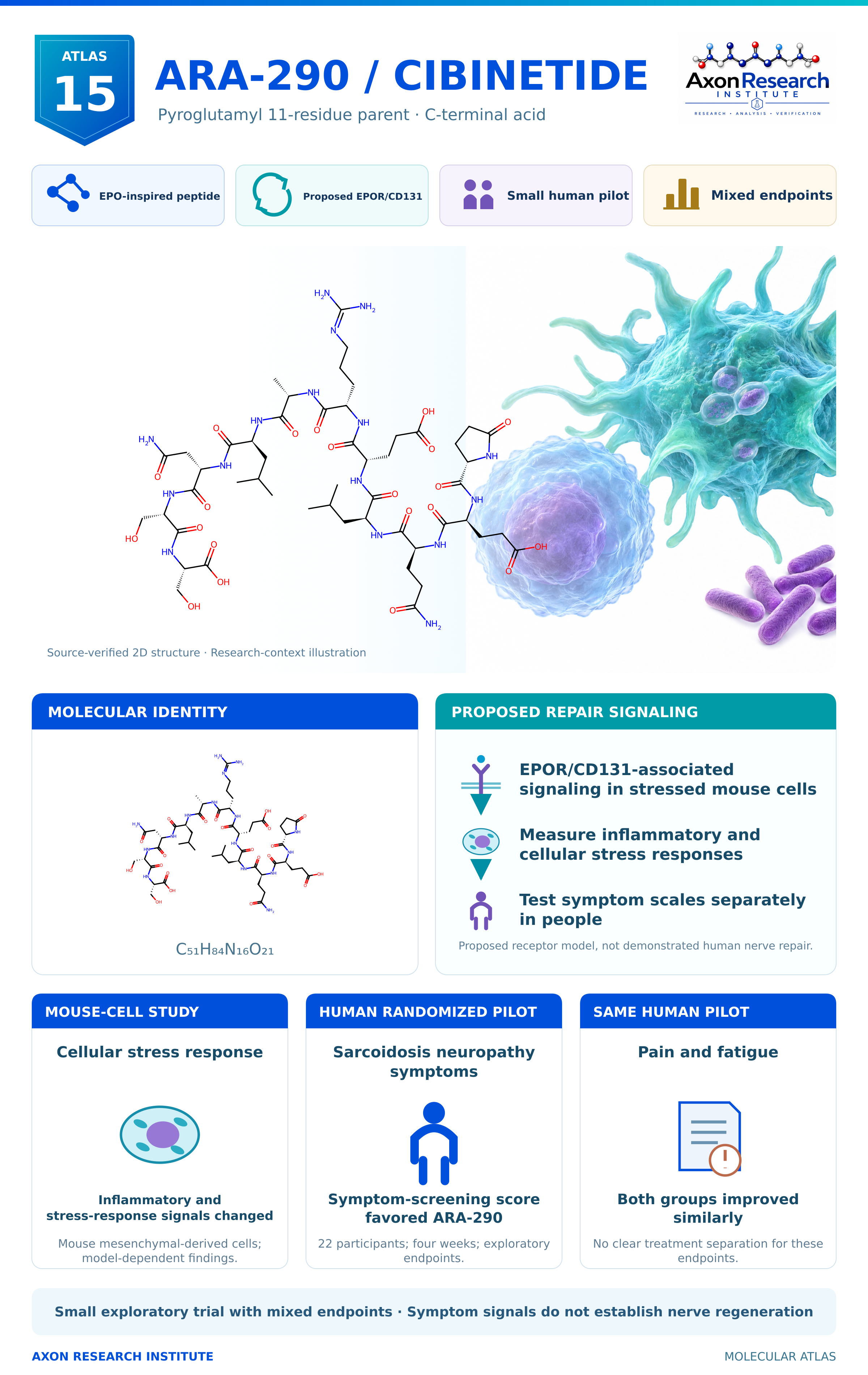
Visual summary only. The research findings, limitations and references accompany the card on this page.
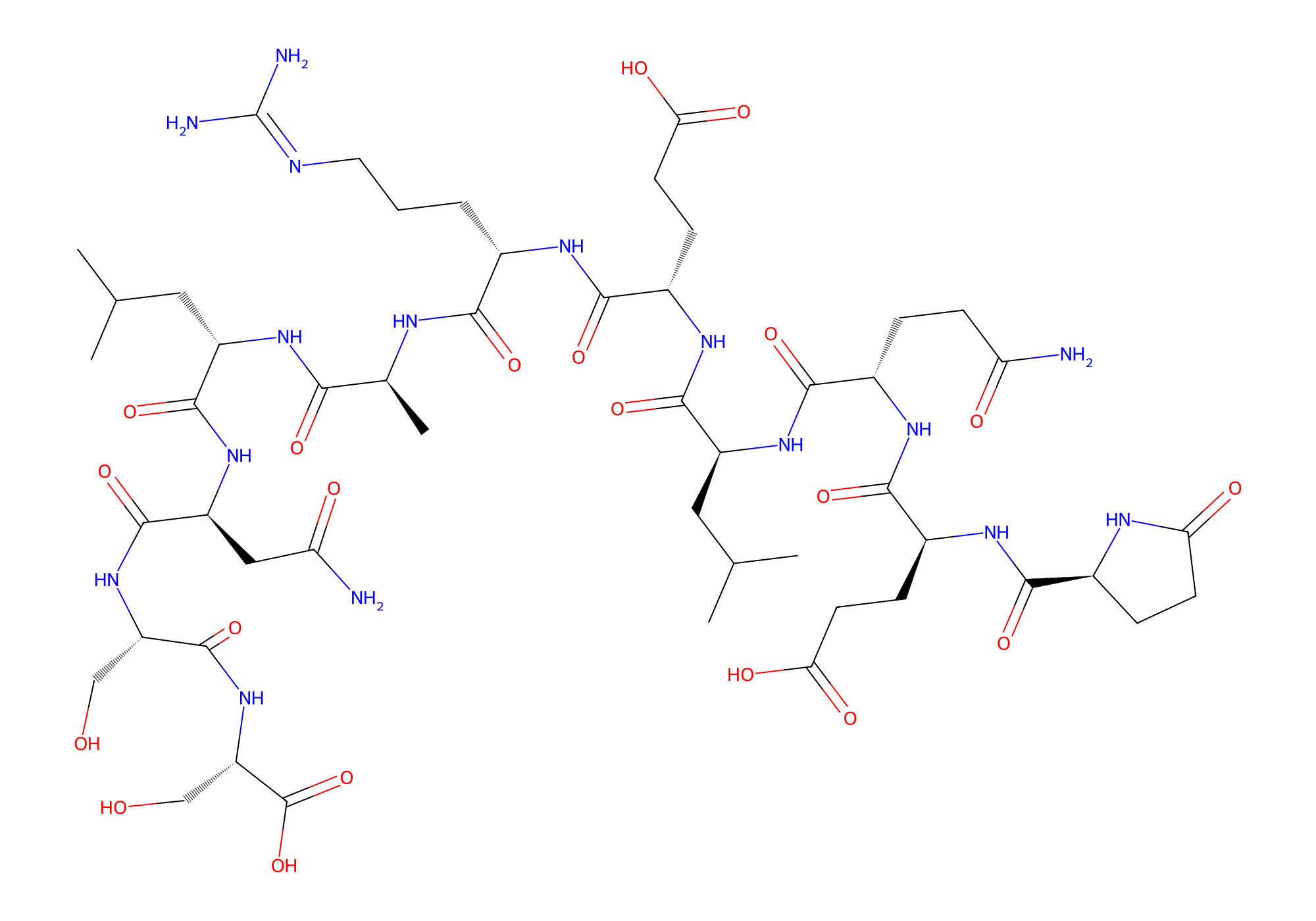
The chemical drawing shows source-verified two-dimensional connectivity and stereochemistry, not an experimental three-dimensional conformation. The biological setting is an illustration. Original study diagrams summarize cited research without reproducing publication artwork or inventing quantitative results.
ARA-290 / cibinetide
Proposed EPOR / CD131 repair signaling
Cibinetide parent with N-terminal L-pyroglutamate and C-terminal acid- Molecular formula
- C51H84N16O21
- Molecular weight
- 1257.3 g/mol
- Class
- Pyroglutamyl 11-residue peptide
- Identity
- pGlu-E-Q-L-E-R-A-L-N-S-S-OH
Research snapshot
Cibinetide, also called ARA-290, is an erythropoietin-inspired peptide designed to engage tissue-protective signaling without reproducing erythropoietin’s full hematopoietic activity. Evidence includes mechanistic work and exploratory neuropathy trials.
Small exploratory human trial
Identity & representation
Literature reference molecule. Catalog naming is not analytical confirmation of AXON contents, salt, purity or formulation. The N-terminal residue is cyclized pyroglutamate, not unmodified glutamine. All chiral residues are L.
Educational reference only. Not a dosing guide, treatment recommendation or product endorsement.
Pyroglutamyl 11-residue parent · C-terminal acid[3]
View the chemical structure →Sources checked: 2026-11-06. Identity and evidence limits are stated above. Independent specialist review is pending.
What researchers study
Cibinetide, also called ARA-290, is an erythropoietin-inspired peptide designed to engage tissue-protective signaling without reproducing erythropoietin’s full hematopoietic activity. Evidence includes mechanistic work and exploratory neuropathy trials.
Erythropoietin-derived nonerythropoietic peptide design
Inflammatory and injury-associated signaling in laboratory models
Small-fiber neuropathy symptoms in defined clinical populations
Mechanism in context
- Designed to engage EPOR/CD131-associated signaling
- Experimental studies assess inflammation and tissue injury
- Exploratory trials measure neuropathic symptoms
The receptor model and biological rationale should be presented as research context, not a promise of nerve repair.
Simplified publication-grounded schematic, not a solved protein structure or proof of clinical benefit.
Selected evidence
Selected human evidence is summarized above; this is not an exhaustive clinical or regulatory review.
Safety and efficacy of ARA 290 in sarcoidosis patients with symptoms of small fiber neuropathy: a randomized, double-blind pilot study.[1]
Randomized double-blind placebo-controlled exploratory trial · Sarcoidosis patients with small-fiber neuropathy symptoms · 4 weeks · Reported n: 22
Observed: The symptom-screening score favored ARA-290; pain and fatigue scores improved similarly in both groups.
Limit: Small sample, multiple exploratory endpoints and brief follow-up limit efficacy and safety conclusions.
Reference identity in detail
Sequences and form distinctions describe the cited reference substance, not a verified supplier preparation.
Safety & evidence limits
The pilot’s favorable symptom result was not uniform across endpoints and does not prove nerve regeneration.
A short study reporting no safety signal cannot establish uncommon risks or long-term safety.
Cibinetide’s pyroglutamate form must remain distinct from uncyclized HBSP and full-length erythropoietin.
Practical identity notes
- The N-terminal residue is cyclized pyroglutamate, not unmodified glutamine. All chiral residues are L.
- Formula and mass apply only to the named reference form, excluding unspecified counterions, solvent and water.
- Educational molecular reference • Selected studies, not a systematic review • No dosing guidance
The 10-second takeaway
An EPO-inspired research peptide with limited exploratory human data; symptom signals do not establish generalized tissue or nerve repair.
What the visual panels show
Original diagrams summarize the cited research or documented evidence search. They are not copied publication figures or claims of treatment benefit.
PROPOSED REPAIR SIGNALING[2][1]
Publication-grounded mechanism schematic · Original publication-grounded diagram
EPOR/CD131-associated signaling in stressed mouse cells · Measure inflammatory and cellular stress responses · Test symptom scales separately in people
Interpretation: Proposed receptor model, not demonstrated human nerve repair.
Cellular stress response[2]
MOUSE-CELL STUDY · Original publication-grounded diagram
Inflammatory and stress-response signals changed
Mouse mesenchymal-derived cells; model-dependent findings.
Interpretation: EPOR/CD131 is a research model. Do not show established clinical regeneration.
Sarcoidosis neuropathy symptoms[1]
HUMAN RANDOMIZED PILOT · Original publication-grounded diagram
Symptom-screening score favored ARA-290
22 participants; four weeks; exploratory endpoints.
Interpretation: Small exploratory trial. No nerve regrowth image or generalized neuropathy-treatment claim.
Pain and fatigue[1]
SAME HUMAN PILOT · Original publication-grounded diagram
Both groups improved similarly
No clear treatment separation for these endpoints.
Interpretation: Keep these mixed findings beside the favorable symptom score; no composite success claim.
Follow the evidence
Sources & what they support
- Safety and efficacy of ARA 290 in sarcoidosis patients with symptoms of small fiber neuropathy: a randomized, double-blind pilot study.
Supports: Pilot design, symptoms and mixed endpoint results
- Modulation of cellular stress response via the erythropoietin/CD131 heteroreceptor complex in mouse mesenchymal-derived cells.
Supports: Preclinical EPOR/CD131 signaling model
- PubChem CID 91810664
Supports: Reference chemical graph, formula and molecular mass; not product identity
Original structure record · Download source SDF
Original PubChem 2D source structure record.
← Explore the Molecular Atlas Continue to the research library →