
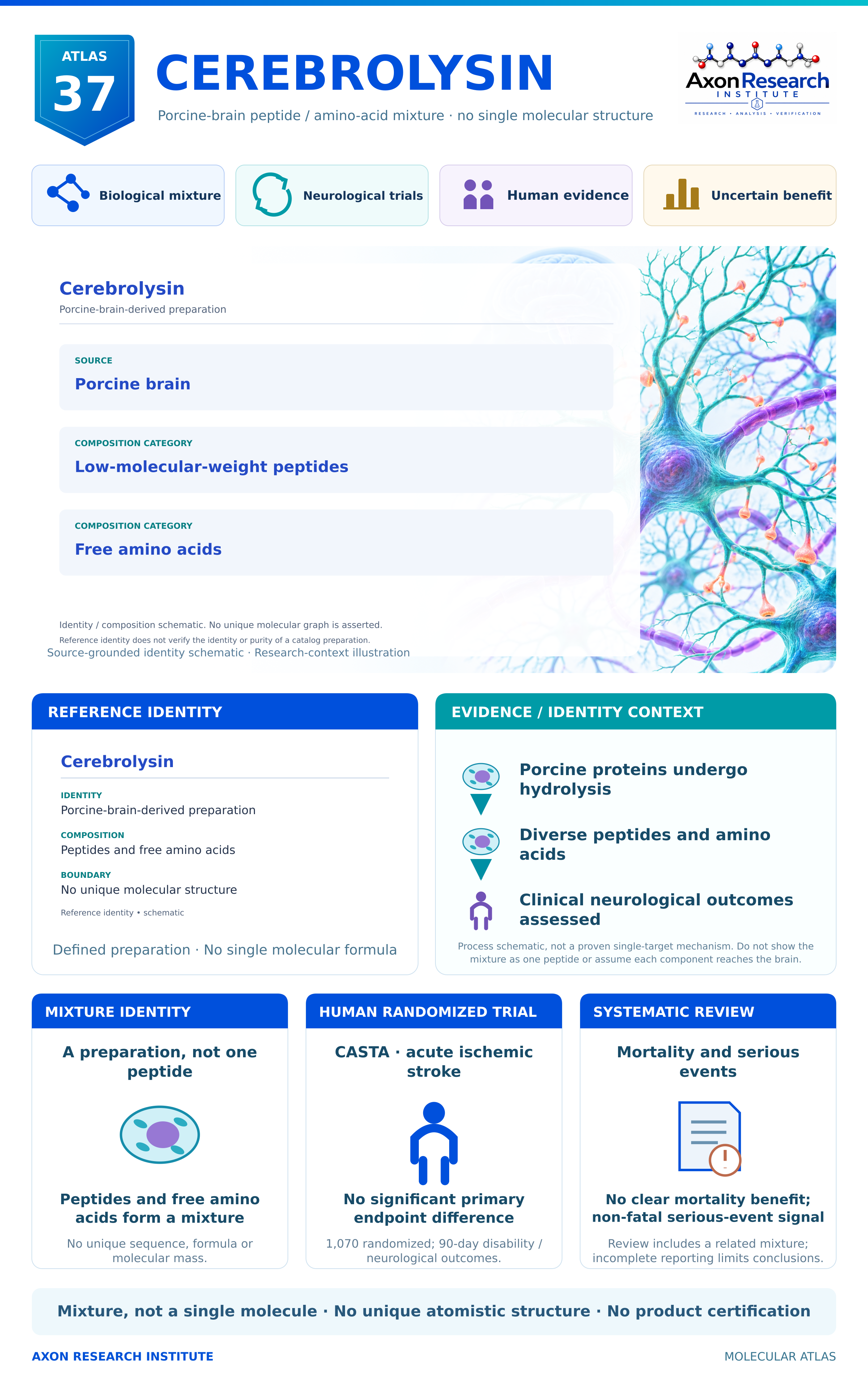
Visual summary only. The research findings, limitations and references accompany the card on this page.
Porcine-brain-derived preparation No fixed constituent count, mixture ratio, formula or molecular mass is asserted. Biological settings and research diagrams are illustrations, not measured anatomy or clinical outcomes.
Cerebrolysin
Multiple proposed neurotrophic effects
Porcine-brain-derived mixture of low-molecular-weight peptides and free amino acids- Identity
- Porcine-brain-derived preparation
- Composition
- Peptides and free amino acids
- Boundary
- No unique molecular structure
Research snapshot
Cerebrolysin is a complex biological hydrolysate studied in neurological disorders. A large acute-stroke trial had a neutral primary result; mixture composition prevents a single definitive molecular structure or target assignment.
Human trials; uncertain benefit
Identity & representation
Porcine-brain-derived peptide and amino-acid preparation. A single molecular graph does not represent this mixture. Reference identity is not confirmation of product contents, purity, sterility or therapeutic equivalence.
Educational reference only. Not a dosing guide, treatment recommendation or product endorsement.
Sources checked: 2026-11-06. Identity and evidence limits are stated above. Independent specialist review is pending.
What researchers study
Cerebrolysin is a complex biological hydrolysate studied in neurological disorders. A large acute-stroke trial had a neutral primary result; mixture composition prevents a single definitive molecular structure or target assignment.
Acute ischemic stroke outcomes
Post-stroke rehabilitation
Neurotrophic effects in laboratory models
Mechanism in context
- Porcine-brain proteins undergo hydrolysis
- Peptides and free amino acids form a mixture
- Neurological outcomes are evaluated clinically
Process schematic, not a proven single-target mechanism. Do not show the mixture as one peptide or assume each component reaches the brain.
Simplified publication-grounded schematic, not a solved protein structure or proof of clinical benefit.
Selected evidence
Human trials; uncertain benefit
Cerebrolysin in patients with acute ischemic stroke in Asia: results of a double-blind, placebo-controlled randomized trial.[1]
Double-blind placebo-controlled randomized trial · 1,070 randomized stroke patients · 10-day intervention; 90-day follow-up
Observed: Combined disability/neurological primary endpoint showed no significant treatment-group difference.
Combined disability/neurological primary endpoint showed no significant treatment-group difference. Severity subgroup findings were post hoc; not general cognitive-enhancement evidence.
Limit: Severity subgroup findings were post hoc; not general cognitive-enhancement evidence.
Cerebrolysin for acute ischaemic stroke.[2]
Cochrane systematic review, not a new primary trial · 7 trials; 1,773 participants, including one related mixture trial · Acute ischemic stroke trials
Observed: Mortality estimate showed little or no difference; non-fatal serious adverse events increased in pooled Cerebrolysin trials.
Mortality estimate showed little or no difference; non-fatal serious adverse events increased in pooled Cerebrolysin trials. Mixed products and incomplete reporting limit interpretation; do not attribute Cortexin composition to Cerebrolysin.
Limit: Mixed products and incomplete reporting limit interpretation; do not attribute Cortexin composition to Cerebrolysin.
Research scope
Targeted source verification, not a systematic review. Citation quality and molecule-specific applicability are stated separately.
Safety & evidence limits
No unique molecular graph, sequence, formula or molecular weight represents this mixture.
CASTA’s primary endpoint was neutral; post-hoc subgroup signals are not confirmatory evidence.
Cochrane synthesis found no mortality benefit and a possible increase in non-fatal serious adverse events.
Practical identity notes
- Porcine-brain-derived mixture of low-molecular-weight peptides and free amino acids
- Reference identity is not confirmation of product contents, purity, sterility or therapeutic equivalence.
- No atomistic depiction. Do not use a random constituent as the entire product.
The 10-second takeaway
A complex mixture with clinical research, not one molecule; major stroke evidence remains uncertain.
What the visual panels show
Original diagrams summarize the cited research or documented evidence search. They are not copied publication figures or claims of treatment benefit.
EVIDENCE / IDENTITY CONTEXT[2][3]
Publication-grounded mechanism schematic · Original publication-grounded diagram
Porcine proteins undergo hydrolysis · Diverse peptides and amino acids · Clinical neurological outcomes assessed
Interpretation: Process schematic, not a proven single-target mechanism. Do not show the mixture as one peptide or assume each component reaches the brain.
A preparation, not one peptide[2][3]
MIXTURE IDENTITY · Original publication-grounded diagram
Peptides and free amino acids form a mixture
No unique sequence, formula or molecular mass.
Interpretation: No unique sequence, formula or molecular mass. Original conceptual illustration only; no fabricated data, docking geometry or clinical extrapolation.
CASTA · acute ischemic stroke[1]
HUMAN RANDOMIZED TRIAL · Original publication-grounded diagram
No significant primary endpoint difference
1,070 randomized; 90-day disability / neurological outcomes.
Interpretation: 1,070 randomized; 90-day disability / neurological outcomes. Original conceptual illustration only; no fabricated data, docking geometry or clinical extrapolation.
Mortality and serious events[2]
SYSTEMATIC REVIEW · Original publication-grounded diagram
No clear mortality benefit; non-fatal serious-event signal
Review includes a related mixture; incomplete reporting limits conclusions.
Interpretation: Review includes a related mixture; incomplete reporting limits conclusions. Original conceptual illustration only; no fabricated data, docking geometry or clinical extrapolation.
Follow the evidence
Sources & what they support
- Cerebrolysin in patients with acute ischemic stroke in Asia: results of a double-blind, placebo-controlled randomized trial.
Supports: CASTA randomized trial and neutral primary result
- Cerebrolysin for acute ischaemic stroke.
Supports: Mixture identity; systematic-review mortality and safety findings
- Manufacturer product monograph
Supports: Porcine peptide preparation; contraindications include epilepsy and severe renal impairment
← Explore the Molecular Atlas Continue to the research library →
