
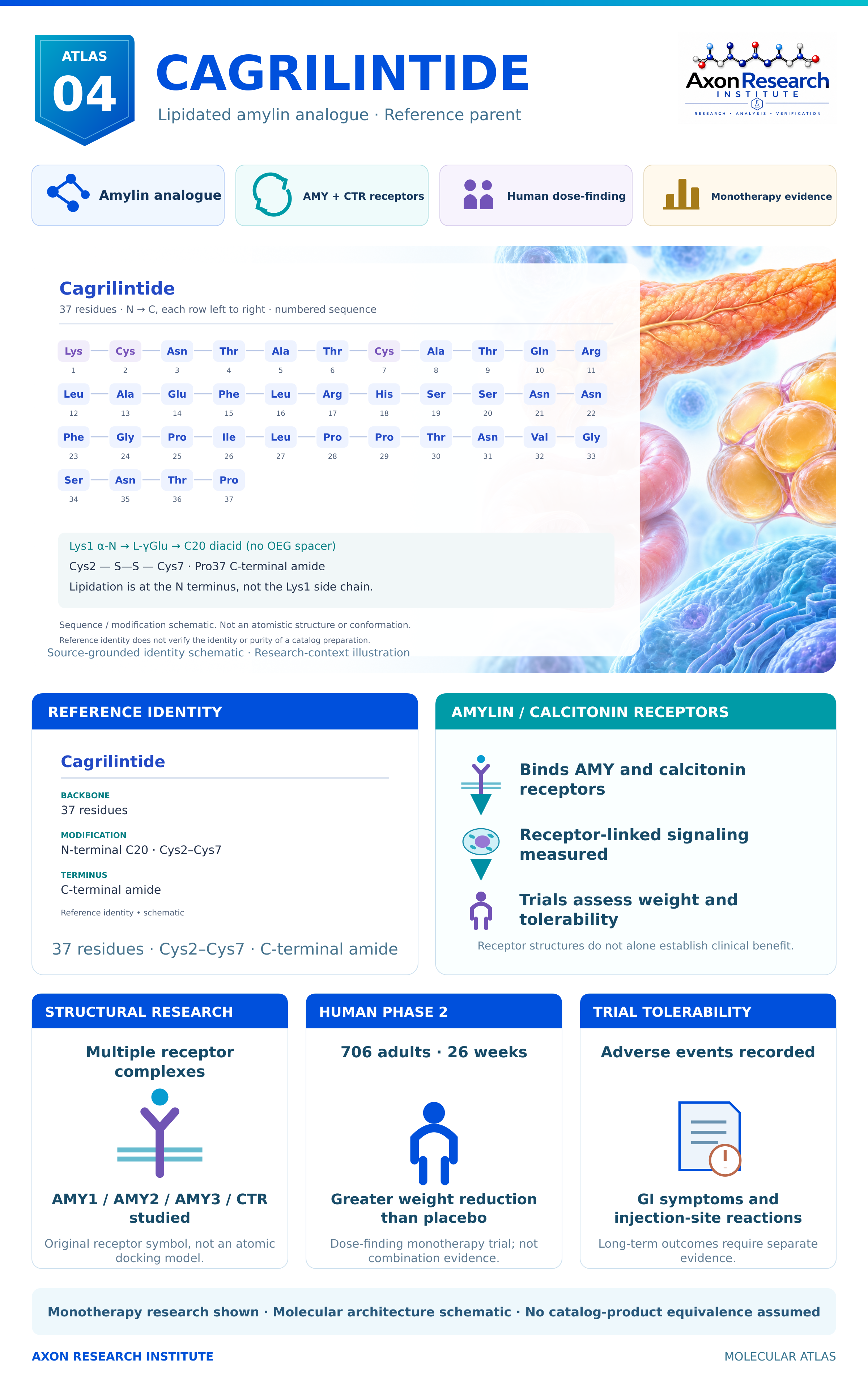
Visual summary only. The research findings, limitations and references accompany the card on this page.
Verified numbered backbone and locus-specific modification map. Sequence transcribed from specified verified source dossier. Linker blocks show identity and ordering, not atomic bonding geometry. Standard chiral amino acids are L; Gly and Aib are achiral. Biological settings and research diagrams are illustrations, not measured anatomy or clinical outcomes.
Cagrilintide
Amylin / calcitonin receptors
Cagrilintide reference parent; C-terminal amide- Backbone
- 37 residues
- Modification
- N-terminal C20 · Cys2–Cys7
- Terminus
- C-terminal amide
Research snapshot
Cagrilintide is an engineered amylin analogue with a lipid extension. Research examines how receptor activation, peptide design and prolonged exposure relate to appetite and body-weight outcomes.
Human trial and receptor structures
Identity & representation
Literature reference molecule. Catalog naming is not analytical confirmation of AXON contents, salt, purity or formulation. All-L peptide; Cys2–Cys7 disulfide. N-terminal α-amino group linked through L-γGlu to a C20 diacid. Not acylation of Lys1 ε-amine.
Educational reference only. Not a dosing guide, treatment recommendation or product endorsement.
Verified numbered backbone and locus-specific modification map.[4][5][1]
Sources checked: 2026-11-06. Identity and evidence limits are stated above. Independent specialist review is pending.
What researchers study
Cagrilintide is an engineered amylin analogue with a lipid extension. Research examines how receptor activation, peptide design and prolonged exposure relate to appetite and body-weight outcomes.
Cryo-EM structures of active amylin and calcitonin receptors
Peptide substitutions and lipidation for prolonged exposure
Monotherapy and combination studies with separately interpreted results
Mechanism in context
- Binds amylin and calcitonin-family receptors
- Activates receptor-linked signaling
- Trials assess body-weight outcomes and tolerability
Receptor structures establish binding interactions; they do not independently establish clinical benefit or long-term safety.
Simplified publication-grounded schematic, not a solved protein structure or proof of clinical benefit.
Selected evidence
Selected human evidence is summarized above; this is not an exhaustive clinical or regulatory review.
Once-weekly cagrilintide for weight management in people with overweight and obesity: a multicentre, randomised, double-blind, placebo-controlled and active-controlled, dose-finding phase 2 trial.[2]
Phase 2 randomized placebo- and active-controlled trial · Adults with overweight or obesity without diabetes · 26-week treatment; 6-week follow-up · Reported n: 706
Observed: Cagrilintide groups had greater weight reduction than placebo. Gastrointestinal symptoms and administration-site reactions were frequent.
Limit: Different active treatments were not mutually masked; dose-finding monotherapy results are not combination-treatment evidence.
Reference identity in detail
Sequences and form distinctions describe the cited reference substance, not a verified supplier preparation.
Safety & evidence limits
Combination studies cannot be attributed to cagrilintide alone; the selected monotherapy study must remain identified as such.
Short clinical trials cannot establish rare adverse effects, long-term outcomes or safety across unstudied populations.
Some chemical database records contain stereochemical or naming conflicts; use the verified sequence and modification definition.
Practical identity notes
- All-L peptide; Cys2–Cys7 disulfide. N-terminal α-amino group linked through L-γGlu to a C20 diacid. Not acylation of Lys1 ε-amine.
- Formula and mass apply only to the named reference form, excluding unspecified counterions, solvent and water.
- Educational molecular reference • Selected studies, not a systematic review • No dosing guidance
The 10-second takeaway
A long-acting amylin analogue studied in humans; distinguish its exact chemistry and monotherapy evidence from combination regimens.
What the visual panels show
Original diagrams summarize the cited research or documented evidence search. They are not copied publication figures or claims of treatment benefit.
AMYLIN / CALCITONIN RECEPTORS[3][2]
Publication-grounded mechanism schematic · Original publication-grounded diagram
Binds AMY and calcitonin receptors · Receptor-linked signaling measured · Trials assess weight and tolerability
Interpretation: Receptor structures do not alone establish clinical benefit.
Multiple receptor complexes[3]
STRUCTURAL RESEARCH · Original publication-grounded diagram
AMY1 / AMY2 / AMY3 / CTR studied
Original receptor symbol, not an atomic docking model.
Interpretation: Do not invent protein structures or relative receptor effects.
706 adults · 26 weeks[2]
HUMAN PHASE 2 · Original publication-grounded diagram
Greater weight reduction than placebo
Dose-finding monotherapy trial; not combination evidence.
Interpretation: No extrapolation to CagriSema combination results.
Adverse events recorded[2]
TRIAL TOLERABILITY · Original publication-grounded diagram
GI symptoms and injection-site reactions
Long-term outcomes require separate evidence.
Interpretation: Do not imply safety established by this study.
Follow the evidence
Sources & what they support
- Development of Cagrilintide, a Long-Acting Amylin Analogue.
Supports: Discovery and lipidated amylin-analogue design
- Once-weekly cagrilintide for weight management in people with overweight and obesity: a multicentre, randomised, double-blind, placebo-controlled and active-controlled, dose-finding phase 2 trial.
Supports: Phase 2 monotherapy trial
- Structural and dynamic features of cagrilintide binding to calcitonin and amylin receptors.
Supports: Active AMY1/AMY2/AMY3/CTR receptor structures
- WHO proposed INN List 123, pages 286–287
Supports: Exact substitutions, N-terminal modification, disulfide definition and molecular formula
- FDA GSRS cagrilintide, UNII AO43BIF1U8
Supports: Full peptide sequence and reference molecular mass
← Explore the Molecular Atlas Continue to the research library →
