Visual summary only. The research findings, limitations and references accompany the card on this page.
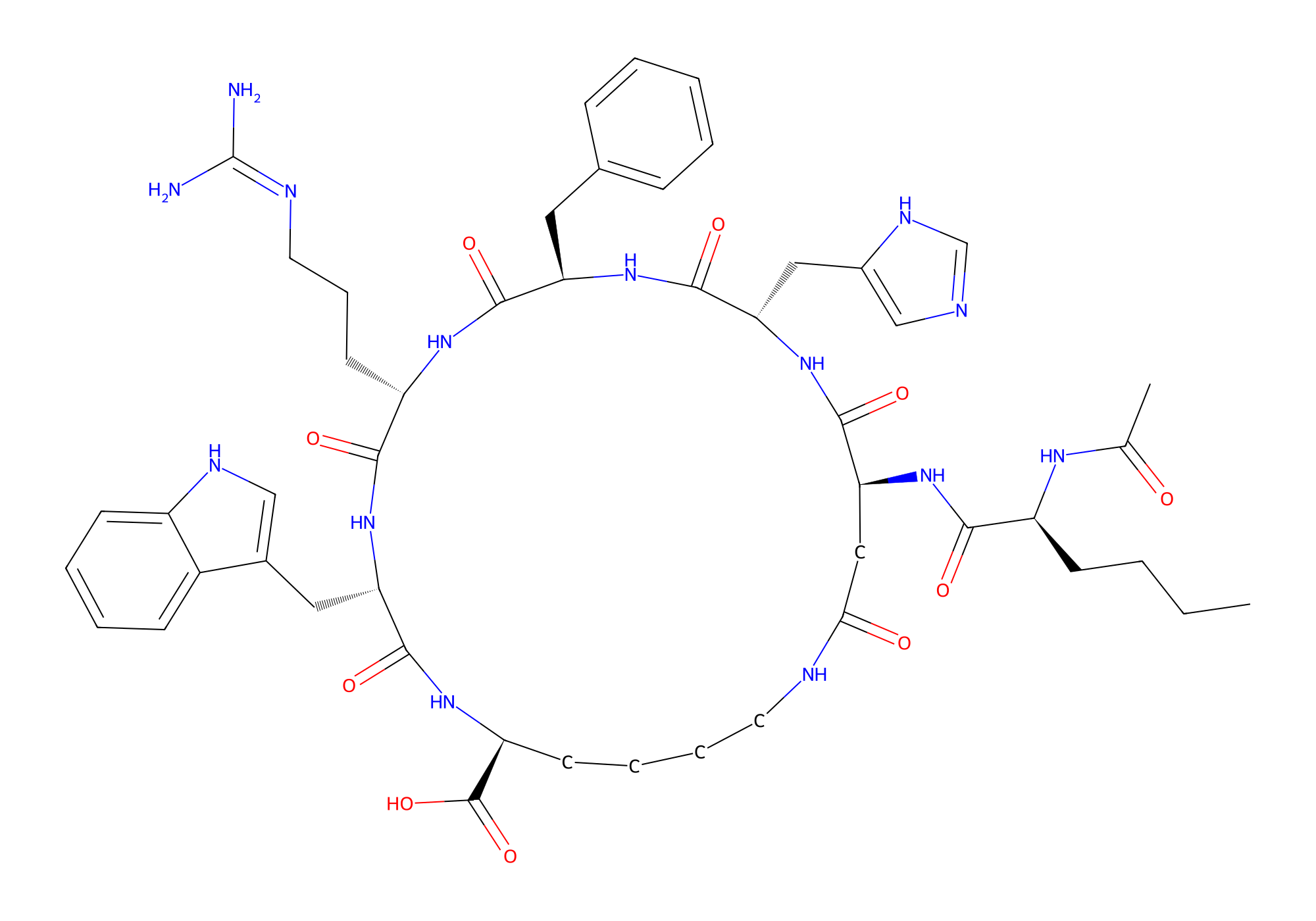
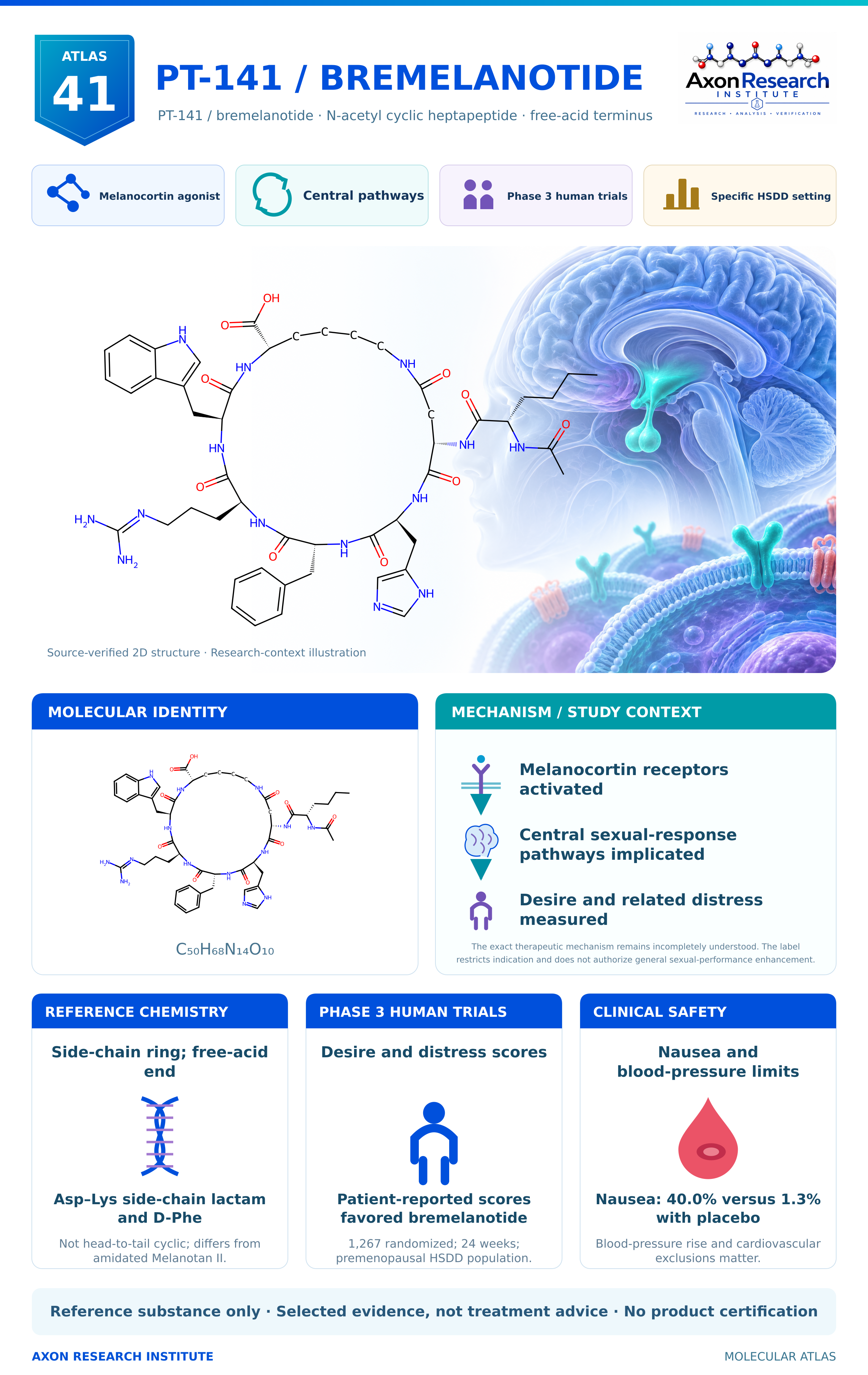
The chemical drawing shows source-verified two-dimensional connectivity and stereochemistry, not an experimental three-dimensional conformation. The biological setting is an illustration. Original study diagrams summarize cited research without reproducing publication artwork or inventing quantitative results.
PT-141 / bremelanotide
Melanocortin receptors
N-acetyl cyclic heptapeptide free-acid parent; Asp side-chain–Lys side-chain lactam- Molecular formula
- C50H68N14O10
- Molecular weight
- 1025.2 g/mol
- Class
- Cyclic melanocortin agonist
- Identity
- Ac-Nle-cyclo[Asp-His-D-Phe-Arg-Trp-Lys]-OH; side-chain lactam
Research snapshot
Bremelanotide is a cyclic melanocortin-receptor agonist. Vyleesi is approved for acquired, generalized hypoactive sexual desire disorder in premenopausal women; that indication does not establish broad performance enhancement or equivalence of research products.
Randomized phase 3 trials
Identity & representation
Reference parent, not an AXON formulation or salt.
Educational reference only. Not a dosing guide, treatment recommendation or product endorsement.
PT-141 / bremelanotide · N-acetyl cyclic heptapeptide · free-acid terminus[1]
View the chemical structure →Sources checked: 2026-11-06. Identity and evidence limits are stated above. Independent specialist review is pending.
What researchers study
Bremelanotide is a cyclic melanocortin-receptor agonist. Vyleesi is approved for acquired, generalized hypoactive sexual desire disorder in premenopausal women; that indication does not establish broad performance enhancement or equivalence of research products.
HSDD patient-reported outcomes
Melanocortin receptor pharmacology
Cardiovascular and tolerability safety
Mechanism in context
- Bremelanotide activates melanocortin receptors
- Central sexual-response pathways are implicated
- Desire and related distress are measured clinically
The exact therapeutic mechanism remains incompletely understood. The label restricts indication and does not authorize general sexual-performance enhancement.
Simplified publication-grounded schematic, not a solved protein structure or proof of clinical benefit.
Selected evidence
Randomized phase 3 trials
Bremelanotide for the Treatment of Hypoactive Sexual Desire Disorder: Two Randomized Phase 3 Trials.[2]
Two randomized double-blind placebo-controlled phase 3 trials · 1,267 randomized; 1,247 safety; 1,202 modified intention-to-treat efficacy · 24 weeks
Observed: Desire and distress scores favored bremelanotide; most participants were white and U.S.-based.
Desire and distress scores favored bremelanotide; most participants were white and U.S.-based. Specific premenopausal HSDD population; patient-reported outcomes, not broad sexual-performance evidence.
Limit: Specific premenopausal HSDD population; patient-reported outcomes, not broad sexual-performance evidence.
Safety Profile of Bremelanotide Across the Clinical Development Program.[3]
Integrated clinical safety analysis · Phase 3 safety population 1,247 · 24-week double-blind core; longer extensions reviewed
Observed: Nausea 40.0% versus 1.3% with placebo; flushing and headache also more frequent.
Nausea 40.0% versus 1.3% with placebo; flushing and headache also more frequent. Safety varies with exposure and clinical context; use current product labeling for full contraindications.
Limit: Safety varies with exposure and clinical context; use current product labeling for full contraindications.
Reference identity in detail
Sequences and form distinctions describe the cited reference substance, not a verified supplier preparation.
Research scope
Targeted source verification, not a systematic review. Citation quality and molecule-specific applicability are stated separately.
Safety & evidence limits
Contraindicated with uncontrolled hypertension or known cardiovascular disease; transient blood-pressure increases occur.
Nausea is common, and focal hyperpigmentation can occur; approved labeling contains additional precautions.
Approval is product- and indication-specific, not a blanket endorsement of PT-141 research vials.
Practical identity notes
- N-acetyl cyclic heptapeptide free-acid parent; Asp side-chain–Lys side-chain lactam
- No original PubChem 3D conformer was available for this exact reference in the checked endpoint; use exact 2D structure.
- Reference identity is not confirmation of product contents, purity, sterility or therapeutic equivalence.
The 10-second takeaway
An approved pharmaceutical exists for a specific HSDD indication, with meaningful cardiovascular and tolerability precautions.
What the visual panels show
Original diagrams summarize the cited research or documented evidence search. They are not copied publication figures or claims of treatment benefit.
MECHANISM / STUDY CONTEXT[4][2]
Publication-grounded mechanism schematic · Original publication-grounded diagram
Melanocortin receptors activated · Central sexual-response pathways implicated · Desire and related distress measured
Interpretation: The exact therapeutic mechanism remains incompletely understood. The label restricts indication and does not authorize general sexual-performance enhancement.
Side-chain ring; free-acid end[1][4]
REFERENCE CHEMISTRY · Original publication-grounded diagram
Asp–Lys side-chain lactam and D-Phe
Not head-to-tail cyclic; differs from amidated Melanotan II.
Interpretation: Not head-to-tail cyclic; differs from amidated Melanotan II. Original conceptual illustration only; no fabricated data, docking geometry or clinical extrapolation.
Desire and distress scores[2]
PHASE 3 HUMAN TRIALS · Original publication-grounded diagram
Patient-reported scores favored bremelanotide
1,267 randomized; 24 weeks; premenopausal HSDD population.
Interpretation: 1,267 randomized; 24 weeks; premenopausal HSDD population. Original conceptual illustration only; no fabricated data, docking geometry or clinical extrapolation.
Nausea and blood-pressure limits[4][3]
CLINICAL SAFETY · Original publication-grounded diagram
Nausea: 40.0% versus 1.3% with placebo
Blood-pressure rise and cardiovascular exclusions matter.
Interpretation: Blood-pressure rise and cardiovascular exclusions matter. Original conceptual illustration only; no fabricated data, docking geometry or clinical extrapolation.
Follow the evidence
Sources & what they support
- PubChem CID 9941379: source reference graph
Supports: Exact reference graph, stereochemistry, formula and mass
Original structure record · Download source SDF
Original PubChem 2D source structure record.
- Bremelanotide for the Treatment of Hypoactive Sexual Desire Disorder: Two Randomized Phase 3 Trials.
Supports: RECONNECT efficacy sample and 24-week outcomes
- Safety Profile of Bremelanotide Across the Clinical Development Program.
Supports: Integrated clinical safety findings
- Vyleesi current prescribing information
Supports: Indication, contraindications, mechanism uncertainty, chemical structure and risks
← Explore the Molecular Atlas Continue to the research library →