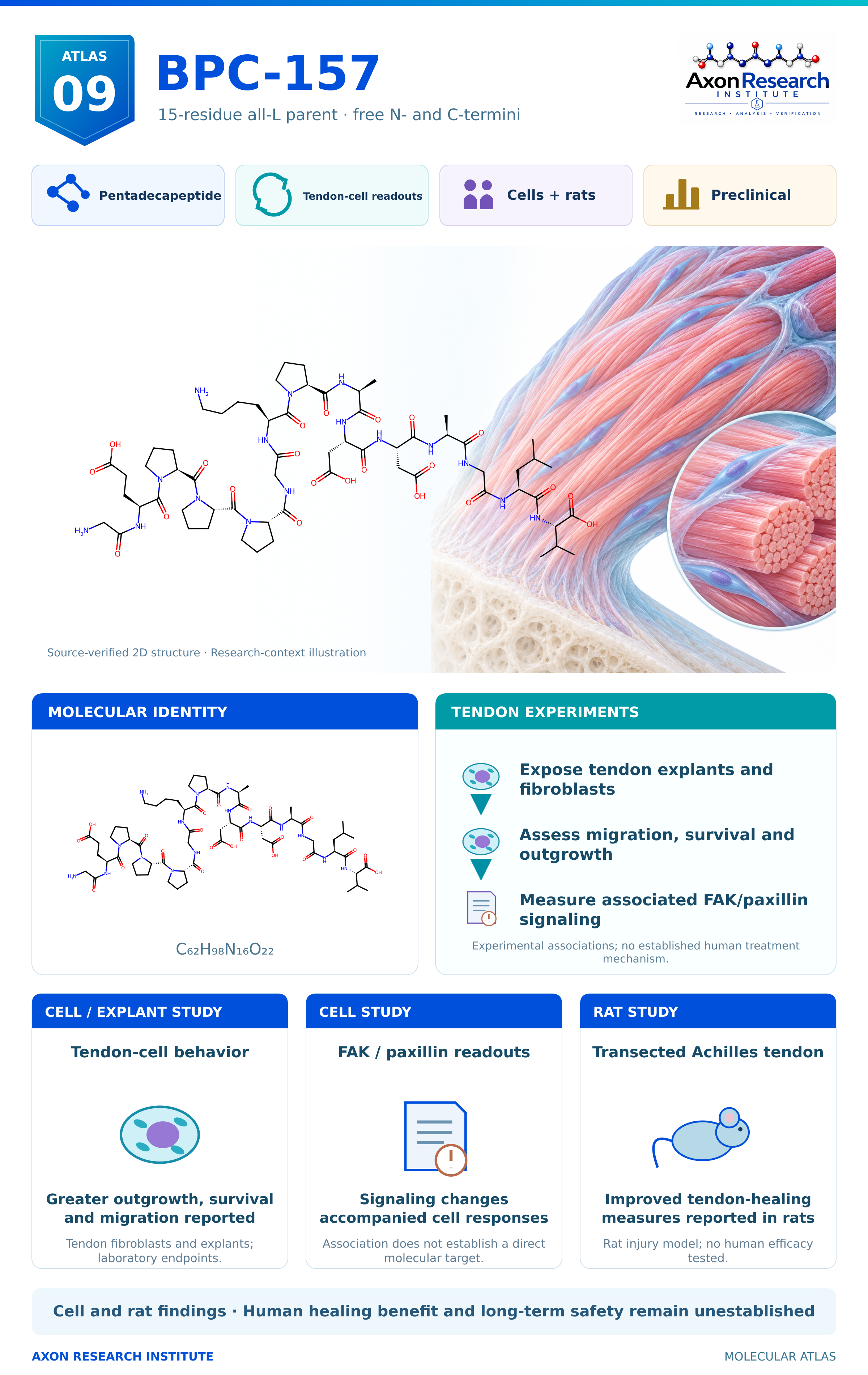
Visual summary only. The research findings, limitations and references accompany the card on this page.
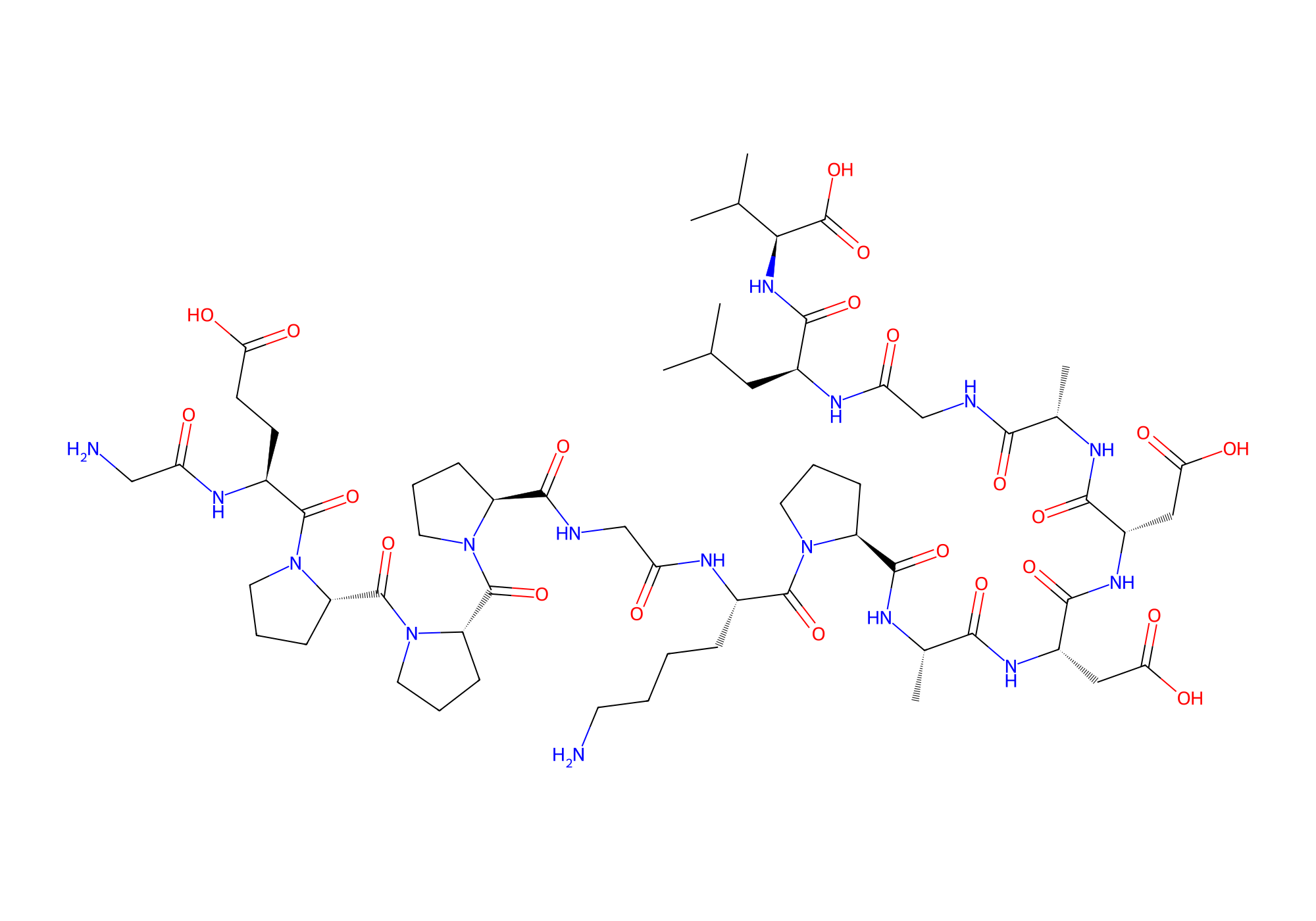
The chemical drawing shows source-verified two-dimensional connectivity and stereochemistry, not an experimental three-dimensional conformation. The biological setting is an illustration. Original study diagrams summarize cited research without reproducing publication artwork or inventing quantitative results.
BPC-157
Experimental FAK / paxillin signaling
All-L reference peptide; free N and C termini- Molecular formula
- C62H98N16O22
- Molecular weight
- 1419.5 g/mol
- Class
- Linear pentadecapeptide
- Identity
- GEPPPGKPADDAGLV
Research snapshot
BPC-157 is a synthetic 15-residue peptide investigated in experimental tissue-injury models. Selected studies examine tendon-cell migration, stress responses and healing-related outcomes in animals.
Cell, explant and animal studies
Identity & representation
Literature reference molecule. Catalog naming is not analytical confirmation of AXON contents, salt, purity or formulation. 15 residues. Standard α-peptide links; glycine is achiral. Not a clinically established tendon-healing formulation.
Educational reference only. Not a dosing guide, treatment recommendation or product endorsement.
15-residue all-L parent · free N- and C-termini[3]
View the chemical structure →Sources checked: 2026-11-06. Identity and evidence limits are stated above. Independent specialist review is pending.
What researchers study
BPC-157 is a synthetic 15-residue peptide investigated in experimental tissue-injury models. Selected studies examine tendon-cell migration, stress responses and healing-related outcomes in animals.
Tendon explant outgrowth and fibroblast migration in culture
Cell survival under experimentally induced oxidative stress
Biomechanical and histological outcomes in rodent tendon injury
Mechanism in context
- Tendon-cell experiments measure migration and survival
- FAK/paxillin signaling changes accompany these responses
- Animal studies assess injury-related endpoints
These are experimental associations and model outcomes, not proof of a validated human treatment mechanism.
Simplified publication-grounded schematic, not a solved protein structure or proof of clinical benefit.
Selected evidence
Selected evidence is preclinical or laboratory-based; human-derived cells are not a human clinical trial.
The promoting effect of pentadecapeptide BPC 157 on tendon healing involves tendon outgrowth, cell survival, and cell migration.[1]
Ex vivo and in vitro mechanistic experiments · Tendon explants and tendon fibroblasts · Laboratory experiments
Observed: Investigators reported increased outgrowth, survival and migration, accompanied by FAK/paxillin signaling changes.
Limit: No human clinical efficacy was tested in this study.
Reference identity in detail
Sequences and form distinctions describe the cited reference substance, not a verified supplier preparation.
Safety & evidence limits
Cell migration and rodent tendon findings do not establish healing efficacy, recovery time or clinical benefit in people.
The selected studies do not provide adequate evidence for long-term human safety or broad disease-treatment claims.
A peptide name and a chemical drawing cannot establish any supplier lot’s identity, purity or suitability for human use.
Practical identity notes
- 15 residues. Standard α-peptide links; glycine is achiral. Not a clinically established tendon-healing formulation.
- Formula and mass apply only to the named reference form, excluding unspecified counterions, solvent and water.
- Educational molecular reference • Selected studies, not a systematic review • No dosing guidance
The 10-second takeaway
A sequence-defined research peptide with preclinical tendon findings; those findings are not established human healing evidence.
What the visual panels show
Original diagrams summarize the cited research or documented evidence search. They are not copied publication figures or claims of treatment benefit.
TENDON EXPERIMENTS[1]
Publication-grounded mechanism schematic · Original publication-grounded diagram
Expose tendon explants and fibroblasts · Assess migration, survival and outgrowth · Measure associated FAK/paxillin signaling
Interpretation: Experimental associations; no established human treatment mechanism.
Tendon-cell behavior[1]
CELL / EXPLANT STUDY · Original publication-grounded diagram
Greater outgrowth, survival and migration reported
Tendon fibroblasts and explants; laboratory endpoints.
Interpretation: Use a symbolic culture icon; no healed human tendon or fabricated microscopy.
FAK / paxillin readouts[1]
CELL STUDY · Original publication-grounded diagram
Signaling changes accompanied cell responses
Association does not establish a direct molecular target.
Interpretation: Do not depict an established BPC-157 receptor or imply mechanistic proof in humans.
Transected Achilles tendon[2]
RAT STUDY · Original publication-grounded diagram
Improved tendon-healing measures reported in rats
Rat injury model; no human efficacy tested.
Interpretation: Qualitative research schematic only; no human recovery timeline, force curve or extrapolated benefit.
Follow the evidence
Sources & what they support
- The promoting effect of pentadecapeptide BPC 157 on tendon healing involves tendon outgrowth, cell survival, and cell migration.
Supports: Cell/explant tendon mechanisms
- Gastric pentadecapeptide BPC 157 accelerates healing of transected rat Achilles tendon and in vitro stimulates tendocytes growth.
Supports: Exact sequence and rat Achilles-injury research
- PubChem CID 9941957
Supports: Reference chemical graph, formula and molecular mass; not product identity
Original structure record · Download source SDF
Original PubChem 2D source structure record.
← Explore the Molecular Atlas Continue to the research library →