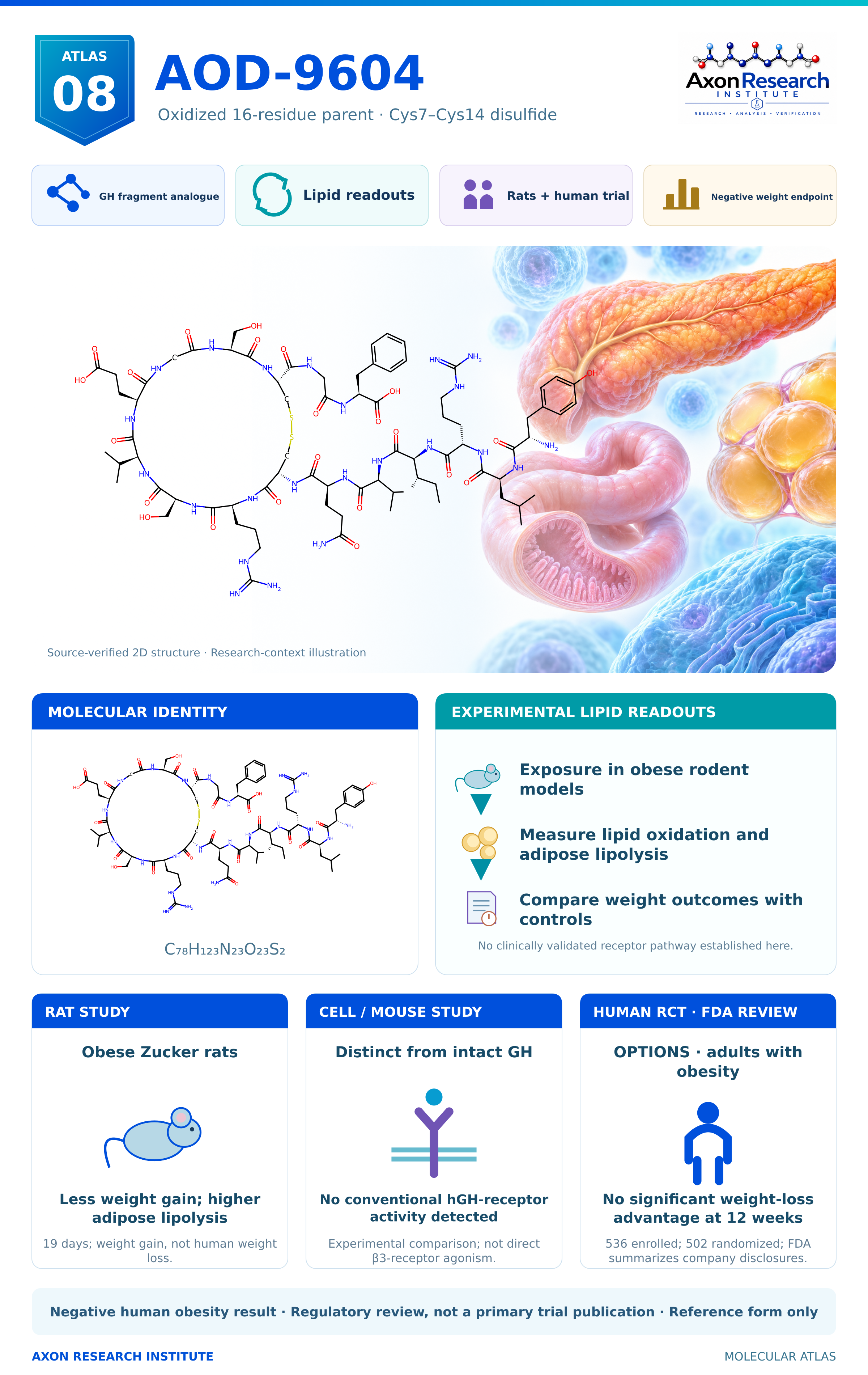
Visual summary only. The research findings, limitations and references accompany the card on this page.
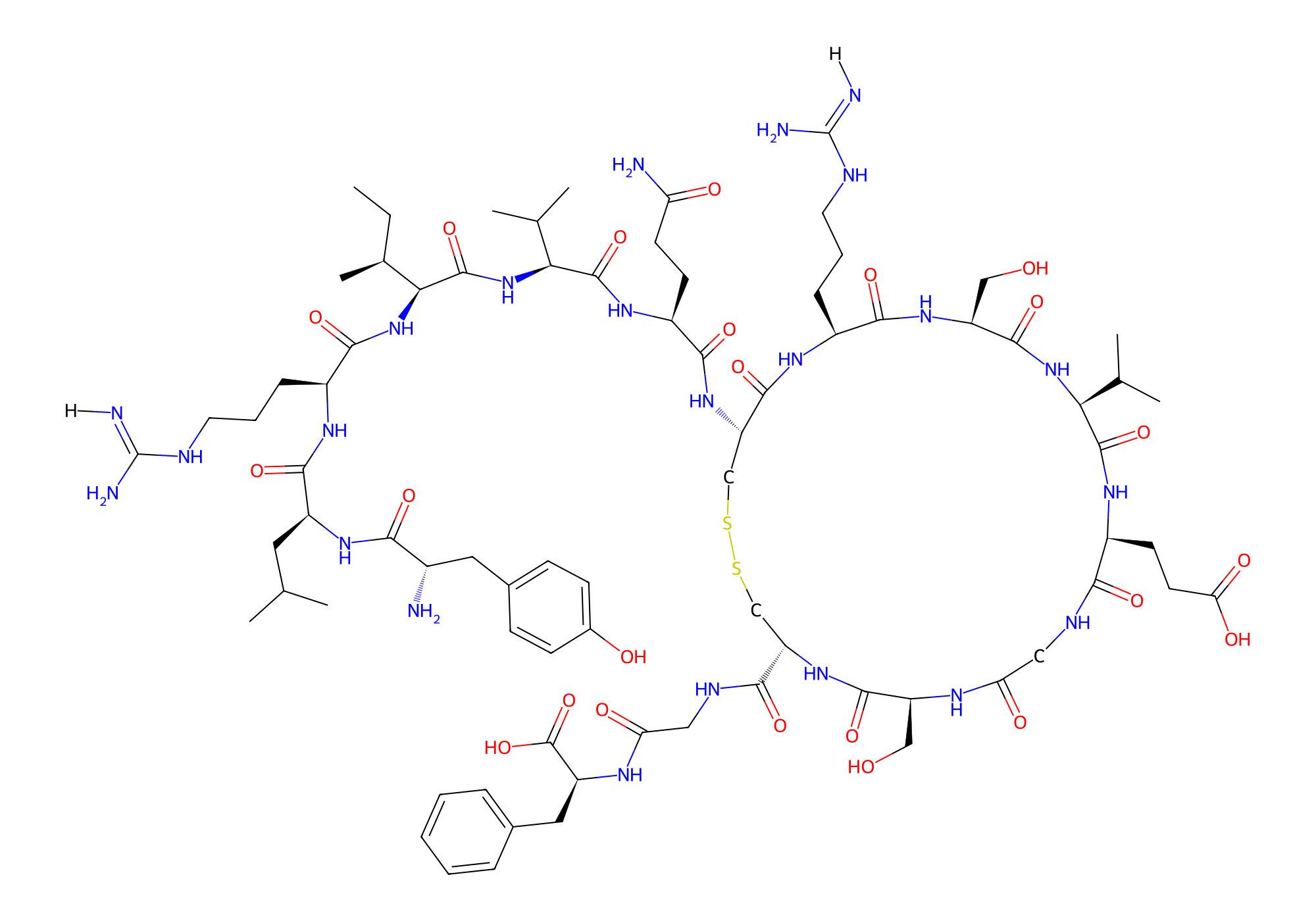
The chemical drawing shows source-verified two-dimensional connectivity and stereochemistry, not an experimental three-dimensional conformation. The biological setting is an illustration. Original study diagrams summarize cited research without reproducing publication artwork or inventing quantitative results.
AOD-9604
Experimental lipid-metabolism pathways
Oxidized reference peptide, free N and C termini- Molecular formula
- C78H123N23O23S2
- Molecular weight
- 1815.1 g/mol
- Class
- Disulfide-linked 16-residue peptide
- Identity
- YLRIVQCRSVEGSCGF
Research snapshot
AOD-9604 is a modified C-terminal growth-hormone fragment studied in lipid-metabolism models. Its experimental actions are not interchangeable with those of full-length human growth hormone.
Animal data / negative human trial
Identity & representation
Literature reference molecule. Catalog naming is not analytical confirmation of AXON contents, salt, purity or formulation. Tyr-hGH(177–191) fragment analogue; Cys7–Cys14 disulfide. Not intact growth hormone or an unspecified GH fragment.
Educational reference only. Not a dosing guide, treatment recommendation or product endorsement.
Oxidized 16-residue parent · Cys7–Cys14 disulfide[4]
View the chemical structure →Sources checked: 2026-11-06. Identity and evidence limits are stated above. Independent specialist review is pending.
What researchers study
AOD-9604 is a modified C-terminal growth-hormone fragment studied in lipid-metabolism models. Its experimental actions are not interchangeable with those of full-length human growth hormone.
Lipid oxidation and lipolysis in obese rodent models
Comparison with intact growth hormone in receptor assays
β3-adrenergic pathway involvement rather than assumed direct agonism
Mechanism in context
- Experimental exposure alters lipid-metabolism readouts
- Studies examine lipolysis and fat oxidation
- Rodent models measure weight gain and adipose outcomes
A specific clinically validated receptor pathway is not established here; selected experiments found no conventional hGH-receptor activation.
Simplified publication-grounded schematic, not a solved protein structure or proof of clinical benefit.
Selected evidence
A negative human OPTIONS trial is summarized in FDA’s 2024 review; its full primary peer-reviewed publication was not located. The selected PubMed studies are preclinical.
Metabolic studies of a synthetic lipolytic domain (AOD9604) of human growth hormone.[1]
Controlled preclinical experiment · Obese Zucker rats · 19 days
Observed: Treated rats gained less weight and had increased adipose lipolytic activity.
Limit: Reduced weight gain in rats is not demonstrated weight-loss efficacy in humans.
FDA AOD-9604-related bulk substances briefing document, November 2024, pages 21–22[5]
Randomized double-blind placebo-controlled OPTIONS trial, summarized by FDA · Adults with obesity · 24 weeks; primary weight endpoint at 12 weeks · Reported n: 502 · Enrolled: 536
Observed: The FDA review reports no significant weight-loss difference from placebo at the primary endpoint.
Limit: The primary methods/results publication was not located by FDA; the card cites the regulatory review of company disclosures.
Reference identity in detail
Sequences and form distinctions describe the cited reference substance, not a verified supplier preparation.
Safety & evidence limits
Human weight-loss efficacy was not established in the FDA-reviewed OPTIONS trial; favorable rodent findings cannot substitute for that negative clinical result.
AOD-9604 is not full-length growth hormone; its receptor effects and molecular identity must remain distinct.
Oxidized disulfide and reduced thiol forms differ chemically; use the specified reference form and verified stereochemistry.
Practical identity notes
- Tyr-hGH(177–191) fragment analogue; Cys7–Cys14 disulfide. Not intact growth hormone or an unspecified GH fragment.
- Formula and mass apply only to the named reference form, excluding unspecified counterions, solvent and water.
- Educational molecular reference • Selected studies, not a systematic review • No dosing guidance
The 10-second takeaway
A modified growth-hormone fragment with preclinical metabolic findings; a larger human obesity trial did not show significant weight-loss efficacy.
What the visual panels show
Original diagrams summarize the cited research or documented evidence search. They are not copied publication figures or claims of treatment benefit.
EXPERIMENTAL LIPID READOUTS[1][2][3]
Publication-grounded mechanism schematic · Original publication-grounded diagram
Exposure in obese rodent models · Measure lipid oxidation and adipose lipolysis · Compare weight outcomes with controls
Interpretation: No clinically validated receptor pathway established here.
Obese Zucker rats[1]
RAT STUDY · Original publication-grounded diagram
Less weight gain; higher adipose lipolysis
19 days; weight gain, not human weight loss.
Interpretation: A generic rodent icon represents rats. No human fat-loss claim or fabricated weight curve.
Distinct from intact GH[2][3]
CELL / MOUSE STUDY · Original publication-grounded diagram
No conventional hGH-receptor activity detected
Experimental comparison; not direct β3-receptor agonism.
Interpretation: Do not show AOD docking to GHR or β3-AR. Pathway involvement is not direct binding.
OPTIONS · adults with obesity[5]
HUMAN RCT · FDA REVIEW · Original publication-grounded diagram
No significant weight-loss advantage at 12 weeks
536 enrolled; 502 randomized; FDA summarizes company disclosures.
Interpretation: Negative primary endpoint stays prominent. FDA could not locate a full primary trial publication; no invented quantitative plot.
Follow the evidence
Sources & what they support
- Metabolic studies of a synthetic lipolytic domain (AOD9604) of human growth hormone.
Supports: 19-day obese-rat study
- Increase of fat oxidation and weight loss in obese mice caused by chronic treatment with human growth hormone or a modified C-terminal fragment.
Supports: Mouse outcomes and absence of conventional hGH-receptor activity
- The effects of human GH and its lipolytic fragment (AOD9604) on lipid metabolism following chronic treatment in obese mice and beta(3)-AR knock-out mice.
Supports: β3-pathway experiments; not direct β3 receptor agonism
- PubChem CID 71300630
Supports: Reference chemical graph, formula and molecular mass; not product identity
Original structure record · Download source SDF
Original PubChem 2D source structure record.
- FDA AOD-9604-related bulk substances briefing document, November 2024, pages 21–22
Supports: FDA review of OPTIONS study design and negative weight-loss result; original trial report not found in peer-reviewed literature
← Explore the Molecular Atlas Continue to the research library →